
Yellow-legged pea weevil
Sitona fronto
Description
How to identify
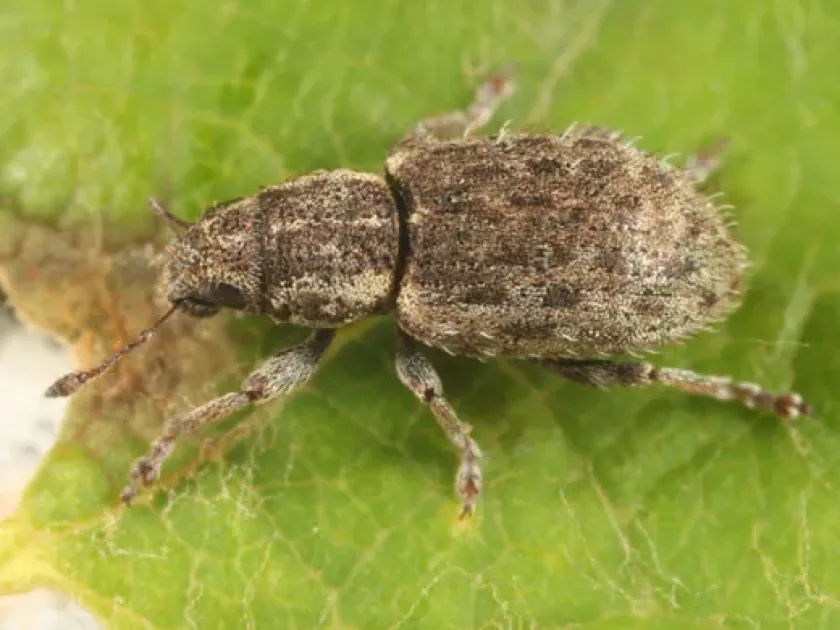
The yellow-legged pea weevil, known scientifically as Sitona fronto, is a small beetle belonging to the Curculionidae family, common in many legume-growing regions.
Adult beetles typically measure between 3.5 and 5 mm in length and are distinguished by their characteristic yellowish legs and scaled body structure.
The larvae are legless, C-shaped grubs with a white body and a light brown head, specifically adapted to live and feed within the soil environment.
This species follows a complete metamorphosis cycle, ensuring that each life stage is perfectly adapted to exploit the resources of host plants.
Adults are strong fliers, which enables them to colonize new fields effectively and quickly, especially during the spring migration period.
What it damages
The pest primarily targets leguminous crops, including peas, lentils, alfalfa, vetch, and soybeans, causing significant economic losses.
Larval activity is focused on the root system, where they consume the nitrogen-fixing nodules, directly impacting the plant's nutrient uptake capacity.
Adult feeding results in characteristic semi-circular or U-shaped notches along the leaf margins, which is a hallmark of Sitona species activity.
Heavy infestations can lead to stunted growth, reduced biomass production, and, in severe cases, the complete death of seedling populations.
The reduction in nodule activity impairs the plant's ability to fix atmospheric nitrogen, leading to an overall decline in yield and grain quality.
When it appears
The yellow-legged pea weevil overwinters as an adult, hiding in the soil, debris, or perennial legume fields to survive the winter season.
Activity resumes in early spring when temperatures rise, at which point the weevils migrate to newly emerged legume crops to begin feeding.
Mating and egg-laying occur during the spring, with eggs deposited in the soil near the root collars of host plants for immediate larval development.
Larval development occurs in the soil throughout late spring and early summer, concluding with pupation at a shallow depth.
The new generation of adults typically emerges by mid-summer, continuing to feed on vegetation until the onset of autumn cooling.
Signs of infestation
The most visible symptom of an infestation is the presence of scalloped edges on the leaves of young legume plants caused by adult feeding.
Inspecting the roots of affected plants often reveals damaged or missing nodules, indicating the presence of larvae in the soil.
Plants showing signs of severe damage may appear stunted, chlorotic, or exhibit signs of nutrient deficiency despite adequate fertilization.
Patchy stands of legumes in the early growth stages often indicate high larval density in specific soil zones within the field.
In cases of heavy pressure, the adults can be easily spotted on the foliage during the cooler parts of the day or early morning.
Control measures
Cultural practices such as crop rotation, which separates legume crops in time and space, remain the foundation of effective management.
Seed treatments with systemic insecticides are crucial to providing early-season protection to seedlings against both adult and larval feeding.
Foliar insecticide applications are recommended if scouting reveals populations exceeding the economic threshold for the specific crop stage.
Maintaining vigorous plant growth through balanced fertilization and optimal planting dates can help mitigate the effects of localized damage.
Regular field scouting and monitoring for the first appearance of leaf notches are essential for timely intervention and successful pest control.
Taxonomy
- Latin name
- Sitona fronto
- Order
- Coleoptera (beetles)
- Family
- Curculionidae
- EPPO code
- SITNFR
Discussion
No discussions yet — be the first.