
Lucerne weevil
Sitona discoideus
Description
How to identify
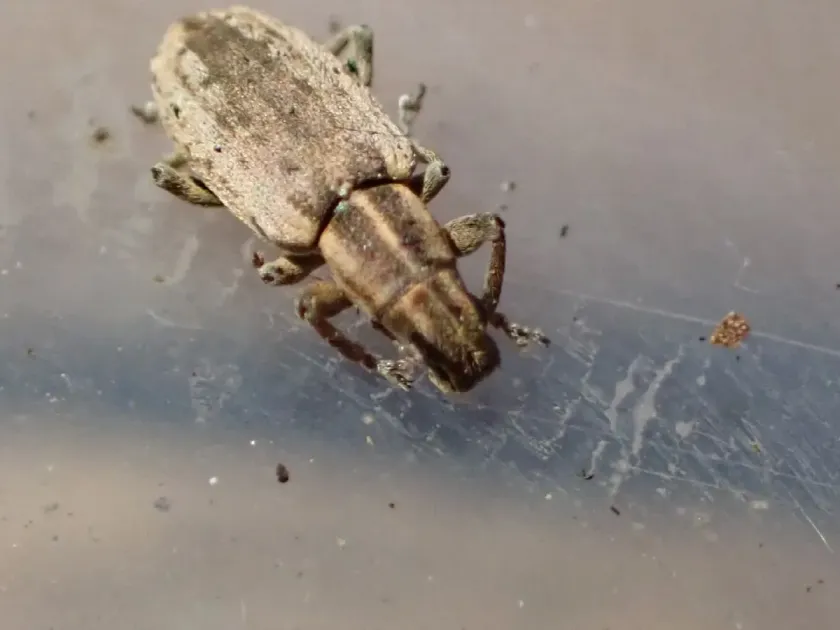
Adults of Sitona discoideus are small weevils, typically 3.5 to 5 mm long. Their body is colored in shades of brown or grey, covered with scales that may appear metallic under specific light.
The larvae are cream-colored, legless, and have a distinct curved shape with a yellow-brown head capsule. They are exclusively subterranean and hard to detect without inspecting the roots.
Eggs are small and spherical, initially pale but turning black shortly after oviposition. They are scattered by females on the soil surface or the base of the alfalfa plants.
Pupation occurs in the soil profile at depths ranging from 5 to 10 cm. The pupal stage is relatively short, allowing for rapid emergence of the new generation of adults.
The species is highly specialized, having evolved to synchronize its life cycle with the growth patterns of perennial legumes, which makes it a persistent agricultural pest.
What it damages
The lucerne weevil primarily affects alfalfa (lucerne), but it also damages other leguminous plants like clover, medics, and sainfoin in various agricultural regions.
The most severe damage is caused by the larvae, which feed on root nodules. This destructive feeding restricts the nitrogen-fixing capabilities of the plants, severely reducing yield.
Adult weevils consume the leaf margins of host plants, resulting in the characteristic notched or serrated appearance of the leaves, commonly known as leaf-notching.
Severe infestations lead to stunted plant growth, chlorosis, and reduced vigor, often making the crop more susceptible to secondary fungal infections and drought stress.
Over time, high larval populations can lead to thinning of the alfalfa stand, causing premature field decline and significant economic loss for farmers.
When it appears
The insect typically overwinters as an adult in the soil or under debris in alfalfa fields. Activity begins early in the spring as soon as soil temperatures reach 8–10°C.
During the spring months, adults feed and reproduce. Oviposition usually peaks in late spring, matching the period of rapid alfalfa growth and nutrient demand.
Larval development takes place during late spring and early summer, coinciding with the peak period of nitrogen fixation in the host plants.
New adults emerge by the start of summer, often during the first hay harvest. They may seek shelter or move to neighboring fields to continue feeding before the onset of diapause.
The life cycle is largely univoltine, but local variations in climate and irrigation can lead to complex overlapping generations in some warmer regions.
Signs of infestation
The most recognizable field sign is the presence of scalloped edges on leaflets, indicating that adult weevils are actively feeding in the upper canopy.
Below ground, the signs include missing or pitted nitrogen-fixing nodules on the taproot and lateral roots, which can be confirmed by washing the roots carefully.
Stunted patches in the field, where plants appear yellowish or wilted compared to surrounding healthy areas, are often indicative of high larval density in the soil.
The presence of adults can be confirmed using sweep nets during the cooler parts of the day when insects are most active near the surface.
A sudden decline in hay productivity or stand density in an established alfalfa field often follows a build-up of the weevil population over consecutive years.
Control measures
Crop rotation remains the most effective management strategy, as it interrupts the life cycle of this specialized subterranean pest.
Implementing proper tillage practices before establishing new alfalfa stands helps to reduce the number of overwintering adults and larvae in the soil.
Chemical control with systemic or contact insecticides is recommended when population thresholds are exceeded, usually timed to catch the early adult activity.
Maintaining spatial separation between young alfalfa stands and old, infested fields helps to prevent rapid colonization by the adult weevil population.
Integrated Pest Management (IPM) programs should also emphasize the use of biological control agents and resistant varieties to maintain sustainable levels of the insect.
Taxonomy
- Latin name
- Sitona discoideus
- Order
- Coleoptera (beetles)
- Family
- Curculionidae
- EPPO code
- SITNDI
Discussion
No discussions yet — be the first.