
Cylindrical pea leaf weevil
Sitona cylindricollis
Description
How to identify
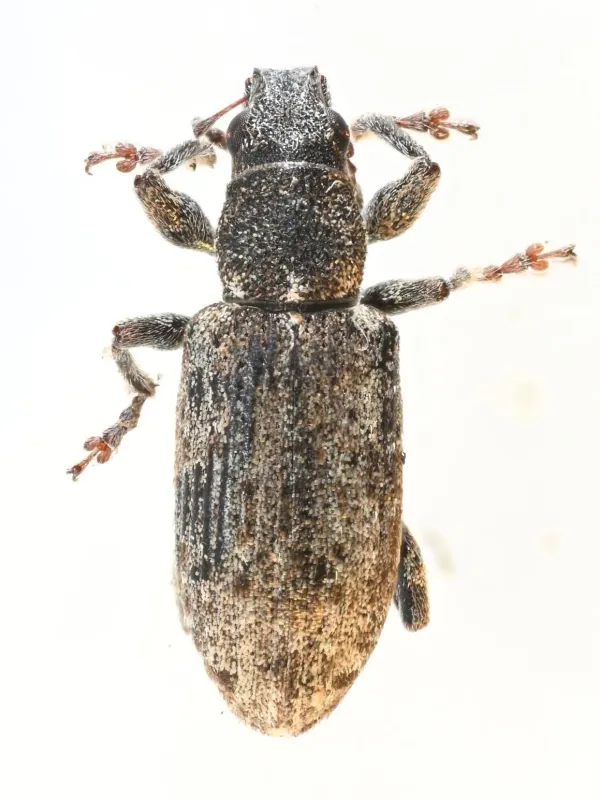
The cylindrical pea leaf weevil (Sitona cylindricollis) is a beetle belonging to the family Curculionidae. Adult weevils are small, measuring approximately 3.5 to 4.5 mm in length, and possess a distinct elongated body covered in greyish-brown scales.
A key identifying feature of the genus Sitona is the short, broad snout. The larvae are legless, C-shaped, and creamy white with a yellowish-brown head, living primarily in the soil around the root systems of host plants.
The life cycle is univoltine, meaning there is one generation per year. Adults overwinter in soil or leaf litter and emerge in the spring once temperatures consistently exceed 8-10 degrees Celsius.
Females deposit their eggs directly onto the soil surface near host plants. A single female can produce a large number of eggs, which contributes to the rapid buildup of populations in favorable environmental conditions.
After hatching, the larvae move into the soil to begin feeding on the root nodules. They undergo several molts before pupating in the soil, emerging eventually as the new generation of adults to complete the yearly cycle.
What it damages
The pest primarily targets leguminous crops, with alfalfa, clover, and sweet clover being the most common hosts. The damage is caused by both the adult stage (feeding on leaves) and the larval stage (feeding on roots).
Adult weevils eat the edges of the leaflets, creating characteristic semi-circular or U-shaped notches. While this feeding does not always kill the plant, it significantly reduces the photosynthetic surface, weakening the plant's growth.
Larvae cause the most significant economic loss by consuming the root nodules responsible for nitrogen fixation. This severely impairs the plant's ability to access nitrogen, leading to stunted growth and reduced yields.
High infestations in young seedlings can lead to total crop failure. If the weevil populations are dense, they can destroy entire fields of newly established legumes, often necessitating the need for replanting.
Furthermore, weakened plants are more susceptible to secondary fungal infections and environmental stresses, as the damaged root system struggles to supply sufficient water and nutrients during the growing season.
Signs of infestation
The most visible sign of infestation is the notched appearance of the leaf margins. Farmers often notice these "serrated" or "scalloped" edges on the leaflets, which are indicative of active feeding by adult weevils.
During the early growth stages, stunted plants and patches of yellowing vegetation are common signs of larval feeding on the roots. These spots usually expand as the larvae grow and consume more root tissue.
Digging around the base of the plants and examining the root system can reveal the presence of the larvae and evidence of missing or damaged nodules, which are normally prominent on healthy legume roots.
Adult weevils are often visible on the soil surface or stems during warm, sunny days. They exhibit a death-feigning behavior, dropping from the plants when disturbed, which makes detection by visual observation slightly challenging.
Regular monitoring using sweep nets in the spring is an essential practice to detect the arrival of adult weevils from overwintering sites before they cause widespread defoliation in the field.
Control measures
Cultural control practices are fundamental to managing this pest. This includes crop rotation to break the cycle and maintaining proper distance between new legume plantings and fields that hosted legumes in the previous year.
Autumn tillage, or plowing, is an effective mechanical measure to disrupt the pupation process and bury larvae, significantly reducing the survival rate of the population entering the winter season.
Chemical control is required when the population density reaches or exceeds the economic threshold. Applying systemic or contact insecticides during the peak period of adult emergence can effectively curb the population.
Seed treatment with systemic insecticides provides a vital protective barrier for young seedlings. This strategy is highly recommended for protecting the crop during the most vulnerable, early establishment phase.
Consistent scouting and integrated pest management (IPM) strategies, including the use of pheromone or sticky traps, allow farmers to time applications precisely, reducing the total amount of pesticide used in the field.
Taxonomy
- Latin name
- Sitona cylindricollis
- Order
- Coleoptera (beetles)
- Family
- Curculionidae
- EPPO code
- SITNCY
Discussion
No discussions yet — be the first.