
Sigastus Weevil
Sigastus
Description
How to identify
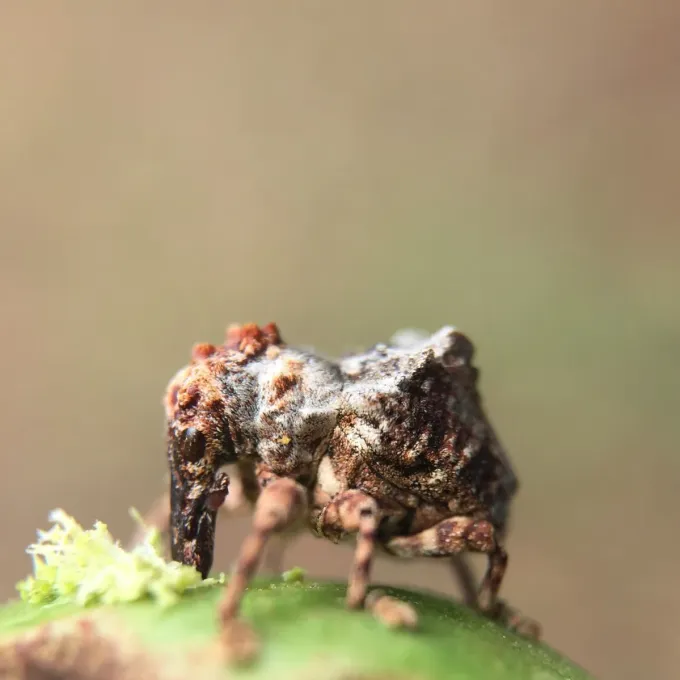
The Sigastus weevil (Sigastus) is a member of the Curculionidae family, easily recognized by its distinctive elongated snout known as a rostrum. This feature is characteristic of the weevil group and is essential for their feeding and egg-laying processes.
Adult insects usually exhibit cryptic coloration, ranging from dark brown to grey, which provides effective camouflage against tree bark and foliage. Their bodies are dense, often covered with minute scales that blend in with the environment.
The larvae are typically legless, cream-colored, and feature a dark head capsule. They develop within plant tissues, making them difficult to detect until significant damage has already occurred to the host plant.
The life cycle involves complete metamorphosis, consisting of the egg, larva, pupa, and adult stages. Adults are strong flyers, allowing them to migrate across orchards or fields in search of suitable host plants during the growing season.
Overwintering usually occurs in the adult stage, with the insects seeking shelter in the soil, leaf litter, or crevices in tree bark, which provides protection against severe winter temperatures.
What it damages
Sigastus weevils primarily damage woody plants and shrubs. Both adults and larvae contribute to the destruction, targeting various parts of the plant, including buds, young shoots, and internal tissues.
Adults are particularly destructive during early spring, when they puncture buds, often resulting in total bud failure and preventing the development of leaves and blossoms for the current season.
Larval activity is hidden and highly damaging, as they create galleries within stems and branches. This activity disrupts the transport of water and nutrients, leading to branch dieback and weakening the entire plant.
Infested plants become highly susceptible to secondary infections, such as fungal pathogens, which can gain entry through the holes created by the weevils, further accelerating the decline of the host.
- Destruction of vegetative and reproductive buds.
- Ragged feeding marks on the edges of leaves.
- Internal structural damage to young stems.
- Increased vulnerability to secondary tree diseases.
Signs of infestation
The first sign of an infestation is the appearance of small, needle-like punctures on the buds in early spring. Often, these punctures are accompanied by sap exudation, which is a common stress response of the plant.
Leaf feeding by adults manifests as irregular or jagged notches along the leaf margins. In severe cases, significant portions of the foliage may be consumed, reducing the plant's photosynthetic capacity.
Wilting of terminal shoots in the summer is a key indicator of internal larval activity. When such shoots are dissected, the presence of frass-filled galleries confirms the larvae's destructive presence.
The adults exhibit a defense mechanism known as thanatosis, where they drop to the ground and play dead when disturbed. Monitoring for this behavior by shaking branches over a white sheet is a reliable way to detect them.
Premature fruit or bud drop without an obvious external cause should also be investigated, as the weevil may have damaged the pedicel or internal structures, leading to the plant discarding the affected part.
Control measures
Effective management of Sigastus weevils relies on an integrated approach that combines mechanical, cultural, and chemical interventions to minimize the population density at every stage of the life cycle.
Cultivation of the soil beneath infested trees in autumn is an effective cultural practice, as it exposes overwintering adults to adverse weather conditions and natural predators, significantly reducing the spring population.
The use of physical barriers, such as sticky bands on tree trunks, can prevent adult weevils from migrating into the canopy during the spring, acting as a non-chemical deterrent against initial colonization.
Chemical control, when necessary, should be applied based on economic thresholds, focusing on critical growth stages such as bud burst or pre-bloom, using products with proven efficacy against Curculionidae.
Sanitation is paramount; pruning and burning infested branches during the growing season helps to remove larvae and pupae from the orchard, thereby preventing the emergence of the next generation of adults.
Taxonomy
- Latin name
- Sigastus
- Order
- Coleoptera (beetles)
- Family
- Curculionidae
- EPPO code
- SIGASP
Discussion
No discussions yet — be the first.