
Alderfly
Sialis lutaria
Description
How to identify
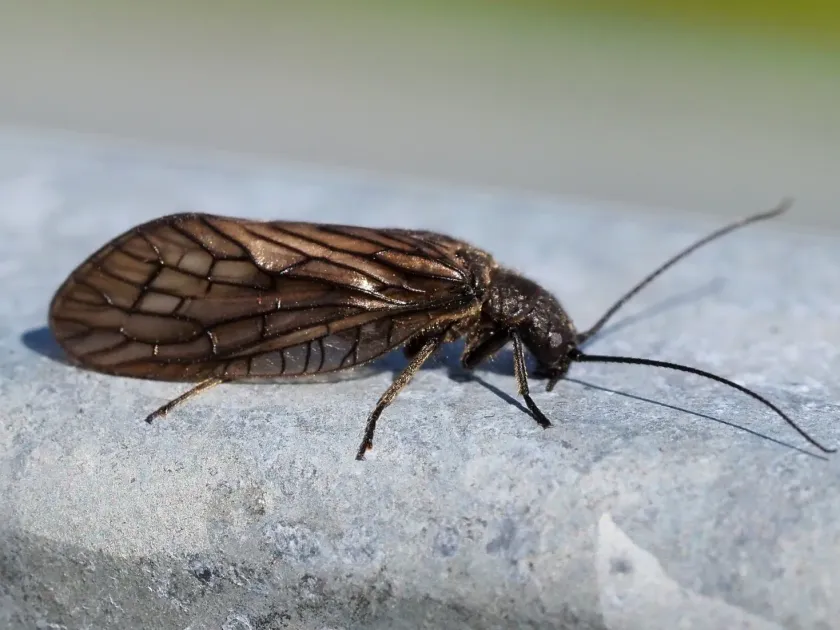
The common alderfly (Sialis lutaria) is an insect belonging to the order Neuroptera and the family Sialidae. Adults are characterized by a wingspan of 30–35 mm and dark, brownish-black bodies with prominent wing venation.
When resting, the insect folds its wings in a roof-like fashion over its body, which is a key diagnostic feature for visual identification in the field.
The larvae, known as hellgrammites, are aquatic. They reach about 20 mm in length and possess a segmented body with lateral, filament-like appendages on each abdominal segment used for respiration.
The life cycle involves an egg stage, where eggs are laid in large, cylindrical batches on vegetation overhanging the water's surface.
After hatching, the larvae drop into the water and spend one to two years developing in the sediment, feeding on small aquatic invertebrates.
What it damages
Sialis lutaria is generally not considered a primary agricultural pest. Adults do not feed on plant tissue and live for a very short period.
In specific cases, such as hydroponic operations or flooded crop systems, larvae may incidentally damage root systems or interfere with nursery substrates.
Their presence can be a sign of high humidity and proximity to stagnant water, which might indicate conditions favorable for other, more serious pests or diseases.
While they do not consume crops, the presence of large numbers of adults can be a nuisance in enclosed greenhouses or packing facilities.
Their predatory nature in aquatic environments makes them part of the local ecosystem, and they only become a concern when they interfere with human-managed water systems.
When it appears
Adult alderflies typically emerge during late spring and early summer, with the peak flight period occurring in May and June.
The reproductive cycle is synchronized with the warmer months to ensure that the larvae have sufficient time to develop in the aquatic environment.
Winter is spent in the larval stage, buried deep within the substrate of ponds or slow-moving streams, where they remain inactive until spring.
Pupation takes place in the soil along the shoreline during the spring months, marking the end of their aquatic development phase.
Warmer temperatures accelerate the transition from pupa to adult, potentially leading to earlier infestations in wet-land areas.
Control measures
Chemical control is rarely required for alderflies. Focus should be placed on cultural practices and environmental management to reduce their presence.
The most effective strategy is to remove unnecessary vegetation along the banks of nearby water bodies, as this limits the sites available for oviposition.
Ensuring proper drainage and maintaining clean irrigation channels prevents the accumulation of stagnant water where larvae prefer to thrive.
For protected cultivation, installing fine-mesh screens on vents and windows is sufficient to prevent the entry of flying adults into the facility.
- Clearance of bank-side vegetation.
- Maintenance of drainage and irrigation systems.
- Installation of insect-proof netting in greenhouses.
- Use of light traps if necessary for monitoring.
Taxonomy
- Latin name
- Sialis lutaria
- Family
- Sialidae
- EPPO code
- SIAWLU
Discussion
No discussions yet — be the first.