
Alderfly
Sialis
Description
How to identify
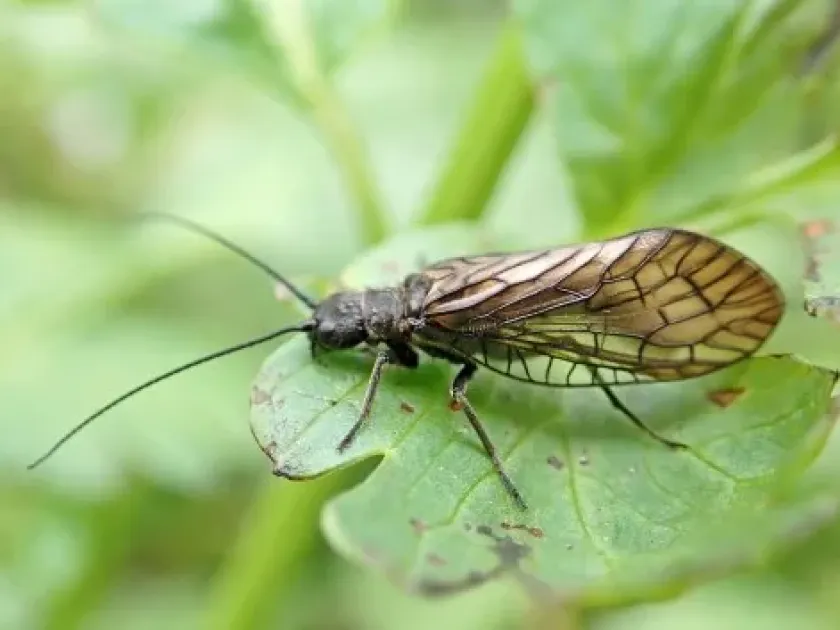
Alderflies (genus Sialis) are members of the order Megaloptera and the family Sialidae. These insects are relatively small, typically measuring 15 to 20 mm in length, with a generally dark, brownish-black appearance.
When resting, they hold their wings in a roof-like position over their bodies, which is a characteristic feature of this group. Their wings exhibit distinct net-like venation, common to many insects in this order.
The head of the adult alderfly is large with well-developed chewing mouthparts. They have long, filamentous antennae, which distinguishes them from many other flying insects found near aquatic habitats.
The larvae are aquatic and possess a unique, caterpillar-like appearance with long, jointed gills along the sides of their abdomens, which are essential for underwater respiration.
The lifecycle is a complete metamorphosis, progressing through the egg, larva, pupa, and adult stages. Adult alderflies are extremely short-lived, as they have vestigial mouthparts and do not feed.
What it damages
In terms of agriculture, alderflies are not recognized as primary pests. They do not feed on crops, and their impact on vegetation is virtually non-existent under normal conditions.
The larvae are predatory organisms that inhabit the bottom sediment of ponds and streams. They feed on small aquatic invertebrates, meaning they do not damage the roots or leaves of terrestrial plants.
Because adult alderflies do not consume plant material, they pose no threat to the harvest. They are often found near water sources simply because that is where their larval stage is completed.
Reports of crop damage are rarely, if ever, linked to this species. They should be considered harmless to farming operations and are often an indicator of a healthy aquatic environment.
Consequently, there is no need for economic threshold assessments or control strategies for this insect, as they are not classified as detrimental to crop production.
When it appears
Adult alderfly emergence typically occurs in late spring or early summer, primarily during May and June. This is when they are most visible in the immediate vicinity of their breeding grounds.
Females lay large egg masses on vegetation, stones, or structures overhanging the water. These egg clutches are distinct and can contain several hundred individual eggs.
Upon hatching, larvae immediately drop into the water, where they spend the majority of their lifecycle. The larval stage is lengthy, often lasting from one to two years depending on the environmental conditions.
The larvae overwinter in the mud at the bottom of ponds and streams, remaining active even in colder temperatures. Pupation takes place on land in damp soil near the shoreline.
Temperature and environmental humidity are the key drivers for the timing of adult emergence, which happens relatively quickly within a specific window each year.
Signs of infestation
The most visible sign of an alderfly presence is the discovery of egg masses deposited on leaves or stems of aquatic plants located near the edge of a water body.
Adults are easily spotted sitting on trunks, fences, or vegetation near water edges. They are notoriously slow and docile, making them very easy to observe or photograph.
During the dredging or cleaning of irrigation ditches and pond banks, the larvae can be found in the bottom sediment, where they actively hunt for smaller organisms.
If a farmer notices damage on plants, it is highly likely caused by a different species. Alderflies leave no typical herbivory signatures, such as holes, yellowing, or wilting.
Proper identification is key: if the insect matches the morphological description of the alderfly, the grower can be assured that it is not the source of any observed crop damage.
Control measures
No specific control measures are necessary for alderflies, as they are part of the beneficial aquatic ecosystem. They act as a food source for fish and various birds.
If their presence is undesirable near protected structures or greenhouses, keeping the shoreline clear of excessive vegetation can limit the places where females deposit their eggs.
Chemical control is strongly advised against, as it would disrupt the balance of the aquatic environment and harm non-target beneficial organisms in the water.
Maintaining clear, flowing water and preventing excessive silting in irrigation reservoirs will naturally discourage large populations of alderfly larvae.
- Keep pond edges free from excess debris.
- Maintain water circulation in irrigation systems.
- Preserve the natural predator balance in aquatic habitats.
Taxonomy
- Latin name
- Sialis
- Family
- Sialidae
- EPPO code
- SIAWSP
Discussion
No discussions yet — be the first.