
Spitting spider
Scytodes thoracica
Description
How to identify
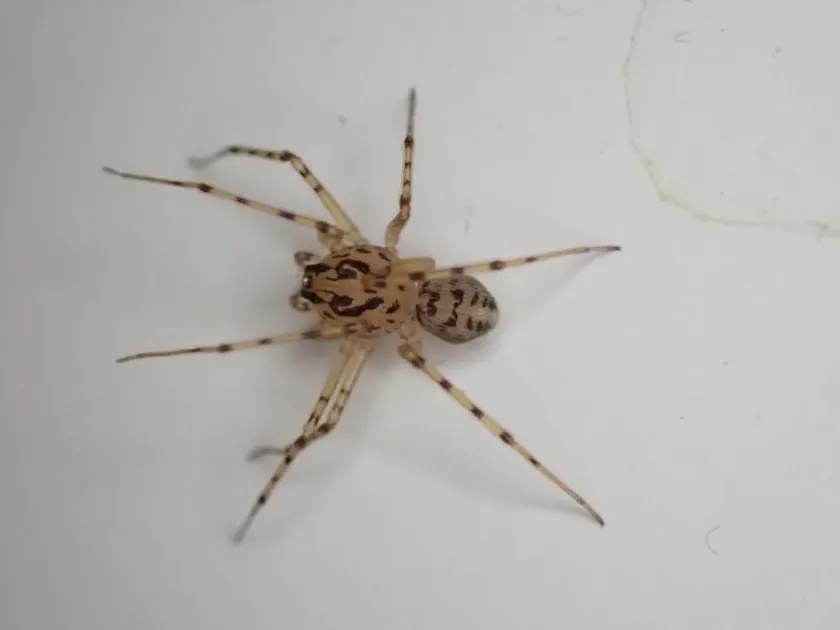
The Spitting spider (Scytodes thoracica) is a member of the Scytodidae family. It is distinct for its anatomical structure: the cephalothorax is highly domed, housing specialized glands that produce a sticky, venomous secretion.
Adults typically measure between 3 to 6 millimeters in length. Their appearance is characterized by a yellowish-brown base color with a distinct pattern of dark spots, providing effective camouflage.
Its primary hunting mechanism is unique: it does not spin a web. Instead, it discharges a rapid, cross-patterned jet of sticky fluid from its chelicerae, immobilizing prey instantly upon contact.
The spider features a complex eye arrangement, providing excellent depth perception, which is crucial for its highly accurate "spitting" behavior during hunting.
These spiders are primarily nocturnal and shy, preferring to inhabit dark, sheltered areas such as crevices, storage rooms, and the structural corners of greenhouse facilities.
What it damages
Scytodes thoracica is not a plant-feeding pest. As an obligate predator, it feeds exclusively on other small insects and arthropods found within the agricultural ecosystem.
In greenhouses, its impact is indirect. While it can help control minor insect populations, it may also prey upon beneficial organisms, disrupting the natural biological control balance.
Heavy populations can become a nuisance in professional agricultural settings due to the accumulation of prey remnants and dried sticky secretions on greenhouse equipment.
The presence of these spiders can occasionally hinder human activity and maintenance operations inside high-density plant production areas.
However, given their predatory nature, they are often tolerated in many horticultural environments as part of the natural predator complex, provided they remain in manageable numbers.
When it appears
The life cycle of the Spitting spider is highly adaptable to the indoor environment. In heated greenhouses, they can maintain continuous activity and reproduction throughout the year.
In outdoor environments, their activity peaks during the warmer spring and summer months when prey availability is at its highest for successful hunting.
Females provide parental care by carrying their eggs in a silken sac between their chelicerae until the spiderlings hatch, ensuring high survival rates.
Development speed from egg to maturity is largely determined by environmental temperature and the abundance of food sources, often ranging from weeks to several months.
High population densities are most frequently observed in humid environments where the survival rate of the early instars is significantly higher.
Signs of infestation
The most visible sign of their presence is the appearance of tiny, transparent, hardened glue spots on greenhouse structures, plastic films, or leaves.
The remains of insect exoskeletons found discarded in corners or crevices are strong indicators of successful hunting activity by this species.
Observations at night with a flashlight often reveal these spiders slowly patrolling walls and structures in search of their next meal.
Unlike many other spider species, the absence of traditional orb webs or cobwebs in an area where insect prey is being consumed suggests the presence of Scytodes thoracica.
Small fecal droppings on glass surfaces or structural beams can also indicate established hunting territories within a facility.
Control measures
The most effective management strategy involves maintaining good sanitation, including the regular removal of debris and dust where spiders might congregate.
Sealing gaps and cracks in the greenhouse structure prevents the influx of spiders from the surrounding landscape, limiting their colonization.
Physical control measures, such as manual removal or vacuuming areas of high spider density, are generally sufficient without the need for toxic substances.
Chemical intervention is strongly discouraged, as the broad-spectrum insecticides used to kill spiders often eliminate essential pollinators and predatory biological control agents.
Optimizing greenhouse ventilation to keep the environment less humid and more aerated helps discourage spider establishment by creating less favorable microclimates.
Taxonomy
- Latin name
- Scytodes thoracica
- Family
- Scytotidae
- EPPO code
- SCTTTH
Discussion
No discussions yet — be the first.