
Fir engraver beetle
Scolytus unispinosus
Description
How to identify
The fir engraver beetle, or Scolytus unispinosus, is a member of the Curculionidae family and the Scolytinae subfamily. These small beetles, typically 2.5 to 3.5 mm long, have a cylindrical, dark brown or black body.
A diagnostic feature of the male beetle is a single small tooth or spine on the abdomen, which distinguishes it from many other closely related species within the Scolytus genus.
The larvae are legless, white, and curved, with a yellowish head capsule. They spend their entire developmental period beneath the bark, feeding on the nutrient-rich phloem of host trees.
Identifying these beetles is challenging as they spend most of their life cycle under the bark, making them invisible until significant damage has already been inflicted on the host.
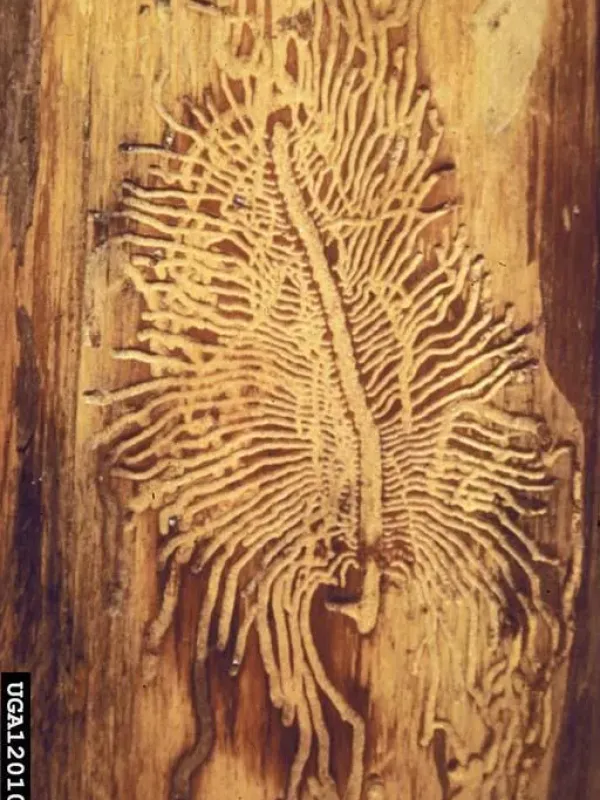
These beetles are highly specialized to thrive in weakened coniferous trees, where they create intricate gallery systems that serve as both feeding sites and breeding chambers.
What it damages
The primary hosts of this beetle are coniferous trees, especially fir and spruce species. The beetles target trees that are stressed due to drought, storm damage, or root diseases.
The damage is caused by both adults and larvae feeding on the phloem and cambium. This girdling effect disrupts the flow of water and nutrients, eventually killing the affected part or the entire tree.
Mass infestations can kill trees within a single season, especially if the tree's natural defense mechanisms, such as resin production, are overwhelmed by the high number of attacks.
Besides the direct damage, these beetles are often vectors for various wood-staining fungi that exacerbate the decline of the host tree, leading to rapid deterioration of the timber quality.
In forest ecosystems, the fir engraver acts as an opportunistic pest that plays a role in the natural thinning of stressed stands, though it can become a serious problem in managed forests.
When it appears
The flight period typically begins in late spring, triggered by rising temperatures. Adult beetles emerge from their overwintering sites to seek new, suitable host trees for colonization.
Once a suitable tree is located, the female excavates a gallery to deposit eggs. The developmental time for the offspring depends heavily on temperature, typically spanning the summer months.
Depending on the geographic region, the beetle may produce one or more generations per year, leading to overlapping life stages and sustained pressure on local forest stands.
Overwintering occurs either as larvae or adults under the bark or in the base of the tree, providing protection against extreme cold and avian predators during the winter months.
Monitoring seasonal temperature patterns is crucial for predicting potential outbreaks, as warmer summers significantly shorten the development cycle of the beetle larvae.
Signs of infestation
The most common sign of an infestation is the presence of small entry holes on the bark surface. These holes are often accompanied by reddish-brown "frass" or sawdust around the entry points.
Resinosis, or "pitch tubes," may be visible on the trunk surface as the tree attempts to push the beetles out. However, if the beetle population is high, the tree may fail to repel them.
Foliage discoloration, starting with a yellowing or browning of needles, is a late-stage symptom indicating that the vascular system of the tree has been severely compromised.
Removing a section of the bark reveals the signature gallery patterns: a main vertical gallery with radiating larval tunnels, which are distinct for the Scolytus genus.
- Small 1-2 mm entry holes in the bark.
- Accumulation of frass (boring dust) at the tree base.
- Crown dieback or sudden browning of needles.
- Visible gallery patterns under the bark.
Control measures
Sanitation is the most effective control method. Removing and disposing of infested trees before the new generation of beetles emerges is crucial to stopping the spread.
Proper management of logging debris and storm-damaged wood is essential, as these materials provide ideal breeding grounds for the population to increase rapidly.
Pheromone-baited traps can be utilized for monitoring and managing local populations, providing early warning of increased beetle activity in high-value forested areas.
In ornamental or urban settings, systemic insecticides or bark sprays may be applied during the flight season to protect high-value specimen trees from initial colonization.
Maintaining tree vigor through proper silviculture, such as thinning stands to reduce competition and ensuring adequate water availability, is the best long-term prevention strategy.
Taxonomy
- Latin name
- Scolytus unispinosus
- Order
- Coleoptera (beetles)
- Family
- Curculionidae
- EPPO code
- SCOLUN
Discussion
No discussions yet — be the first.