
Tsuga bark beetle
Scolytus tsugae
Description
How to identify
The Tsuga bark beetle, Scolytus tsugae, is a small beetle belonging to the Curculionidae family and the Scolytinae subfamily. It is a specialized forest pest known for attacking hemlock trees.
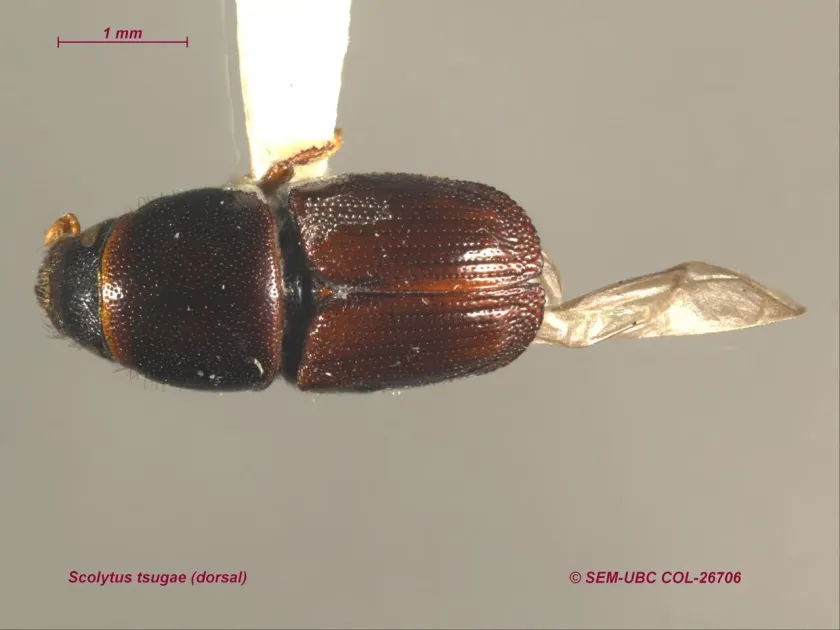
Adult beetles are typically 3–4 mm long, with a dark brown to black cylindrical body. Their head is often recessed, a characteristic trait of many bark beetle species within the Scolytinae group.
Larvae are legless, white grubs with a well-developed head capsule, designed for tunneling through the phloem and cambium layers beneath the bark of host trees.
The species exhibits a distinct mating behavior, with females boring into the tree to create egg galleries where the next generation will develop.
Morphological identification requires careful examination under magnification, focusing on the elytral structure and the specific patterns of the galleries created by adults.
What it damages
The primary hosts of this beetle are species of the genus Tsuga, commonly known as hemlocks. It poses a significant threat to these trees in both natural forest ecosystems and landscape plantings.
Feeding larvae create extensive gallery systems that sever the tree's vascular tissue, effectively girdling the tree and preventing the transport of nutrients and water.
Severe infestations often result in the rapid decline and death of the tree, characterized by top-down wilting and progressive needle loss over the entire crown.
The beetle acts as a vector for various wood-decay fungi, which further expedite the death of the host tree and cause structural weakness in the wood.
Outbreaks can lead to large-scale mortality of hemlock stands, causing ecological shifts and significant loss of timber value or aesthetic appeal in managed environments.
When it appears
Adult activity usually commences in late spring as temperatures rise, signaling the transition from the winter diapause to the reproductive phase of the life cycle.
The flight period, when adults seek new host trees to colonize, typically occurs during May and June, depending on local climate conditions and regional elevation.
Developmental stages, including egg, larval, and pupal stages, occur primarily under the bark, ensuring the offspring are protected from external predators and fluctuating temperatures.
Depending on the latitude, the insect may complete one or more generations per year, with the final generation overwintering as larvae deep within the bark tissue.
Monitoring for adult flight is crucial during the active season to apply control measures before the pests have successfully bored into the host trees.
Signs of infestation
Initial signs of infestation include small, round "shot holes" on the tree's bark surface, which are entry points created by the adult beetles.
Frass, which resembles fine sawdust or wood flour, accumulates in bark crevices or at the base of the tree as a byproduct of the beetles' boring activity.
Needle yellowing and browning are the most obvious indicators that the internal systems of the tree have been compromised, typically appearing once the damage is severe.
Resinosis, where the tree produces excess sap in response to the attack, is a common defensive reaction that can be seen as wet patches or drips on the trunk.
- Entrance holes on the tree trunk.
- Accumulation of fine boring dust (frass).
- Discoloration of needles from green to yellow/brown.
- Visible gallery patterns under removed sections of bark.
Control measures
Sanitation is the most critical management strategy; removing and destroying infested trees before the beetles emerge is essential to contain the spread.
Proper disposal of slash and infested wood through burning or chipping is vital to ensure that emerging adults do not re-infest nearby healthy hemlocks.
The use of pheromone traps can be an effective way to monitor beetle populations and time chemical treatments or other interventions more accurately.
In ornamental or high-value landscapes, systemic insecticides applied as soil drenches or trunk injections can provide protective barriers against initial attack.
Promoting overall tree vigor through appropriate fertilization, watering during droughts, and avoiding mechanical damage helps the trees defend themselves against low-level infestations.
Taxonomy
- Latin name
- Scolytus tsugae
- Order
- Coleoptera (beetles)
- Family
- Curculionidae
- EPPO code
- SCOLTS
Discussion
No discussions yet — be the first.