
Elm bark beetle
Scolytus sulcifrons
Description
How to identify
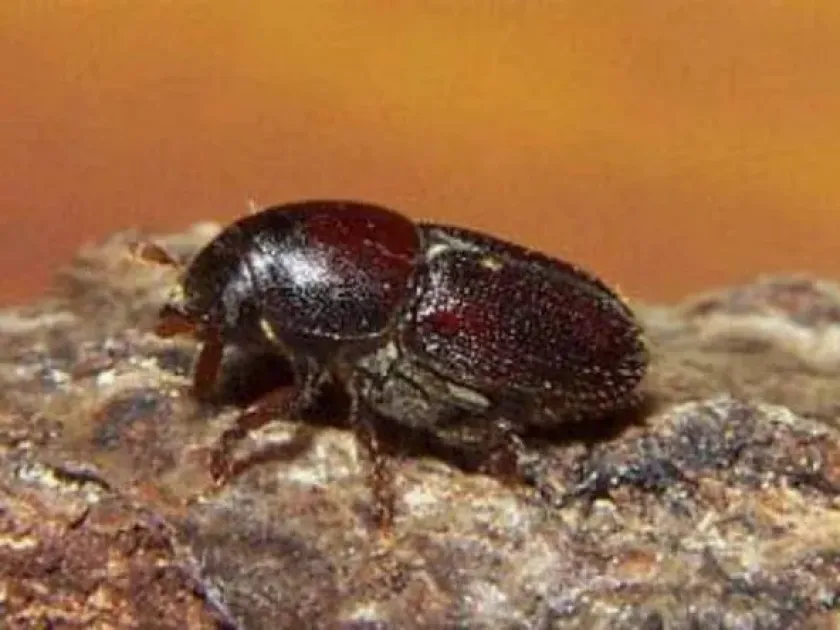
The Elm bark beetle (Scolytus sulcifrons) is a small beetle belonging to the Curculionidae family. Adults typically measure between 3 and 4 millimeters in length and possess a dark, shiny, almost black exoskeleton.
A distinctive feature of this species is the noticeable depression on the forehead of the male, which is reflected in its specific epithet sulcifrons. The elytra are covered in shallow, longitudinal grooves that serve as a key characteristic for species identification.
The larvae are white, legless, and curved, with a yellowish head capsule. They spend their entire developmental phase feeding within the inner bark, constructing intricate galleries that eventually girdle the tree.
As strong flyers, these beetles actively search for host trees, primarily relying on chemical cues emitted by weakened or stressed elm trees. Their high mobility makes them efficient at spreading infestations across forest stands.
Taxonomically, they are classified under the order Coleoptera. Their biology is adapted to exploit the vascular system of elm trees, making them a significant concern for arborists and foresters managing elm-rich areas.
What it damages
This pest exclusively attacks trees of the genus Ulmus. While they prefer trees already suffering from drought, mechanical damage, or other stressors, high populations can overwhelm even relatively healthy specimens.
The most devastating aspect of their activity is their role as a primary vector for the fungus causing Dutch elm disease. As the beetles move from infected wood to fresh hosts, they carry fungal spores, introducing them directly into the tree's vascular system.
Both adults and larvae contribute to the damage. Adults feed on young twigs, causing localized dieback, while larvae create a complex network of tunnels beneath the bark, disrupting the flow of water and essential nutrients.
Severe infestations lead to rapid tree decline. The combination of larval girdling and the fungal infection causes yellowing of the leaves, premature leaf drop, and the eventual death of the entire tree within a few seasons.
The cumulative damage often renders affected trees beyond recovery. Once the beetle population establishes itself within a tree, the chances of the tree surviving without intensive management are extremely low.
When it appears
Adult activity begins in the spring when temperatures consistently rise above the threshold required for flight. In many regions, this occurs as early as late spring, depending on the local climate and weather patterns.
The beetle typically completes two generations per year. The first generation emerges in late spring to early summer, followed by a second generation that peaks in mid-to-late summer, ensuring continued pressure on host trees.
Winter is spent primarily in the larval stage, residing safely beneath the bark of the host tree. This life-stage adaptation provides excellent protection against harsh winter conditions and predators.
Adult supplemental feeding coincides with the peak growth season of the elm trees. This timing is critical, as it allows for the transmission of Dutch elm disease at a time when the tree's vascular system is most active and susceptible.
Unusually warm and dry seasons can accelerate the reproductive cycle of the beetle, leading to larger populations and a higher probability of widespread disease transmission throughout the local elm population.
Signs of infestation
The presence of fine, sawdust-like material (frass) near the base of the trunk or in bark crevices is a primary indicator. This material is ejected by the beetles as they carve out their entrance holes.
Crown symptoms, such as flagging or the yellowing of leaves on individual branches, are often the first visible signs of Dutch elm disease infection introduced by the beetles.
Entrance holes, measuring roughly 1 to 1.5 millimeters in diameter, are visible on the bark surface. In some cases, sap flow around these holes can be observed as the tree attempts to defend itself against the invaders.
The galleries found under the bark display a unique pattern, with a central maternal gallery and radiating larval tunnels. This geometric structure is characteristic of Scolytus species and serves as an important diagnostic sign.
As the infestation progresses, the bark may begin to loosen or peel away. This stage indicates a terminal level of colonization, at which point the tree serves as a breeding ground for the next generation of beetles.
Control measures
Sanitation is the cornerstone of control efforts. Infected trees should be removed and destroyed promptly to eliminate the source of infestation before new adults can emerge and spread to healthy trees.
Maintaining tree vigor through proper irrigation and soil management is essential. Healthy trees are better equipped to produce defensive chemicals that can deter beetle attacks and limit successful colonization.
Pheromone traps are effective tools for monitoring beetle activity and managing localized populations. These traps help identify peak flight times, allowing for more precise timing of any necessary chemical interventions.
Systemic insecticides or fungicides, administered via trunk injection, can protect high-value landscape elms, although these treatments require professional application to ensure efficacy and environmental safety.
- Immediate removal of dead or dying elm wood.
- Avoidance of pruning during the peak beetle flight season.
- Use of trap trees to attract and subsequently destroy beetle populations.
- Regular inspections to detect early signs of infestation or disease.
Taxonomy
- Latin name
- Scolytus sulcifrons
- Order
- Coleoptera (beetles)
- Family
- Curculionidae
- EPPO code
- SCOLSU
Discussion
No discussions yet — be the first.