
Banded Elm Bark Beetle
Scolytus schevyrewi
Description
How to identify
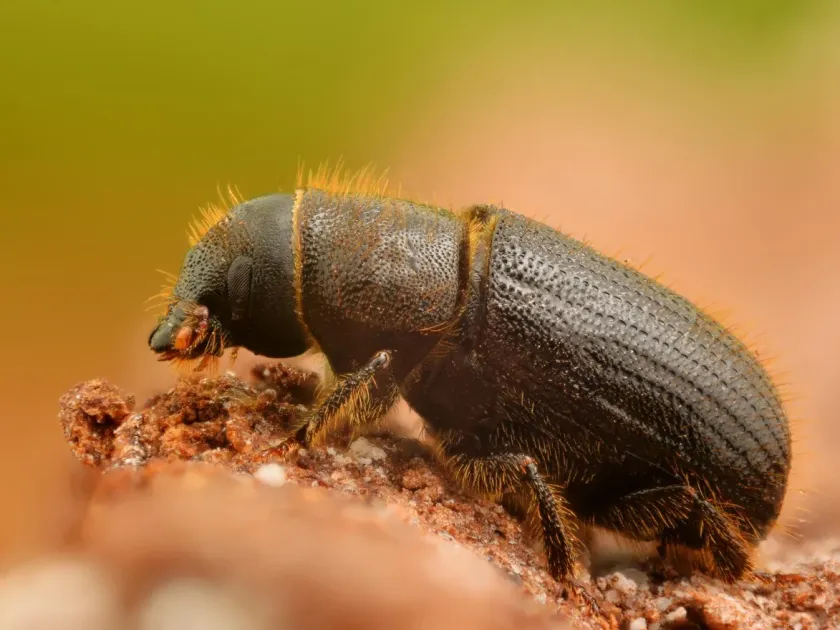
The Banded Elm Bark Beetle (Scolytus schevyrewi) is a small wood-boring insect belonging to the family Curculionidae, subfamily Scolytinae. Adult beetles are typically 3 to 4 mm long.
Their bodies are cylindrical and dark brown to black in color, featuring a shiny exterior. The defining characteristic is the concave shape of the abdominal segments in males.
Larvae are white, legless, and possess a distinct brown head. They are primarily responsible for the structural damage beneath the bark by consuming the phloem and cambium layers.
The pupal stage occurs within small chambers carved by the larvae just before they transform into adults. The entire metamorphosis process takes place within the host tree.
Adult beetles are proficient flyers, allowing them to spread rapidly throughout forest stands and urban landscapes, targeting weakened trees with precision.
What it damages
This pest primarily attacks trees within the Ulmus genus. Elms, such as the Siberian elm and the American elm, are particularly susceptible to widespread infestation.
While elms are the main targets, the beetle has also been observed on various fruit and ornamental tree species when suitable host trees are scarce.
The beetle causes damage by boring into the sapwood to feed and reproduce, which effectively disrupts the tree's vascular system, preventing the flow of nutrients and water.
A significant threat associated with this pest is its role as a vector for various fungal pathogens, which can exacerbate the tree's decline and lead to rapid mortality.
Heavily infested trees often exhibit complete canopy dieback and bark separation, rendering them irreparable and hazardous to the surrounding environment.
When it appears
The flight season of the adults typically begins in spring, coinciding with temperatures consistently above 15°C (59°F). This usually occurs from May through June.
Depending on the climatic zone, the beetle can complete multiple generations within a single year, significantly increasing the pressure on local tree populations.
After mating, females bore into the bark to construct egg galleries. The resulting larvae feed throughout the summer, while the next adult generation emerges by late summer.
Overwintering occurs in various stages, predominantly as larvae or adults tucked away in protective galleries beneath the bark of the host tree.
The seasonal activity remains robust as long as weather conditions remain favorable for their metabolism and reproductive activities.
Signs of infestation
The most prominent sign of an infestation is the appearance of small, round exit holes on the tree trunk, often resembling shotgun pellets pattern.
Upon closer inspection, fine brown sawdust, known as frass, can be found accumulating near the base of the tree or within the crevices of the bark.
Observable symptoms in the canopy include premature yellowing or wilting of leaves, especially on specific branches, which eventually turn brown and die.
The internal bark structure reveals complex patterns of galleries, where the central maternal tunnel is flanked by numerous larval tunnels stretching outwards.
- Numerous 1–2 mm holes on the bark surface.
- Brown sawdust piles at the base of the trunk.
- Flagging or wilting branches in the upper canopy.
- Peeling bark revealing intricate tunneling galleries.
Control measures
Sanitation is the most effective management strategy; this includes the immediate removal and proper disposal of infested wood to prevent the spread of new generations.
The use of pheromone-based traps is highly recommended to monitor adult activity and, in some cases, to reduce the overall population pressure on specific stands.
For high-value ornamental trees, systemic insecticide treatments applied via soil injection or trunk treatment can provide a significant layer of protection during peak flight times.
Maintaining tree vigor through proper irrigation and balanced fertilization helps trees develop better defenses against beetle colonization and environmental stress.
Regular inspections of elm stands, especially after periods of drought or mechanical damage, are essential for early detection and successful intervention.
Taxonomy
- Latin name
- Scolytus schevyrewi
- Order
- Coleoptera (beetles)
- Family
- Curculionidae
- EPPO code
- SCOLSH
Discussion
No discussions yet — be the first.