
Birch bark beetle
Scolytus ratzeburgi
Description
How to identify
The birch bark beetle is a member of the Curculionidae family (subfamily Scolytinae). An adult specimen has a cylindrical body measuring between 4 and 6.5 mm in length and is colored in a shiny black hue.
A distinctive feature of the adult beetle is the steep, almost vertical slope of the elytra at the rear and the presence of prominent teeth on the underside of the abdomen. These traits make it easily recognizable among other bark beetle species.
The larvae are legless, white in color, with a yellowish-brown head, and possess a strongly curved shape. They develop directly beneath the tree bark, feeding on the phloem and cambium, which disrupts the transport of nutrients.
The pupae of the insect are white and free, developing within the subcortical space inside specialized chambers. The entire transformation cycle takes a significant amount of time, depending on the climatic conditions of the region.
This pest is active primarily in forest areas and parks, preferring old or weakened trees, though in cases of mass outbreak, it can attack healthy and vigorous specimens as well.
What it damages
The primary food source for this species includes the silver birch and the downy birch. Under conditions of severe infestation, other closely related hardwood species may also be affected.
Adult beetles colonize the trunks and thick branches by boring deep maternal galleries. The larvae then create numerous perpendicular tunnels, which completely sever the plant's nutrient flow.
Damage to the cambium layer results in the disruption of sap flow. Consequently, the affected tree begins to experience an acute deficit of water and minerals, which leads to the inevitable wilting of the crown.
The pest is often the cause of death for trees already weakened by drought, forest fires, or leaf-eating insect invasions. Large outbreaks can affect entire sections of forest stands.
For home gardens and ornamental plantings, this bark beetle poses a serious threat, as it can quickly kill valuable mature trees that cannot be saved once the infestation has reached a deep level.
When it appears
The flight of adult beetles begins in spring, usually in May or early June, when the average daily air temperature becomes consistently warm. This period coincides with the start of active sap flow in birch trees.
After mating, the female selects a suitable host tree and begins boring an entrance hole into the bark, forming a maternal gallery. This process lasts from a few days to several weeks.
The development of one generation typically takes one year in temperate climates. However, in northern regions, the cycle may be prolonged, while in southern areas, a partial second generation can sometimes be observed.
By the end of summer, the larvae complete their feeding and pupate. Young beetles emerge from under the bark in autumn or remain in the wood to overwinter, waiting for the favorable conditions of the next season.
The most active dispersal of the population occurs during hot and dry spells, when host trees become more vulnerable due to decreased turgor pressure and lowered defensive mechanisms.
Signs of infestation
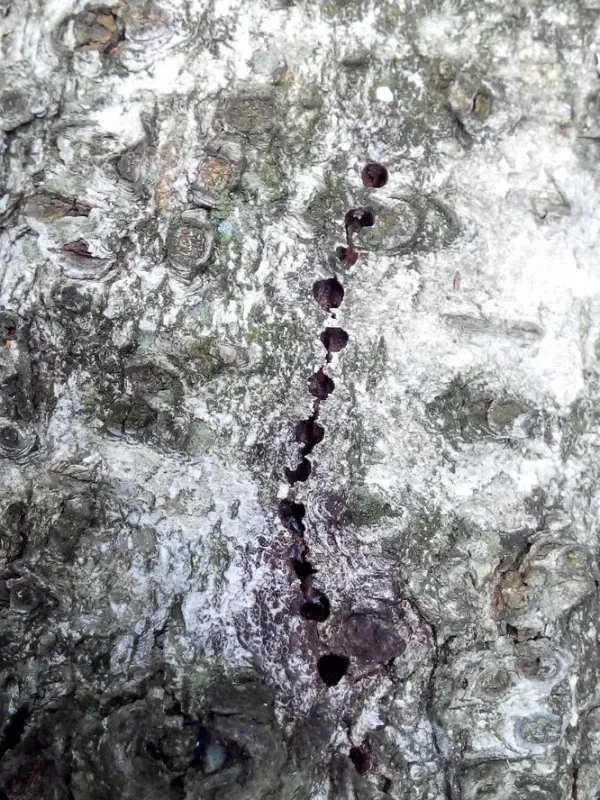
The first sign of infestation is the presence of numerous small holes on the bark of the trunk, known as entrance holes. Around these, one can often find "frass" — fine, sawdust-like wood particles.
Gradually, the crown of the tree begins to turn yellow, the leaves shrink in size, and the terminal shoots start to wither. These processes indicate that the tree's nutrient transport system has been severely compromised by larval tunneling.
Upon inspecting the trunk, one may discover characteristic "mirrored" impressions of maternal galleries beneath the peeling bark. In advanced cases, the bark begins to crack and fall off in large pieces.
Trees colonized by the birch bark beetle often become targets for woodpeckers. The intense activity of these birds searching for larvae under the bark is frequently a visible external signal of tree distress.
- Yellowing of foliage in the upper part of the crown.
- Presence of frass (sawdust) at the base of the trunk.
- Small, round holes (perforation) on the bark surface.
- Massive bark peeling and exposure of the wood.
- Visible signs of woodpecker activity on the trunk.
Control measures
The primary method of prevention is maintaining high standards of forest and garden management. Healthy and vigorous trees are often capable of "flooding" beetle galleries with resin or sap, preventing the pest from establishing itself.
It is necessary to conduct timely sanitary felling and removal of infested trees. Damaged wood should be immediately removed from the site or burned to destroy the larvae living within the timber.
In ornamental gardens, insecticide treatments of the trunks can be applied during the beginning of the beetle's flight. The use of systemic pesticides allows for the creation of a protective barrier that is lethal to adults attempting to bore into the wood.
It is important to regularly provide fertilizer and irrigation, especially during drought periods. Weakened trees act as a magnet for bark beetles, making tree vitality the most effective defensive shield.
The use of pheromone traps can be effective for population monitoring and reducing the number of adult beetles. However, their use requires professional guidance and proper placement within the infestation zones.
Taxonomy
- Latin name
- Scolytus ratzeburgi
- Order
- Coleoptera (beetles)
- Family
- Curculionidae
- EPPO code
- SCOLRA
Discussion
No discussions yet — be the first.