
Hickory bark beetle
Scolytus quadrispinosus
Description
How to identify
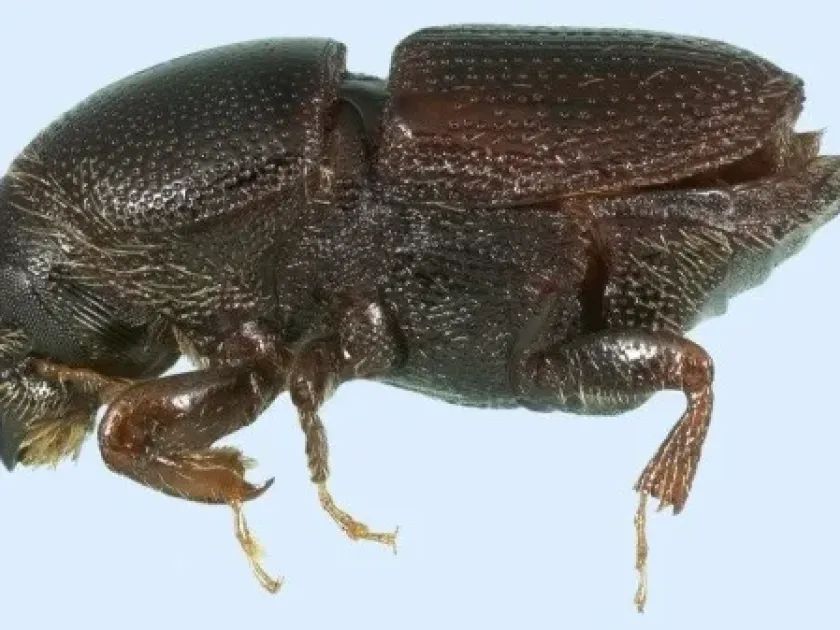
The hickory bark beetle (Scolytus quadrispinosus) is a small beetle belonging to the Curculionidae family and the Scolytinae subfamily. Adults are typically 3.5 to 4.5 mm long and have a dark brown or black appearance.
Their bodies are cylindrical and compact, which is an evolutionary adaptation for moving within the narrow galleries they construct beneath the bark of host trees.
Male beetles are distinguished by the presence of four small spines on the posterior declivity of the elytra, which serves as a primary diagnostic feature for this species.
The larvae are legless, white-colored, and curved in shape. They spend their entire developmental cycle beneath the bark, feeding on the tree's phloem and cambium layers.
As the most destructive pest of hickory (Carya) species in North America, this insect can significantly impact forest health and orchard productivity.
What it damages
The primary hosts of this beetle are trees of the genus Carya, including hickory and pecan. Occasionally, it may infest other hardwood species if the population is extremely high.
Adult beetles cause damage by boring into the base of leaf petioles and young twigs, causing the foliage to wither and fall prematurely.
The most severe damage is caused by the larval stages. They excavate extensive galleries beneath the bark, which effectively girdles the tree and disrupts the transport of water and nutrients.
Infested trees show signs of decline, characterized by chlorosis of leaves, followed by dieback of the crown and eventually the death of the entire tree.
Once a tree is heavily infested, it often cannot recover, and its presence serves as a breeding ground for subsequent generations of the beetle.
When it appears
The activity of the hickory bark beetle is highly temperature-dependent, usually beginning in late spring as the ambient temperature rises above 18-20 degrees Celsius.
Depending on the climatic zone and the duration of the growing season, this insect can produce one to two generations per year.
The peak period of adult flight and infestation typically occurs during the hot summer months, when trees may be under drought stress and are more susceptible to attack.
During the autumn, the larvae enter a period of overwintering, remaining beneath the bark until the following spring, when they resume their development.
Environmental monitoring during the spring and early summer is crucial for detecting the emergence of the first generation of adults.
Signs of infestation
The first sign of infestation is often the premature dropping of leaves during the summer, which may appear as if the tree is entering an early autumn state.
Tiny, round entry holes, resembling small-gauge shotgun blasts, are visible on the surface of the bark, often surrounded by small accumulations of sap or frass.
Stressed trees may exhibit sap bleeding from the bark surfaces where the beetles have entered, leaving dark, sticky streaks on the trunk.
Upon removing a section of the bark, one can observe a distinct pattern of galleries: a central vertical maternal gallery with numerous lateral larval tunnels.
Crown dieback, where top branches lose their foliage or turn brown, is a critical sign of advanced infestation and indicates a high risk of tree mortality.
Control measures
Maintaining tree vigor is the most effective preventative measure; well-irrigated and properly fertilized trees are less attractive to the beetle.
Sanitation is essential: trees that show signs of severe infestation must be promptly removed and destroyed to prevent the spread to healthy neighbors.
Wood debris from removed trees should not be left on-site, as it provides an ideal environment for the beetle to continue its life cycle and re-infest the area.
Protective insecticide applications to the trunks of valuable trees can be performed when adult beetle flight is at its peak to prevent new attacks.
- Monitor populations using pheromone traps.
- Prioritize the health of stressed trees during drought periods.
- Utilize biological control agents that target the beetle's life cycle.
Taxonomy
- Latin name
- Scolytus quadrispinosus
- Order
- Coleoptera (beetles)
- Family
- Curculionidae
- EPPO code
- SCOLQU
Discussion
No discussions yet — be the first.