
Smaller elm bark beetle
Scolytus pygmaeus
Description
How to identify
The smaller elm bark beetle (Scolytus pygmaeus) is a small wood-boring insect belonging to the family Curculionidae, subfamily Scolytinae.
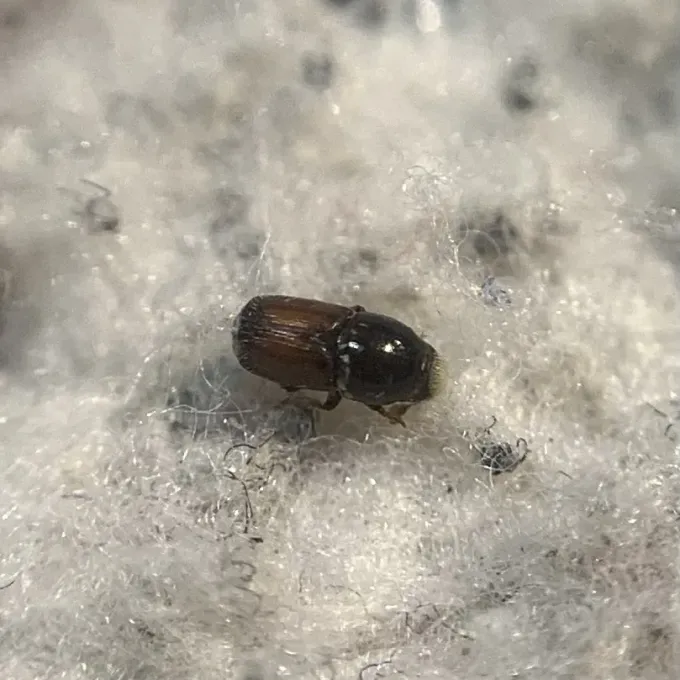
Adult beetles are typically 2.5 to 4 mm long, with a dark brown to black cylindrical body that exhibits a noticeable sheen when observed under light.
The larvae are legless, white, and curved, with a distinct brownish head capsule, adapted for life in the cambium layer between the bark and wood.
Identification is most accurately achieved by observing the unique gallery patterns: the maternal tunnels are cut transversely across the wood grain.
While often confused with other bark beetles, the specific host preference and the transverse gallery orientation serve as key markers for this species.
What it damages
The primary hosts of this beetle are species of the genus Ulmus (elm trees), which are frequently targeted when stressed by drought or disease.
Feeding by larvae destroys the cambium layer, effectively girdling branches or even entire trunks and disrupting the plant's nutrient transport system.
This beetle is a major vector for Ophiostoma ulmi, the fungus responsible for Dutch elm disease, which is often more lethal than the beetle infestation itself.
Severe infestations cause rapid wilting and necrosis of the crown, leading to the eventual death of the tree if left untreated over several seasons.
Economic damage is substantial in urban landscapes and forests, as infested timber loses its structural integrity and aesthetic value.
When it appears
Adult beetles emerge in late spring (May-June) to seek out suitable host trees for breeding and to feed on young twig tissue.
After mating, females bore into the bark to construct transverse maternal galleries, where they lay their eggs in small niches along the sides.
Larvae hatch and start feeding outward, creating individual galleries that broaden as the larvae increase in size throughout the summer months.
Pupation typically occurs in the late summer, and depending on latitude and temperature, a second generation can complete its cycle by autumn.
The beetle overwinters primarily in the larval stage, tucked safely within the bark, and resumes development as temperatures rise in the following spring.
Signs of infestation
Small circular entry holes, resembling exit wounds from a shotgun, are the most prominent sign of an active or recent infestation on the bark.
Fine wood dust, known as frass, often accumulates around the base of the tree or in bark crevices, indicating that the beetles are actively boring.
Branch dieback, characterized by yellowing or wilting leaves at the top of the canopy, is a common indicator of underlying beetle-related stress.
Peeling back a piece of bark reveals the classic transverse gallery architecture and the galleries created by the developing larvae.
Staining on the bark surface caused by sap bleeding from the entry holes is another common visual clue in vigorously reacting trees.
Control measures
The most effective management strategy is sanitation: promptly removing and disposing of infested wood to prevent the maturation of the next generation.
Burning infested bark or burying it deep is recommended to destroy larvae and prevent adult beetles from dispersing to healthy trees.
Pheromone traps are highly effective for monitoring adult beetle flight periods and can be used to mass-trap them in high-risk areas.
Maintaining tree vigor through proper irrigation and soil management increases the tree's natural resistance to beetle attacks.
Preventative insecticide applications on high-value trees during the peak flight season can protect them from adult beetle entry.
Taxonomy
- Latin name
- Scolytus pygmaeus
- Order
- Coleoptera (beetles)
- Family
- Curculionidae
- EPPO code
- SCOLPG
Discussion
No discussions yet — be the first.