
Elm bark beetle
Scolytus praeceps
Description
How to identify
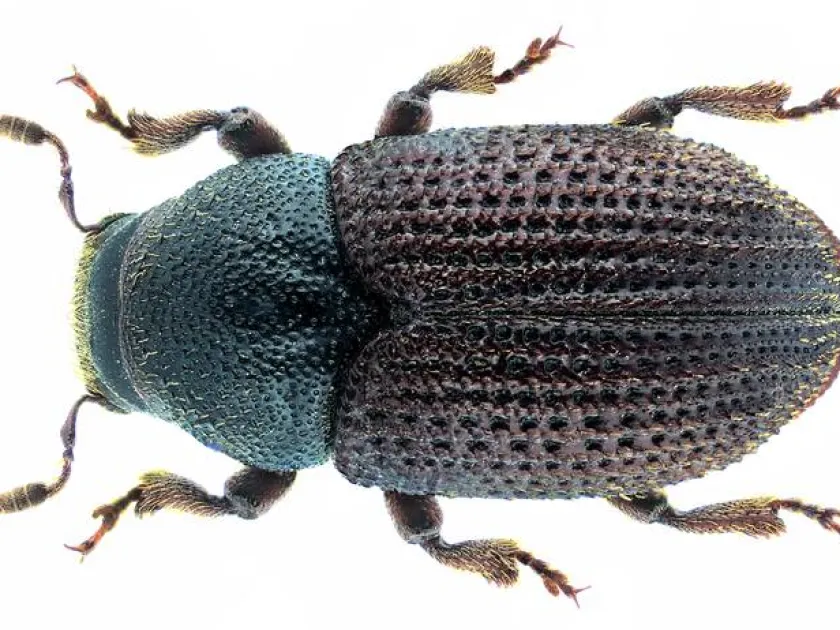
The Elm bark beetle (Scolytus praeceps) belongs to the Curculionidae family, subfamily Scolytinae. Adult beetles are small, typically measuring between 3 and 4 millimeters in length.
The body has a cylindrical shape and is dark brown or black in color with a distinctive luster. The pronotum is large, and the elytra feature clear longitudinal grooves with small pits.
Identification is often based on the specific morphology of the male abdomen. Distinguishing this species from other Scolytus beetles on elm trees often requires specialized expertise.
Larvae are legless, white, and possess a well-developed brownish head. Their bodies are curved, allowing them to navigate efficiently through the narrow spaces under the bark.
Pupae develop inside the bark layers. They appear pale initially, gradually darkening as the beetle matures and prepares for emergence.
What it damages
The primary host for this beetle is the Elm tree (Ulmus). It targets both forest stands and urban tree plantings, preferring trees that are already stressed or diseased.
While healthy trees are usually resistant, high population densities can lead to beetles attacking trees that are only mildly physiologically weakened.
This beetle is a vector for the fungus Ophiostoma ulmi, the causative agent of Dutch elm disease, making it an extremely destructive pest in temperate regions.
Firewood stacks and stored logs are significant risk factors, as they often serve as breeding grounds if not treated or processed correctly.
The damage caused by larvae feeding on cambium disrupts nutrient transport, which typically leads to the death of the tree if left untreated over several seasons.
When it appears
Adult beetle emergence typically occurs in the spring, usually during May, triggered by warm temperatures reaching the bark surfaces.
Following emergence, beetles engage in maturation feeding, where they consume bark tissue from young shoots and twigs to gain energy for reproduction.
Reproductive activity takes place in the summer, where females bore tunnels into the bark to lay eggs. One or two generations can occur per season depending on the climate.
Larval development is most intense during the summer months, with larvae actively carving galleries into the phloem and cambium layers.
The insects overwinter as larvae or young adults inside the bark, remaining dormant until the following spring when the cycle begins anew.
Signs of infestation
The initial sign of an infestation is the appearance of tiny entry holes in the bark, resembling shot holes or buckshot damage.
- Accumulation of fine, brown sawdust (frass) at the base of the tree.
- Yellowing and wilting of leaves (flagging) on specific branches.
- Specific gallery patterns (maternal and larval) visible when the bark is peeled back.
- Sap bleeding or resin flow on the trunk surface at infestation sites.
- Rapid decline or crown dieback in infected trees.
Advanced signs include large patches of dead or loose bark that can be easily flaked off, revealing the extensive tunneling work of the larvae.
Control measures
Sanitation is the most critical control measure, involving the removal and proper disposal of diseased or heavily infested elm trees.
Wood management is essential; logs should be debarked or treated with insecticides promptly to prevent them from becoming breeding hotspots.
Prophylactic insecticide applications on healthy tree crowns during the flight period can help protect vulnerable trees from beetle attacks.
Farming practices, such as adequate watering and soil nutrient management, help keep trees vigorous and more resilient to successful beetle colonization.
Monitoring populations using pheromone traps is a recommended practice for urban forestry to detect the arrival of the pest and mitigate its impact.
Taxonomy
- Latin name
- Scolytus praeceps
- Order
- Coleoptera (beetles)
- Family
- Curculionidae
- EPPO code
- SCOLPR
Discussion
No discussions yet — be the first.