
Elm bark beetle
Scolytus muticus
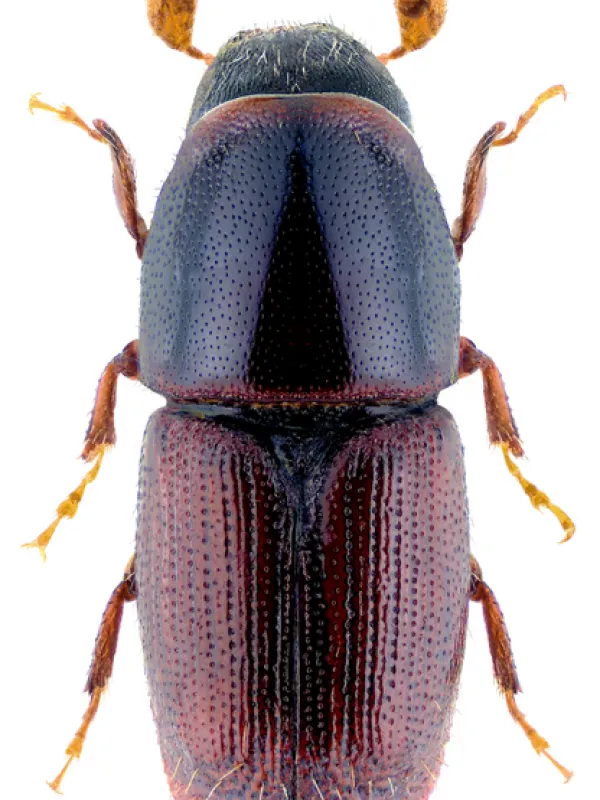
Description
How to identify
The Elm bark beetle (Scolytus muticus) is a small wood-boring insect belonging to the Curculionidae family and the Scolytinae subfamily, typically measuring 3 to 4.5 mm in length.
These beetles are dark brown to black in appearance, featuring a characteristic structure of the abdomen with a specific tubercle in males, which is a key diagnostic feature for the species.
The larvae are legless, creamy white grubs with a distinct brown head capsule, specialized for feeding within the phloem and cambium layers of the host tree bark.
The life cycle involves an egg stage, several larval instars, a pupal stage, and the emergence of adults, who are responsible for both gallery construction and disease vectoring.
Depending on the climatic conditions, the species can complete one or two generations per year, with overwintering occurring primarily at the larval stage within the host tree tissue.
What it damages
The primary hosts for this species are trees in the Ulmus genus. Weakened or stressed trees are most susceptible, although high populations can overwhelm healthy specimens.
These beetles are recognized as significant vectors of fungi that cause vascular diseases, most notably Dutch elm disease, which leads to severe decline and rapid tree mortality.
Larval feeding destroys the conductive tissues under the bark, cutting off the supply of nutrients and water to the canopy, which results in wilting and branch death.
Adults also cause damage by boring into the axils of young twigs for maturation feeding, which often leads to twig breakage and provides entry points for pathogens.
Over time, unchecked infestations can decimate entire elm populations in both urban environments and natural woodlands, causing irreversible ecological damage.
Signs of infestation
The most reliable sign of an active infestation is the presence of numerous small, circular exit holes on the bark surface, often accompanied by fine, sawdust-like bore dust.
Removing a small section of the bark reveals a distinct gallery system, consisting of a central egg gallery with radiating larval tunnels etched into the sapwood.
Visually, infected trees exhibit flagging, where individual branches or the crown turn yellow and wilt prematurely during the growing season due to disrupted vascular flow.
The bark may show vertical cracks or patches of dead, loose material as the underlying tissues are systematically consumed by the developing larvae.
- Circular emergence holes in the bark
- Accumulation of boring dust at the base of the trunk
- Premature yellowing and wilting of the foliage
Control measures
Sanitation is the most critical management practice; infested trees must be promptly felled and the wood destroyed or debarked before the new generation of adults emerges.
Maintaining tree vigor through proper irrigation, fertilization, and avoiding mechanical root or stem damage increases the tree's natural defense against colonization.
The use of trap trees, which are intentionally stressed or partially felled to attract beetles, can be an effective way to concentrate and then eliminate the local population.
Chemical control using systemic insecticides can be applied to the canopy during adult flight periods to deter feeding and nesting, though it requires precise timing.
Regular monitoring of forest stands using pheromone-based traps is essential to detect early outbreaks and prevent the rapid spread of the beetle to healthy surrounding elms.
Taxonomy
- Latin name
- Scolytus muticus
- Order
- Coleoptera (beetles)
- Family
- Curculionidae
- EPPO code
- SCOLMT
Discussion
No discussions yet — be the first.