
Smaller European elm bark beetle
Scolytus multistriatus
Description
How to identify
The smaller European elm bark beetle (Scolytus multistriatus) is a member of the Curculionidae family, subfamily Scolytinae. Adult beetles are small, ranging from 2.5 to 3.5 mm in length, and possess a shiny dark brown or black body.
Identification is aided by the presence of a distinct, slanted abdominal profile. Their larvae are C-shaped, legless, and white with a brown head, residing primarily in the inner bark of host trees.
These beetles are highly mobile and capable of flight over significant distances, allowing them to rapidly infest surrounding trees. They are well-known vectors for the fungi that cause Dutch elm disease.
The lifecycle consists of egg, larval, pupal, and adult stages. Overwintering occurs typically in the larval stage beneath the bark, which provides insulation against cold winter temperatures.
Monitoring for adults is effectively achieved through the use of pheromone traps, which allow for timely intervention before the insects can establish colonies under the bark.
What it damages
This beetle primarily attacks elm trees, but it is also known to infest various fruit trees, including apple, pear, apricot, and plum. It thrives on weakened or stressed trees but can attack healthy specimens if the population density is high.
Adult beetles feed on the small twigs of healthy trees, which often leads to the death of these twigs. However, the most severe damage is caused by the larvae, which construct galleries in the phloem and cambium layers.
By boring through the cambium, the larvae disrupt the vascular system of the tree, effectively cutting off the flow of water and nutrients. This leads to tree decline, canopy thinning, and often total mortality.
Wounds created by the beetles serve as entry points for pathogens and secondary invaders, significantly weakening the tree's immune system and leading to severe fungal infections.
The infestation often results in extensive bark loss as trees struggle to cope with the physiological stress, ultimately rendering the tree vulnerable to secondary pests and environmental stressors.
When it appears
Adult activity begins in the spring when average daily temperatures reach approximately 15–18°C. This timing often aligns with the blooming period of host trees.
Depending on the climate and length of the growing season, the beetle can complete one to two generations per year, which significantly impacts the damage potential in a single season.
Mass emergence of adults typically occurs in late spring and early summer, when they seek out host trees for both maturation feeding and subsequent egg-laying.
Pupation takes place within the bark. Upon completion of the pupal stage, the new generation of adults bores exit holes, appearing as small, uniform, round perforations on the surface of the tree bark.
As autumn arrives, the growth rate of larvae slows down, and they enter a stage of winter diapause, remaining in their galleries until the environmental conditions become favorable again in the spring.
Signs of infestation
The most prominent sign of an infestation is the appearance of small, round exit holes on the tree trunk, which look remarkably like shotgun pellet marks.
In many cases, the tree will respond to the attack by exuding sap or gum at the entry points, which can be seen on the outer bark as small sticky patches or droplets.
Canopy thinning and premature leaf yellowing are common, particularly on specific branches, creating a pattern where isolated dead limbs appear within an otherwise healthy-looking crown.
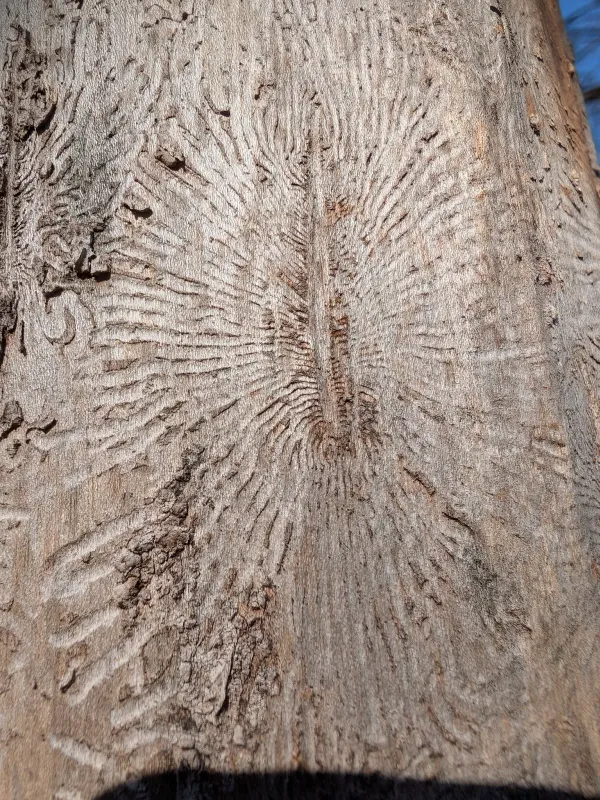
Peeling back a piece of infested bark reveals complex gallery patterns: a main central tunnel created by the female, with larval galleries branching out perpendicularly in a characteristic "centipede" design.
In advanced stages, the bark may begin to slough off in large patches, exposing the sapwood riddled with numerous boreholes and packed with wood dust (frass).
Control measures
Sanitary management is the most effective control strategy. All dead, dying, or heavily infested trees should be promptly removed and destroyed to prevent the further spread of the beetle.
Eliminating wood piles and logging debris from the orchard or landscape is critical, as these materials provide optimal breeding grounds for the beetles to proliferate.
Systemic insecticides can be applied to the trunk and main branches during the period of peak adult flight to prevent the beetles from successfully burrowing into the bark.
- Maintain tree vigor through regular irrigation and fertilization.
- Deploy pheromone traps to monitor adult emergence cycles.
- Apply lime whitewash to trunks to deter initial colonization.
- Practice regular pruning to remove infested branches immediately.
For high-value trees, trunk injections with specialized insecticides can provide localized and sustained protection against larval development inside the vascular tissue.
Taxonomy
- Latin name
- Scolytus multistriatus
- Order
- Coleoptera (beetles)
- Family
- Curculionidae
- EPPO code
- SCOLMU
Discussion
No discussions yet — be the first.