
Apple bark beetle
Scolytus mali
Description
How to identify
The Apple bark beetle (Scolytus mali) is a small wood-boring insect belonging to the Curculionidae family. Adult beetles are typically 3–4.5 mm long, black or dark brown, and have a cylindrical, shiny body.
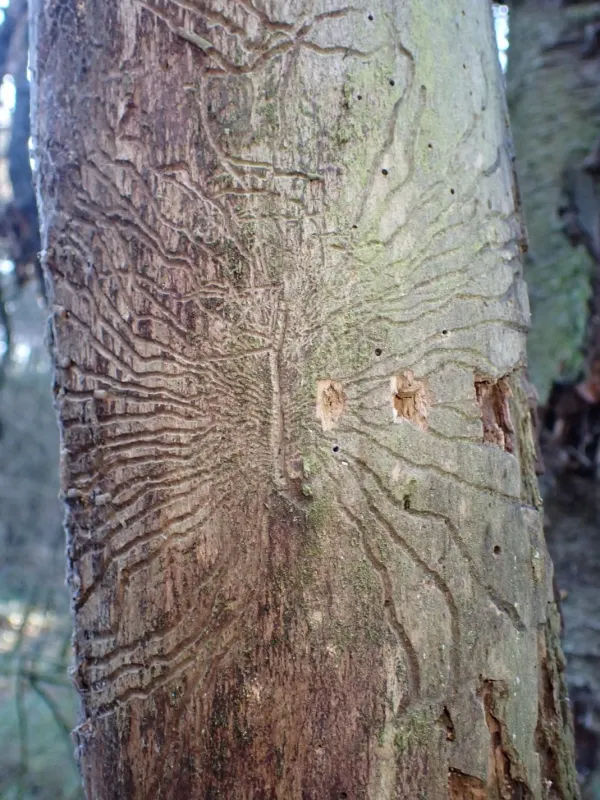
The larvae are white, legless, and curved, residing in galleries excavated between the bark and the wood. These galleries often radiate from a central maternal tunnel, causing significant disruption to the tree's vascular system.
The species is highly specialized, and its presence is often an indicator that the host tree is suffering from environmental stress, disease, or physical damage.
What it damages
This pest targets a wide range of fruit-bearing trees, including apple, pear, plum, cherry, apricot, and hawthorn. Weakened trees are the primary targets, but high populations can lead to attacks on healthy specimens.
By feeding on the cambium and inner bark, the beetle destroys the layers responsible for nutrient transport. Sustained infestation results in branch dieback and, eventually, the death of the entire tree.
When it appears
The flight period for adult beetles generally begins during the apple blossom season (late spring). A second generation can occur in mid-to-late summer depending on the regional climate.
The adults engage in maturation feeding on buds and young shoots, which can lead to additional damage to the tree's foliage and growth potential. The life cycle involves egg-laying in fresh tunnels and pupation within the bark.
Signs of infestation
The most distinctive sign of an infestation is the appearance of numerous small, circular exit holes on the trunk and thick branches. These holes resemble a shot pattern on the bark surface.
- Fine, sawdust-like frass (boring dust) appearing on the bark or at the tree base.
- Sudden yellowing and wilting of leaves on individual branches during the growing season.
- Splitting or loosening of the bark in areas where galleries are present.
- Dying branches or tops of trees that do not leaf out correctly in spring.
Control measures
Effective management starts with rigorous orchard hygiene. Pruning out and destroying infested wood before the beetles emerge is the most critical step to prevent the spread of the population.
Maintaining tree vitality through appropriate fertilization and irrigation reduces the susceptibility to infestation. Protecting tree trunks from sunscald with whitewash or protective wraps can also discourage beetle colonization.
During peak flight periods, insecticide applications may be used to reduce the adult population. Monitoring using pheromone traps or trap logs can help determine the timing of chemical interventions.
Taxonomy
- Latin name
- Scolytus mali
- Order
- Coleoptera (beetles)
- Family
- Curculionidae
- EPPO code
- SCOLMA
Discussion
No discussions yet — be the first.