
Large elm bark beetle
Scolytus major
Description
How to identify
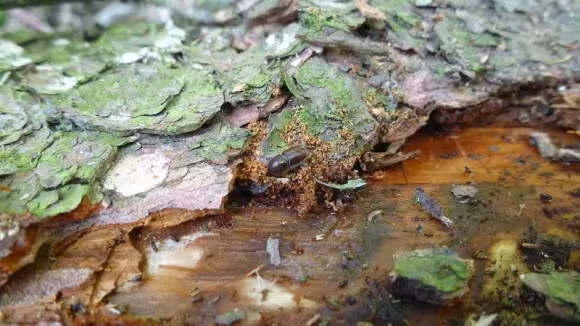
The large elm bark beetle (Scolytus major) is a coleopteran insect belonging to the family Curculionidae, subfamily Scolytinae. It is one of the most significant pests affecting elm trees, characterized by its relatively large size, ranging from 4.5 to 6 mm in length.
The adult beetle has a cylindrical, shiny black body. A distinctive morphological feature of the genus Scolytus is the abdominal segments, which slope upward toward the posterior end, allowing them to effectively navigate and clear frass from their galleries.
The larvae are typically wood-boring, legless grubs with a white body and a sclerotized, brownish head. They live exclusively in the subcortical space, feeding on the phloem and cambium layers of the host tree.
These insects are highly adapted to the bark environment. They possess specialized sensory organs to detect the volatile compounds released by stressed or wounded elm trees, which helps them locate suitable hosts for reproduction.
Due to its high reproductive capacity and ability to spread rapidly in favorable environments, this species is considered a primary driver of forest decline in regions where elm populations are dense.
What it damages
The primary hosts of this beetle are species of the genus Ulmus. Damage is caused by both adults, which feed on young twigs, and larvae, which consume the inner bark, effectively girdling the tree.
The most critical impact of Scolytus major is its role as a vector for the fungus Ophiostoma ulmi, the causative agent of Dutch elm disease. As beetles feed, they introduce fungal spores into the tree's vascular system.
The fungal infection triggers the tree’s defense mechanism, leading to the occlusion of xylem vessels. This prevents water transport to the canopy, causing sudden wilting, crown dieback, and eventually the death of the entire tree.
In addition to transmitting disease, heavy larval infestation physically destroys the transport tissues, leading to nutritional stress and making the tree susceptible to secondary attacks by other pests and pathogens.
Economic damage includes the loss of urban tree canopy, increased costs for tree removal in parks and forests, and the destruction of genetically valuable elm stands.
When it appears
The flight period of overwintering beetles usually begins in late spring, around May or June, when temperatures are consistently warm. During this time, adults emerge from exit holes to seek new hosts.
After emergence, beetles engage in maturation feeding on young shoots. This feeding activity is the most dangerous moment, as it facilitates the transmission of fungal spores from infested bark to the current-year growth of healthy trees.
Following feeding, females initiate gallery construction. They bore into the bark of suitable hosts to lay eggs. The larvae hatch and begin feeding, creating their own tunnels that radiate from the mother gallery.
The larvae overwinter under the bark, which provides insulation against freezing winter temperatures. As temperatures rise in spring, they complete their development and pupate, ready to emerge as adults.
Depending on climatic conditions and latitude, the species may complete one or two generations per year, with warmer climates significantly increasing the speed of the reproductive cycle.
Signs of infestation
A primary indicator of infestation is the presence of numerous small, perfectly round exit holes on the trunk and thick branches, often referred to as "shot holes."
Peeling back a piece of bark reveals a characteristic gallery pattern, consisting of a longitudinal maternal gallery with numerous lateral larval galleries spreading outward like a spider web.
Visible crown symptoms include flagging, which is the premature wilting and yellowing of leaves on individual branches. This often progresses rapidly to involve the entire crown within a single season.
The presence of sawdust-like frass on the bark surface or near the base of the tree is a strong indication of active boring by beetles. The color of this dust typically matches the inner bark layers.
Increased woodpecker activity on elm trees is a common, though indirect, sign that the tree is heavily infested with bark beetle larvae, as they are a primary food source for these birds.
Control measures
- Implement strict sanitation programs, including the immediate felling and destruction of infested trees to prevent the spread of beetles.
- Use pheromone-baited traps to monitor adult beetle populations and potentially reduce the number of breeding insects in the area.
- Apply systemic or contact insecticides to the trunk and branches during the known flight periods to prevent beetle entry.
- Promote overall tree health through adequate irrigation and proper soil management to increase the tree's natural resistance to beetle attacks.
- Explore biological control options, such as the introduction of predatory insects or parasitic wasps that target bark beetle larvae.
Taxonomy
- Latin name
- Scolytus major
- Order
- Coleoptera (beetles)
- Family
- Curculionidae
- EPPO code
- SCOLMJ
Discussion
No discussions yet — be the first.