
Elm bark beetle
Scolytus laevis
Description
How to identify
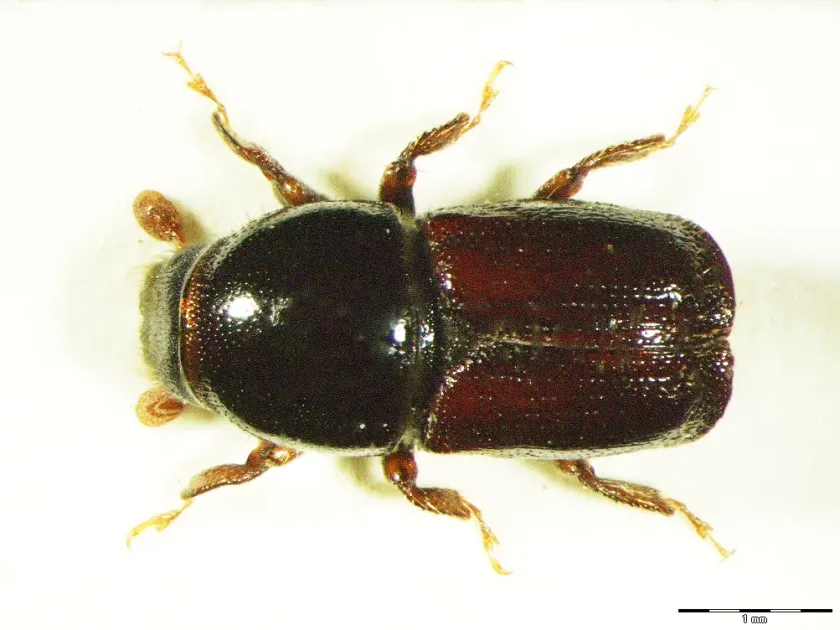
The Elm bark beetle (Scolytus laevis) is a small wood-boring insect belonging to the family Curculionidae, subfamily Scolytinae. Adult beetles typically measure between 3 and 4.5 mm in length and possess a shiny, dark brown or black cylindrical body.
A key diagnostic feature distinguishing S. laevis from other species is the smooth, barely punctured surface of the pronotum. Males can be identified by a distinct small tubercle on the third abdominal sternite.
The larvae are legless, white, and C-shaped, featuring a well-developed, dark-colored head capsule that allows them to chew through the cambium layer of elm trees effectively.
Pupation occurs in small, specialized chambers constructed by the larvae just before transforming into adults. These chambers are located between the bark and the sapwood of the host tree.
Adult beetles are capable of flight and are highly attracted to the chemical signals emitted by stressed or dying elm trees, allowing them to locate suitable breeding sites over long distances.
What it damages
The primary hosts of this beetle are trees belonging to the genus Ulmus (elms). While they often target stressed or recently felled trees, they can attack healthy trees if the beetle population is sufficiently high.
The most severe damage is not the physical tunneling by the larvae, but the beetle's role as a major vector of Ophiostoma ulmi, the fungus responsible for Dutch elm disease.
As the beetles feed on the shoots of healthy trees, they introduce fungal spores into the vascular system of the tree, causing the blockage of water transport and leading to rapid wilting and death.
Larval galleries constructed under the bark further weaken the tree by disrupting the nutrient flow, which can lead to localized bark necrosis and a general decline in tree vigor.
The economic and ecological impact is profound, as the infestation leads to the rapid loss of mature elm specimens in urban landscapes, forests, and shelterbelts, requiring extensive removal efforts.
When it appears
The adult beetle emerges in late spring, usually from May to June, depending on local temperatures. This coincides with the period of active growth for elm trees.
Following a period of maturation feeding on healthy twigs, the adults seek out suitable host trees to mate and lay eggs, carving out mother galleries in the inner bark.
The life cycle is generally univoltine, meaning one generation per year, though warmer climates may allow for partial second generations, increasing the pressure on the trees.
Overwintering takes place in the larval stage under the bark. These larvae are remarkably hardy and can survive freezing winter temperatures in their subcortical galleries.
Monitoring the flight period is essential, as the window for effective preventative measures is limited to the weeks when adults are actively searching for new hosts.
Signs of infestation
Visual identification starts with the presence of numerous tiny exit holes in the bark, often resembling the pattern left by a shotgun blast, caused by emerging adults.
Fine wood dust, known as frass, accumulates near the entry holes or at the base of the tree, indicating active boring activity occurring beneath the bark surface.
Removing a section of the bark reveals distinct gallery patterns: a primary longitudinal mother gallery with numerous perpendicular larval galleries branching off in both directions.
The crown of the tree shows signs of distress, such as flagging (individual wilting branches), yellowing leaves, and sudden dieback, which are classic symptoms of associated fungal infection.
Cross-sections of infested branches often reveal dark brown staining in the xylem rings, which confirms the presence of the vascular pathogen spread by these beetles.
Control measures
Strict sanitation is the most effective management strategy. Infested or dead elm wood should be identified and removed from the site before the next generation of beetles emerges.
It is vital to prohibit the storage of unpeeled elm logs near healthy stands, as these serve as potent attractants and breeding grounds for the beetle population.
Pheromone traps are useful tools for monitoring adult activity levels and can help in suppressing local beetle populations if deployed strategically in high-risk areas.
Preventative insecticide applications on high-value specimen trees during the adult flight period can provide temporary protection, although this requires precise timing and expert application.
Maintaining tree health through proper irrigation, fertilization, and avoiding mechanical damage helps trees produce defensive resins that discourage beetle colonization and boost resistance.
Taxonomy
- Latin name
- Scolytus laevis
- Order
- Coleoptera (beetles)
- Family
- Curculionidae
- EPPO code
- SCOLLV
Discussion
No discussions yet — be the first.