
Scolytus kirschi
Scolytus kirschi
Description
How to identify
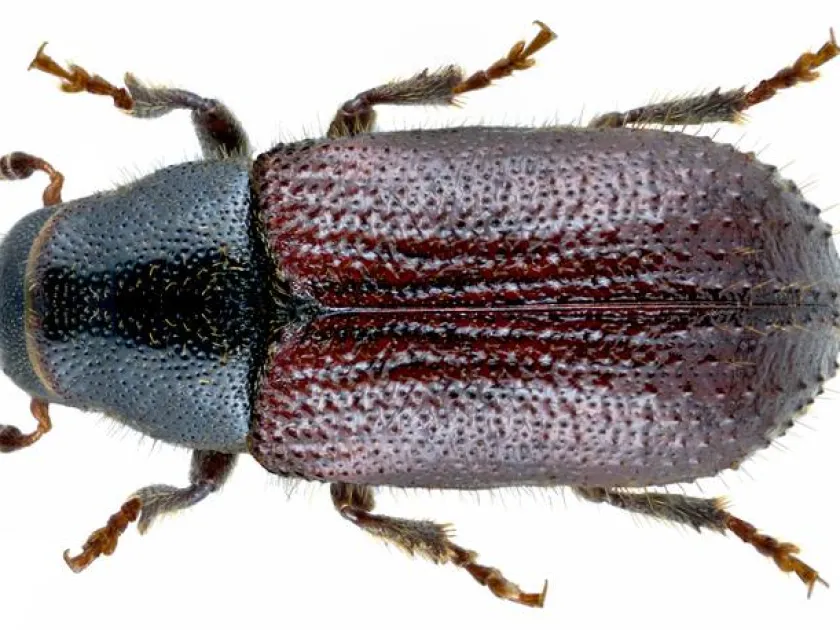
Scolytus kirschi is a small bark beetle belonging to the family Curculionidae (subfamily Scolytinae). Adult beetles are cylindrical, typically measuring between 2.5 and 3.5 mm in length, with a shiny, dark brown or black exoskeleton.
The head is retracted into the pronotum, and the antennae possess a characteristic club-shaped terminal segment. The larvae are legless, white, and C-shaped, living exclusively beneath the bark of host trees.
This species is classified as a secondary stem pest, usually targeting trees that are already under stress, although it can cause significant damage in dense populations.
The physical presence of the beetle is often hidden until the emergence holes become visible on the surface of the bark, signaling an established infestation.
Adults possess functional wings, allowing them to disperse throughout orchards during their flight period to locate suitable hosts for reproduction.
What it damages
The primary hosts for Scolytus kirschi include various pomaceous and stone fruit trees, with apple, pear, plum, and cherry trees being the most frequently attacked.
The beetle targets trees weakened by environmental stressors such as drought, frost damage, or mechanical injuries caused during orchard maintenance.
Larvae feed on the phloem and cambium layers, creating transverse tunnels that disrupt the flow of nutrients and water, which ultimately leads to the drying out of branches.
Severe infestations cause a rapid decline in tree health, manifesting as branch dieback and, if left unchecked, the total death of the tree within a few growing seasons.
Adult feeding on young shoots can further damage the tree, causing the wilting of terminal growth and weakening the overall vigor of the plant.
When it appears
The flight activity of adult Scolytus kirschi typically begins in spring when average temperatures reach 15–18 degrees Celsius, signaling the start of the breeding season.
Peak infestation activity is usually observed during May and June, when the beetles actively seek out hosts to initiate mating and gallery construction.
The life cycle duration may vary depending on climate; it can be univoltine (one generation per year) or semivoltine, depending on regional temperature variations.
Overwintering occurs primarily at the larval stage deep within the host bark, providing protection against winter cold and natural predators.
Pupation occurs in early spring within the larval galleries, followed by the emergence of the new generation of adults who chew their way out of the tree.
Signs of infestation
The most visible indicator of an infestation is the presence of numerous small, circular emergence holes on the bark, often described as resembling pellet holes.
Peeling back a piece of infested bark will reveal the maternal gallery, from which numerous larval tunnels branch off, creating a distinct, fan-like pattern.
Early signs of infestation include the wilting and yellowing of foliage, as well as the drying of twigs where adults have fed on the tender tissues.
In cases of high beetle density, the tree may exhibit exudations of sap or gum, a stress response indicating the plant is attempting to defend itself against the invaders.
Progressive dieback of the crown, starting from the upper branches, is a classic symptom that the vascular system of the tree has been severely compromised.
Control measures
The cornerstone of managing Scolytus kirschi is sanitation: the immediate removal and destruction by burning of all dead, dying, or infested tree branches.
Maintaining optimal tree vigor through proper irrigation and fertilization is crucial, as healthy trees are better equipped to resist bark beetle attacks.
Chemical control involving systemic or contact insecticides may be applied during the peak flight season to prevent beetles from boring into the bark.
- Regular pruning and destruction of infested wood.
- Usage of pheromone traps to monitor adult flight periods.
- Whitewashing trunks to discourage beetle boring and protect bark.
- Application of targeted insecticides during peak spring activity.
In orchards where infestation has become widespread, it may be necessary to remove entire heavily infested trees to protect the remaining healthy population.
Taxonomy
- Latin name
- Scolytus kirschi
- Order
- Coleoptera (beetles)
- Family
- Curculionidae
- EPPO code
- SCOLKI
Discussion
No discussions yet — be the first.