
Oak bark beetle
Scolytus intricatus
Description
How to identify
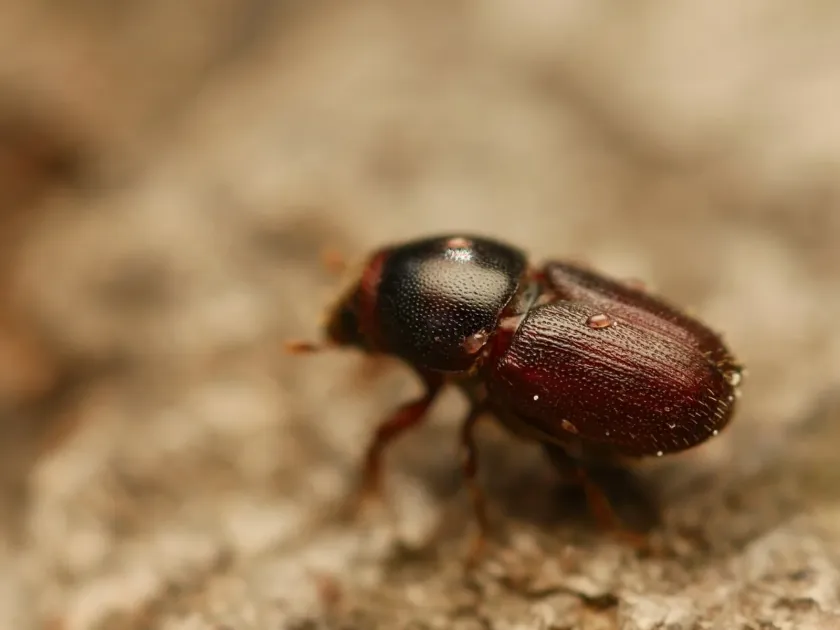
The oak bark beetle (Scolytus intricatus) belongs to the Curculionidae family and the Scolytinae subfamily. Adult beetles are small, ranging from 2 to 4 millimeters in length, with a cylindrical body and a dark brown or black coloration.
A key identifying feature of these beetles is their glossy chitinous armor, which is lightly covered with fine hairs. The head is largely retracted under the pronotum, a common trait for most bark beetle species found in temperate regions.
Larvae are legless, cream-colored, and typically C-shaped. Their well-developed head capsule allows them to efficiently excavate galleries beneath the tree bark, feeding on the nutrient-rich phloem layer.
Adults exhibit sexual dimorphism, though it is often difficult to distinguish males from females without specialized equipment. Their entire development occurs inside the tree, making them difficult to detect during the early stages of infestation.
The specific pattern of the larval galleries is often used to diagnose the species. The central maternal gallery with numerous lateral larval tunnels creates a distinct branching appearance under the bark of the host tree.
What it damages
The primary hosts for this pest are oak trees (Quercus spp.). They preferentially attack trees that are already stressed by environmental factors such as severe drought, frost damage, or physical injury, which reduces the tree's natural defense mechanism.
While oak is the primary host, the beetle can occasionally infest beech, hornbeam, birch, and some fruit trees. This adaptability allows the population to survive even when the density of oak trees is low in mixed forests.
Both young nursery saplings and mature forest trees are susceptible. In urban park settings, the beetle can cause significant aesthetic and structural damage to ornamental oak alleys, leading to branch dieback.
Mass infestations can overcome even relatively healthy trees. When the population density is high, the combined feeding activity of thousands of larvae disrupts nutrient transport, leading to rapid crown decline.
The beetle significantly degrades the economic value of timber. Once the wood is infested with tunnels and larvae, it becomes unsuitable for high-quality construction or furniture production, resulting in heavy financial losses.
When it appears
The flight period for adult oak bark beetles typically occurs from May through June. During this time, they emerge from hibernation sites to seek suitable host trees for mating and colonization.
Once the host is selected, females bore into the bark to create maternal galleries where they lay their eggs. Larval development begins shortly after, and they remain in the wood throughout the summer season.
In warmer southern regions, two generations may occur per year. However, in cooler temperate zones, the cycle is usually univoltine, with the larvae overwintering under the bark and pupating the following spring.
Climate variations, especially warm and dry spring weather, significantly influence population dynamics. Such conditions often lead to earlier emergence and more aggressive colonization of forest stands.
Autumn marks the end of active larval feeding as they enter a state of diapause. They spend the winter protected beneath the bark, which provides a stable environment against harsh winter frosts.
Signs of infestation
The first sign of infestation is the presence of tiny, circular exit holes on the tree trunk. These holes are often accompanied by "boring dust" or frass, which collects at the base of the tree or in bark crevices.
Visible wilting of leaves and premature yellowing in the canopy are strong indicators that the vascular system is being compromised by larval activity. Bark loosening or cracking may also appear on heavily infested stems.
Peeling back a piece of loose bark will reveal the telltale gallery system: a clear maternal tunnel and several radiating larval galleries. This structure is a definitive diagnostic sign of recent bark beetle activity.
The frequent presence of woodpeckers on oak trunks is an indirect sign of infestation. These birds seek out the larvae under the bark, creating larger, irregular holes as they remove sections of the outer bark.
If left unmanaged, the cumulative damage leads to stag-headedness and crown dieback. Eventually, the tree reaches a state of irreversible decline, making it a hotspot for further colonization by other secondary forest pests.
Control measures
Sanitation felling is the most effective control method. Removing and destroying infested timber before the new generation of beetles emerges is crucial to stopping the spread of the infestation to surrounding healthy trees.
Maintaining high vitality of forest stands through proper forest management is essential. Providing adequate water and nutrients to trees increases their natural resistance, allowing them to defend against beetle entry attempts.
Pheromone traps are used for monitoring purposes to determine population density and peak flight times. This data allows foresters to decide when to implement chemical control measures if necessary.
Chemical treatments, involving the application of insecticides to the trunk surface, can be employed in high-value areas to deter beetles during their flight period and prevent successful colonization of healthy oaks.
- Conducting regular forest pathology inspections.
- Removing logging debris to reduce potential breeding sites.
- Encouraging natural predators such as insectivorous birds.
- Applying preventive trunk treatments in ornamental urban settings.
Taxonomy
- Latin name
- Scolytus intricatus
- Order
- Coleoptera (beetles)
- Family
- Curculionidae
- EPPO code
- SCOLIN
Discussion
No discussions yet — be the first.