
Hornbeam bark beetle
Scolytus carpini
Description
How to identify
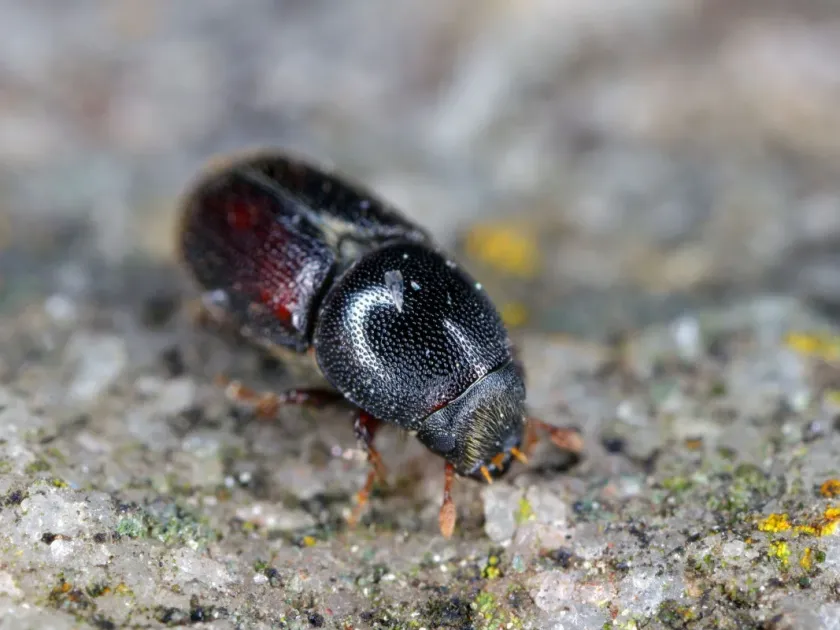
The hornbeam bark beetle (Scolytus carpini) is a small wood-boring insect belonging to the Curculionidae family and Scolytinae subfamily, commonly known as bark beetles.
These beetles are typically 2.5 to 3.5 mm long, with a cylindrical, dark brown to black body, which is a classic feature for this genus.
Male beetles often exhibit a characteristic beveled abdominal apex, a key diagnostic feature used by entomologists to distinguish this species from similar bark beetles.
The larvae are small, legless, cream-colored grubs that live hidden under the tree bark, feeding primarily on the phloem and cambium layers.
As part of the Coleoptera order, this species is highly specialized, focusing its life cycle on the health and tissues of specific hardwood tree hosts.
What it damages
The hornbeam bark beetle primarily infests trees such as hornbeam (Carpinus), elm, beech, and alder, and can occasionally be found on fruit trees like apple or pear.
The damage is caused by both adults, which create entrance holes, and larvae, which tunnel into the cambium layer, disrupting the tree's nutrient transport system.
Significant infestations lead to the wilting of foliage, branch dieback, and, in severe cases, the complete death of the infested tree.
Healthy trees can usually defend themselves with resin or sap, so the beetle most often targets trees weakened by drought, disease, or mechanical damage.
In forest environments, large populations of this beetle can lead to localized outbreaks, resulting in extensive mortality among vulnerable stands.
When it appears
Adult beetle flight generally commences in late spring, typically during May, as temperatures rise, allowing them to seek out suitable hosts for breeding.
Female beetles excavate egg galleries under the bark, where they lay eggs. The larvae hatch and begin their development, tunneling through the growing tissues.
The larval development period lasts throughout the summer, with the insects feeding continuously and expanding their gallery network beneath the bark surface.
Pupation usually occurs by late summer or early autumn, resulting in the emergence of a new generation of adults prepared for winter.
The species overwinter as adults within the galleries or pupal chambers, awaiting the return of warmer spring conditions to repeat their lifecycle.
Signs of infestation
The most visible sign of an infestation is the presence of small, circular entrance holes in the bark, accompanied by fine wood shavings known as frass.
Peeling back a piece of bark reveals complex gallery patterns, with a central maternal tunnel and lateral larval tunnels that widen as the larvae grow.
Canopy thinning, yellowing leaves, and premature leaf drop are common symptoms that the tree's vascular system has been compromised by the beetle colony.
Increased woodpecker activity on the tree trunk is a strong indicator of larvae presence, as birds seek out these insects for food.
Over time, the bark may begin to flake off, exposing the dead wood and the intricate galleries left behind by the feeding larvae.
Control measures
The primary control measure is the prompt removal and destruction of infested wood, specifically before the new generation of adults emerges.
Maintaining high tree vigor through proper watering, mulching, and nutrient management is the best long-term strategy for preventing bark beetle attacks.
In ornamental settings, contact or systemic insecticides can be applied during the flight period to protect high-value or vulnerable trees.
Trap logs can be deployed to attract beetles, which can then be removed and destroyed to significantly reduce the local population.
- Implement strict sanitation measures in forests.
- Apply pheromone traps for monitoring purposes.
- Avoid wounding tree trunks during maintenance.
- Monitor the health of drought-stressed trees closely.
Taxonomy
- Latin name
- Scolytus carpini
- Order
- Coleoptera (beetles)
- Family
- Curculionidae
- EPPO code
- SCOLCA
Discussion
No discussions yet — be the first.