
Poplar wood-boring beetle
Scolytus assimilis
Description
How to identify
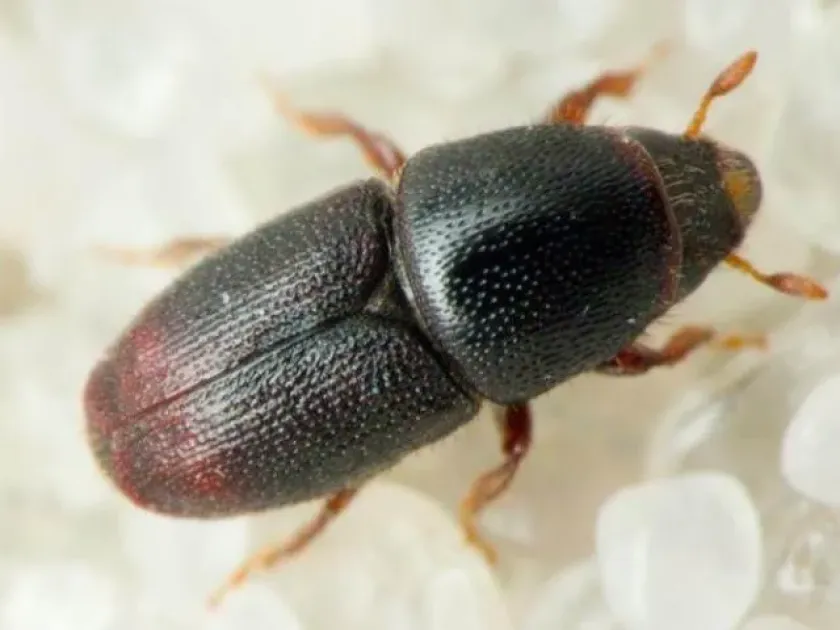
The aspen wood-boring beetle (Scolytus assimilis) belongs to the order Coleoptera and the Curculionidae family (subfamily Scolytinae). It is a tiny insect, typically measuring 3 to 4 mm in length.
The beetle’s body is cylindrical and dark brown or black in color. A distinctive feature is the truncated abdomen, a trait common to members of the Scolytus genus.
The larvae are legless, white-colored, with a yellowish head, and they develop entirely underneath the bark of host trees, feeding on nutrient-rich tissue.
Adults possess functional wings, which enable them to travel long distances to find suitable host trees, particularly after winters or during drought periods.
The life cycle involves a complete metamorphosis: eggs, larvae, pupae, and adults. Hibernation usually occurs at the larval stage or as young adults within the bark galleries.
What it damages
This pest primary targets deciduous trees, especially aspen, but can also infest poplars and willows when the trees are weakened by environmental stress.
While the beetle prefers stressed or downed trees, high population densities allow it to attack healthy, vigorous trees, which often leads to the trees' decline.
The main damage is caused by larvae mining galleries between the bark and wood, effectively severing the tree's phloem and cambium layers.
This disruption of nutrient and water flow leads to the gradual death of branches and can eventually cause the death of the entire tree if the infestation is severe.
Economic losses in forestry occur when large stands are killed, reducing the timber value and compromising the ecological health of the woodland area.
When it appears
Adult flight typically begins in late spring, usually May or early June, as soon as temperatures are consistently warm enough to support reproductive activity.
Females bore into the bark to create egg-laying galleries. Once the eggs hatch, the larvae begin feeding outward, creating their characteristic branching patterns.
Larval development occurs throughout the summer months. Depending on the geographical region and climate, the beetle may produce one or two generations per year.
As autumn approaches, the final-instar larvae finish their feeding cycle, pupate, and may transition into adults to overwinter under the bark.
Drought-stricken summers often exacerbate infestation rates, as stressed trees produce fewer defensive compounds to repel the beetle's initial attack.
Signs of infestation
The most visible sign of infestation is the presence of small, round entry holes on the bark surface, often described as looking like shotgun pellet impacts.
Boring dust, which is fine frass (sawdust-like material), is often visible around the entry holes or accumulated in the crevices of the bark at the base of the tree.
Canopy thinning is a late-stage symptom, where the foliage yellows, wilts, and drops prematurely as the tree's vascular system fails due to larval galleries.
Under the bark, one can observe a complex network of maternal and larval galleries, which is the definitive diagnostic sign of a bark beetle infestation.
In advanced cases, the bark begins to peel away or loosen significantly, exposing the destroyed cambium and wood beneath the protective layer.
Control measures
Effective management relies heavily on forest hygiene, which involves the prompt removal and disposal of infested trees before new generations of beetles can emerge.
Maintaining a healthy stand is crucial, as is the removal of debris, slash, and storm-damaged timber that could otherwise serve as breeding grounds.
The use of trap trees, which are felled intentionally to attract beetles, is an effective strategy to collect and destroy the population before they spread.
- Regular monitoring of tree stands for signs of infestation.
- Sanitary logging to remove dying or heavily infested trees.
- Using pheromone-based traps to monitor or reduce beetle populations.
- Encouraging natural predators such as woodpeckers and parasitic wasps.
Chemical control is rarely practical for large forest areas but may be considered for high-value ornamental trees or nursery settings when other measures fail.
Taxonomy
- Latin name
- Scolytus assimilis
- Order
- Coleoptera (beetles)
- Family
- Curculionidae
- EPPO code
- SCOLAS
Discussion
No discussions yet — be the first.