
Almond bark beetle
Scolytus amygdali
Description
How to identify
The almond bark beetle (Scolytus amygdali) is a small wood-boring insect belonging to the family Curculionidae, subfamily Scolytinae. Adult beetles are small, cylindrical, and measure about 3 to 4 mm in length with a dark brown or black coloration.
Larvae are white, legless, and curved, with a distinct brownish head. They are specialized for life within the subcortical layers of the host tree, where they create complex gallery patterns.
Pupation occurs within specially prepared chambers in the xylem or phloem. The developmental duration of the pupal stage is highly dependent on ambient temperatures and environmental moisture levels.
The species identification relies heavily on the pattern of maternal galleries found beneath the bark, which for Scolytus amygdali typically run perpendicular to the wood grain.
Adults are strong flyers, especially in spring, and are highly attracted to volatile compounds released by stressed or wounded trees, facilitating rapid colonization of an orchard.
What it damages
As the name suggests, the almond tree is a primary host, but this pest is also highly destructive to other stone fruits, including peaches, apricots, plums, and cherries.
The beetle primarily targets trees that are stressed due to drought, frost injury, or poor site conditions. However, in high-density populations, even healthy trees can be overwhelmed by mass attack.
Adult feeding on the buds and shoots can lead to shoot tip dieback and stunted development. This feeding behavior significantly reduces the tree's vigor and subsequent fruit yield.
The most severe damage is caused by larval boring, which disrupts the tree’s phloem. This damage impedes the flow of nutrients, leading to branch wilt, dieback, and eventually the death of the entire tree if the infestation is severe.
Massive infestations often result in reduced tree longevity and make the orchard highly susceptible to pathogens and secondary wood-decaying fungi.
When it appears
The emergence of overwintering adults usually starts in early spring, coinciding with the beginning of the fruit tree growing season when temperatures begin to rise.
The species is multivoltine, typically producing two to three generations per year depending on the climatic conditions and the duration of the hot summer season.
The peak activity of the second generation often occurs in mid-summer, increasing the risk of re-infestation of the same trees throughout the growing cycle.
Overwintering takes place primarily in the larval stage, residing deep within the bark of infested branches, which provides protection against cold and predators.
Environmental factors, particularly temperature, determine the developmental speed of each generation, with hotter summers significantly accelerating the lifecycle of the beetle.
Signs of infestation
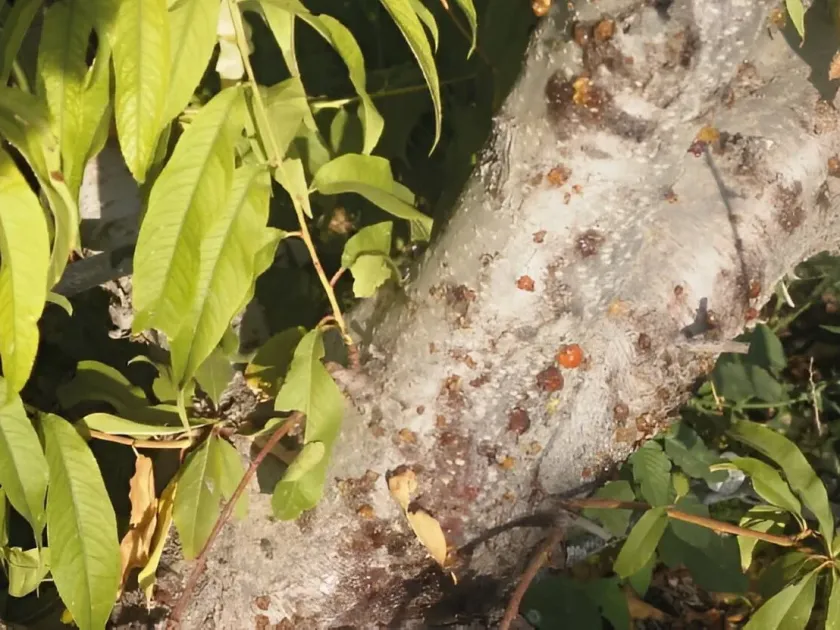
The most visible sign of an infestation is the presence of numerous tiny circular "shot holes" on the bark of the trunk and primary scaffold branches.
Gummosis, or the excessive exudation of sap and resin from the bark, is a common reaction of stone fruit trees attempting to isolate or eject the boring beetles.
Sudden wilting or yellowing of leaves on individual branches during the heat of summer is often a definitive indicator that the nutrient supply has been cut by larval galleries.
Removing a small portion of the bark reveals the characteristic star-shaped or transverse maternal galleries with lateral larval tunnels branching outwards.
- Circular emergence holes on the bark surface.
- Visible gumming on trunks and branches.
- Premature dieback of branches and shoots.
- Frass (wood dust) accumulation at the base of the tree.
- Visible gallery patterns under the bark.
Control measures
Strict sanitation is the cornerstone of management: all infested, weak, or dead wood must be pruned and burned immediately to eliminate overwintering populations.
Maintaining optimal orchard health through proper irrigation and nutrition increases the tree’s natural ability to withstand and repel initial beetle attacks.
Chemical control using systemic or contact insecticides is effective if applied during the emergence windows, targeting adults before they bore into the bark.
Pheromone traps are essential for monitoring adult population dynamics, allowing for precise timing of chemical applications to maximize efficacy and minimize environmental impact.
Whitewashing trunks in early spring can serve as a physical barrier and deterrent against initial adult colonization on the main trunk of susceptible fruit trees.
Taxonomy
- Latin name
- Scolytus amygdali
- Order
- Coleoptera (beetles)
- Family
- Curculionidae
- EPPO code
- SCOLAM
Discussion
No discussions yet — be the first.