
Citrus thrips
Scirtothrips citri
Description
How to identify
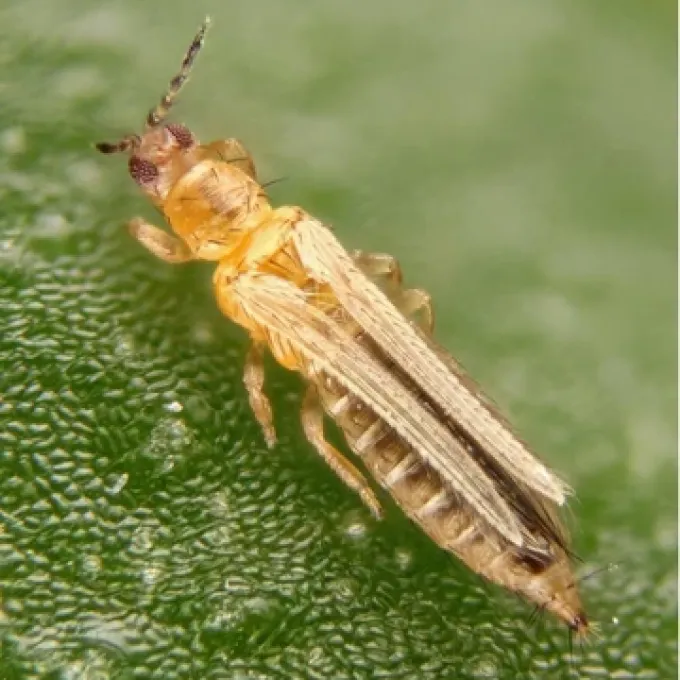
Citrus thrips is a small insect belonging to the order Thysanoptera, family Thripidae. Adult individuals are approximately 0.6–0.8 mm in length and feature a yellowish-orange coloration.
The body of the pest is elongated, with two pairs of wings fringed with long hairs, which gives them a feathery appearance. When at rest, the wings are folded flat against the back.
Larvae are similar in appearance to adults but lack wings and have a lighter, almost translucent color. They are highly active and typically concentrate on the young, tender parts of the plant.
The life cycle includes the egg stage, two larval stages, two pupal stages (prepupa and pupa), and the adult stage. The duration of this process is heavily influenced by ambient temperatures.
In warm climates, this species is capable of producing 8–12 generations per year, making it a significant challenge for intensive fruit production.
What it damages
The primary hosts are citrus crops: lemons, oranges, mandarins, and grapefruits. Both adult thrips and their larvae cause significant damage to the plant tissue.
The pest prefers feeding on young, actively growing tissues, such as emerging shoots, tender leaves, and developing fruitlets.
Beyond citrus, this species can temporarily feed on a wide variety of other plants, including grapes, pomegranates, and certain ornamental species, complicating control efforts.
Damage to the plant tissue disrupts metabolic processes, leads to leaf curling, shoot malformation, and may cause premature leaf drop under heavy infestations.
The economic impact is primarily driven by the loss of fruit marketability, as the characteristic scarring makes the citrus fruit unsuitable for the fresh market.
When it appears
The appearance of citrus thrips is directly linked to the beginning of the plant's growth season. As soon as new leaves appear, the insects begin their active colonization.
Population peaks generally coincide with periods of warm and dry weather, which accelerate the life cycle and minimize the time required for each generation to develop.
In greenhouse environments, thrips activity can persist almost year-round provided that favorable temperature conditions are maintained.
The pest overwinters in the egg stage, deposited within the tissues of young leaves or shoots, or in the pupal stage within the leaf litter beneath the tree canopy.
In the spring, when temperatures stabilize above 15 degrees Celsius, adults emerge from overwintering sites to begin the initial infestation of the canopy.
Signs of infestation
The first indicator of an infestation is the appearance of characteristic silvery or greyish ring-like scars on the rind of the fruit, caused by epidermal destruction.
Leaves in the areas of thrips feeding begin to curl, turn yellow, and gradually dry out, which negatively affects the plant's photosynthetic capacity.
Upon inspection of the terminal shoots, one may notice stunted growth and "thinning" of the branches, resulting from the systematic sap-sucking activity.
The presence of insect excrement, appearing as tiny black spots on the underside of the leaves, serves as an additional diagnostic indicator of a population.
Yellow sticky traps are frequently used to monitor adult thrips populations and to accurately time potential intervention measures.
Control measures
Effective management requires a comprehensive approach, combining agrotechnical, biological, and chemical methods to control the population density.
- Monitoring population density using yellow sticky traps.
- Timely pruning and destruction of heavily infested shoots.
- Application of specialized insecticides during periods of peak vulnerability, such as early flowering.
- Utilizing beneficial insects (entomophages) to provide natural suppression of the population.
- Implementing strict quarantine measures when introducing nursery stock from endemic regions.
Taxonomy
- Latin name
- Scirtothrips citri
- Order
- Thrips
- Family
- Thripidae
- EPPO code
- SCITCI
Discussion
No discussions yet — be the first.