
Citrus thrips
Scirtothrips aurantii
Description
How to identify
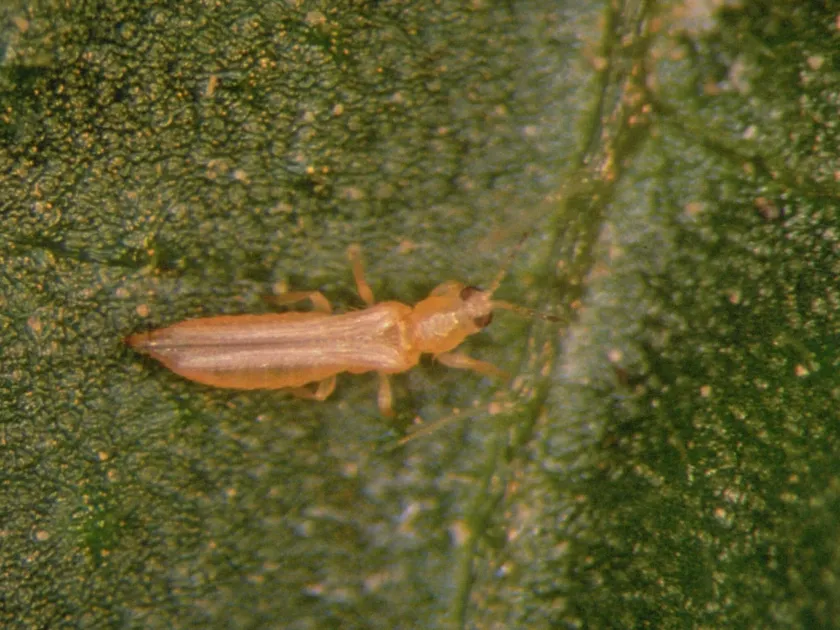
Citrus thrips (Scirtothrips aurantii) is a significant insect pest belonging to the order Thysanoptera and the family Thripidae. These are tiny insects with adults measuring approximately 1 mm in length.
The adult stage is characterized by a yellowish-orange body color. They possess narrow wings fringed with long hairs, which enable their movement and spread across the plantation.
Larvae closely resemble adults in form but are smaller and lack wings. Their developmental cycle consists of an egg stage, two larval instars, prepupa, pupa, and the final adult stage.
Environmental temperature is the primary driver of their life cycle. Under favorable conditions, the entire life cycle can be completed in just a few weeks, leading to rapid population expansion.
They prefer to dwell in sheltered areas such as leaf axils, flower buds, and succulent terminal shoots, where they feed on the delicate plant tissues.
What it damages
Citrus thrips primarily target citrus species, including oranges, lemons, and grapefruits, posing a serious threat to the citrus industry worldwide.
Beyond citrus, these pests are known to infest a broad range of other host plants, including tea, mango, grapevines, avocados, and various ornamental plants.
Damage occurs when both adults and larvae pierce the epidermis of young leaves, buds, and fruits to ingest cell contents, disrupting the plant's normal growth.
Feeding on young fruit causes characteristic silver-colored scarring on the peel. This superficial damage reduces the cosmetic quality of the fruit, making it unmarketable.
Heavy infestations on young shoots can lead to stunted growth, leaf curling, and premature leaf drop, which significantly impacts the overall health and yield of the tree.
When it appears
The presence and activity of citrus thrips are closely tied to the plant's vegetative cycle, specifically during periods of rapid shoot development and fruit set.
In warm climates, these insects can breed year-round, though their population peaks are typically associated with warmer temperatures and moderate humidity levels.
Temperatures above 20-25 degrees Celsius significantly accelerate their development, allowing them to complete more generations during a single growing season.
Spring is a critical period for monitoring because the emerging soft tissues and developing fruits are highly susceptible to the feeding habits of the thrips.
During periods of drought or unfavorable weather, they may hide deep within the canopy, remaining a persistent threat to the orchard's productivity.
Signs of infestation
Initial signs of infestation include silvery or grayish streaking on leaves, which may turn into necrotic spots as the tissue dies due to damage.
Developing fruits exhibit distinct ring-like or irregular silvery scars, which are a hallmark of citrus thrips feeding during the early stages of fruit expansion.
Shoots appear distorted, and leaves may become brittle, curled, and drop prematurely, indicating a high density of the pest within the canopy.
Detecting the insects visually is difficult due to their microscopic size, so yellow sticky traps are standard tools used for monitoring and identification purposes.
- Silvering and distortion of young leaf tissues.
- Presence of tiny black fecal spots on the underside of leaves.
- Visible scarring on the rind of citrus fruit affecting its market value.
Control measures
Effective management of citrus thrips requires an integrated approach that combines careful monitoring, cultural practices, and chemical intervention.
Regular monitoring using yellow sticky traps is essential to determine the timing of insecticide applications based on the pest's migration into the canopy.
Chemical control usually involves the rotation of systemic or contact insecticides to prevent the development of pesticide resistance in the thrips population.
Biological control, including the use of predatory mites and other natural enemies, can be highly effective in maintaining the pest at non-economic threshold levels.
Cultural methods, such as weed management in and around the orchard and ensuring proper irrigation, help to improve plant vigor and increase resilience to damage.
Taxonomy
- Latin name
- Scirtothrips aurantii
- Order
- Thrips
- Family
- Thripidae
- EPPO code
- SCITAU
Discussion
No discussions yet — be the first.