
Grey bud weevil
Sciaphobus squalidus
Description
How to identify
The Grey bud weevil (Sciaphobus squalidus) is a member of the Curculionidae family, known as a destructive pest for various fruit and ornamental tree species.
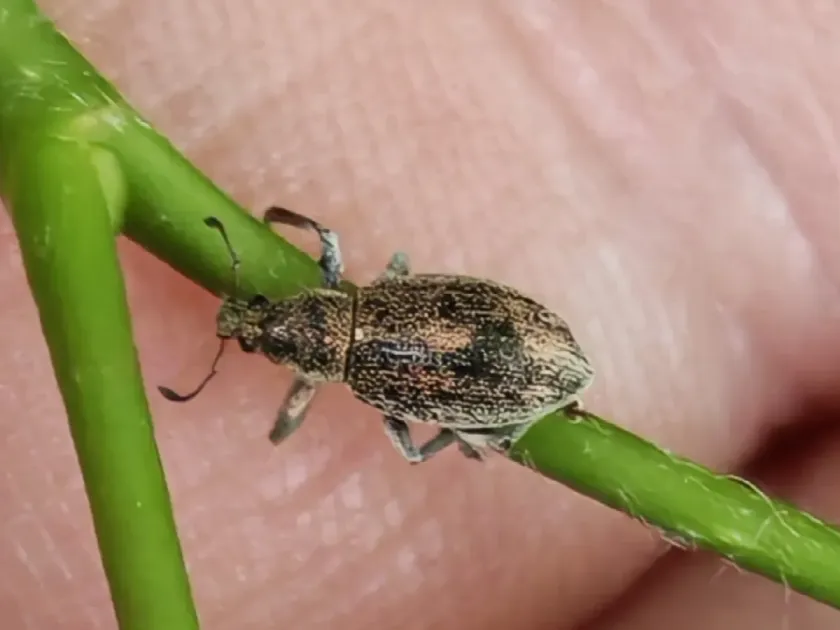
Adult weevils are small, measuring about 5 to 7 mm in length. Their bodies are covered with grey or brownish-grey scales, providing excellent camouflage against tree bark.
They are characterized by a short, broad snout. The larvae are legless, white-colored grubs that live within the soil profile, feeding primarily on the fine roots of host plants.
This species undergoes complete metamorphosis. Adults typically overwinter in the soil at depths of up to 20 cm, emerging in early spring when temperatures rise.
Both males and females are active during the budding season. The grey coloration makes them difficult to spot on twigs until they are disturbed or captured.
What it damages
These weevils target various fruit crops including apples, pears, cherries, and plums. They are particularly dangerous during the initial stages of tree awakening in spring.
Adult beetles feed voraciously on swelling and opening buds, often destroying them entirely, which leads to a direct reduction or total loss of the year's harvest.
In addition to destroying flower buds, the weevils feed on young leaves, creating irregular holes and ragged edges, which significantly weakens the tree's vigor.
Larval stages living in the soil feed on root systems, causing cumulative damage that reduces the plant's overall resilience to environmental stressors like drought.
Young orchards are especially susceptible to population outbreaks, which can severely stunt the development of new plantings if left unmanaged.
When it appears
Adult weevils emerge from the soil in early spring. This emergence is tightly linked to the phenological phase of the host trees, specifically the green bud stage.
The peak period of feeding activity occurs as temperatures stabilize, allowing the beetles to migrate from their wintering sites in the soil up the trunks into the canopy.
Morning observations reveal that beetles are less active early in the day and exhibit a defensive reaction of falling to the ground when touched or disturbed.
By late spring, as the trees finish blooming, the adult feeding activity tapers off as the insects migrate back toward the soil to lay eggs for the next generation.
The life cycle ensures that the most damaging stage occurs exactly when the trees are most vulnerable, requiring timely monitoring by orchard managers.
Signs of infestation
The primary symptom of infestation is the presence of hollowed-out or completely missing buds on the branches, indicating heavy feeding by adult beetles.
If you inspect the trees in the morning, you may find the weevils themselves hiding in bark crevices or attached to the remaining bud scales.
Young leaves showing irregular holes or notched edges are a clear sign of previous or ongoing feeding by the adults in the tree canopy.
A sudden decline in branch development or leaf cover can often be traced back to early-season damage caused by these insects to the primary growth buds.
- Buds that fail to sprout.
- Ragged and holey young leaves.
- Beetles falling when branches are shaken.
Control measures
Cultural control is essential, including regular cultivation of the soil under the canopy, which disrupts the development cycle of the larvae and overwintering adults.
Applying sticky bands around the trunks of trees acts as a physical barrier, preventing the flightless adults from crawling up to reach the susceptible buds.
Chemical control involving systemic or contact insecticides should be applied at the onset of bud development, targeting the insects before they cause significant damage.
Mechanical control, such as shaking the beetles onto sheets in the early morning, is a simple and effective method for small-scale orchards and hobbyists.
Integrated pest management strategies focusing on early detection and monitoring help minimize the need for heavy pesticide usage during the flowering season.
Taxonomy
- Latin name
- Sciaphobus squalidus
- Order
- Coleoptera (beetles)
- Family
- Curculionidae
- EPPO code
- SCPBSQ
Discussion
No discussions yet — be the first.