
Bamboo spider mite
Schizotetranychus bambusae
Description
How to identify
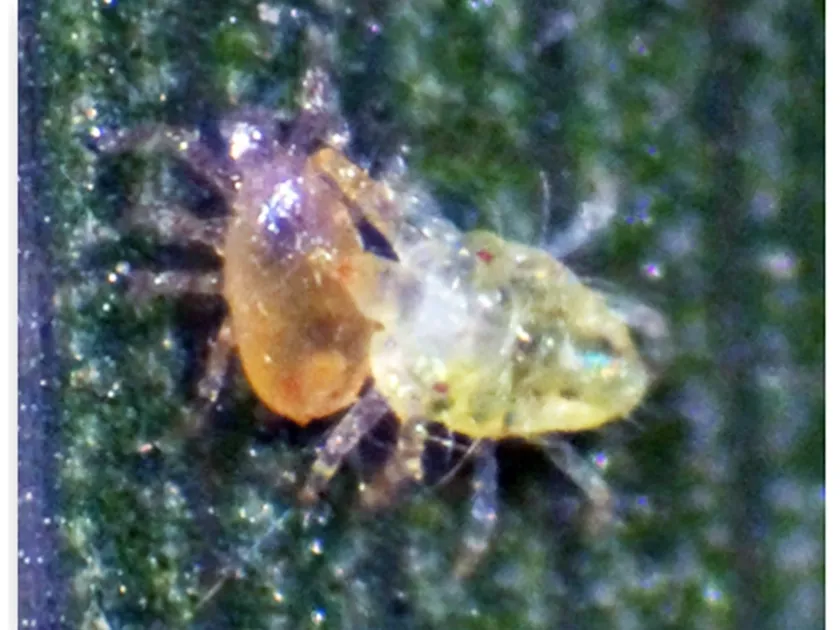
The bamboo spider mite (Schizotetranychus bambusae) is a member of the Tetranychidae family, specifically known for its tendency to create silk nests on bamboo leaves.
These microscopic arachnids are roughly 0.4 mm in length, featuring a yellowish-green body that makes them difficult to spot without magnification.
They are primarily found on the undersides of leaves, where they establish colonies protected by delicate webbing, which serves as a micro-environment for their life cycle.
The biological development from egg through larval and nymphal stages to adult takes approximately two weeks under optimal warm conditions.
Due to their high reproductive rate, a few individuals can grow into a massive colony within a short time, potentially overwhelming the host plant.
What it damages
This mite specifically targets various species within the Bambusoideae subfamily, using its mouthparts to pierce leaf cells and suck out chlorophyll-rich sap.
This persistent feeding results in the destruction of plant cells, leading to localized chlorosis and a decrease in the plant's overall photosynthetic efficiency.
As damage progresses, the leaves develop distinct pale spots, eventually turning yellow, drying out, and potentially falling off the stem prematurely.
Heavy infestations can lead to significant defoliation, which severely stresses the plant, stunts its growth, and makes it susceptible to opportunistic pathogens.
In ornamental settings, the loss of foliage density and the presence of webbing significantly reduce the aesthetic appeal of bamboo groves.
When it appears
The bamboo spider mite is most active during the spring and summer months, particularly when temperatures consistently exceed 22°C (72°F).
Hot, dry weather conditions provide the perfect environment for their population to explode, as low humidity hinders the natural predators and fungi that normally control mite levels.
Initial signs of activity usually appear after dry spells, when the plants themselves are already slightly stressed by the lack of moisture.
As temperatures drop in autumn, the mites begin to slow their reproductive cycle, though populations may persist in sheltered or greenhouse environments year-round.
Proactive monitoring during the peak growth season is essential for catching the infestation before it reaches critical thresholds.
Signs of infestation
Initial detection relies on observing tiny, pale-yellow or white stippling on the upper surfaces of the leaves, which corresponds to the feeding sites on the underside.
Closer inspection with a magnifying lens will reveal the fine silk webbing constructed along the veins of the leaf, housing clusters of mites and their eggs.
As the infestation continues, the leaves will appear dull, lose their natural sheen, and begin to curl or brown along the edges.
Heavy webbing may eventually become visible across the entire surface of the leaf if the population density is high enough.
- Fine, translucent webbing on the underside of leaves.
- Pin-prick white spots on the leaf surface.
- Gradual chlorosis and yellowing of the foliage.
- Leaf curling and premature leaf drop.
Control measures
Integrated Pest Management (IPM) is the most effective approach, starting with regular visual inspections and maintaining adequate irrigation for the plants.
Chemical control involving acaricides is highly effective; however, products must be applied thoroughly to the undersides of the leaves to reach the colonies.
Biological control agents, such as the predatory mite Phytoseiulus persimilis, can be introduced to manage and suppress mite populations naturally.
Increasing the humidity levels around the bamboo plants through misting can help create conditions that are less favourable for spider mite proliferation.
Pruning and disposing of heavily infested foliage helps reduce the mite population, preventing the spread to healthier parts of the plant or neighboring groves.
Taxonomy
- Latin name
- Schizotetranychus bambusae
- Order
- Mites
- Family
- Tetranychidae
- EPPO code
- SCZTBM
Discussion
No discussions yet — be the first.