
Lesser grain borer
Rhyzopertha dominica
Description
How to identify
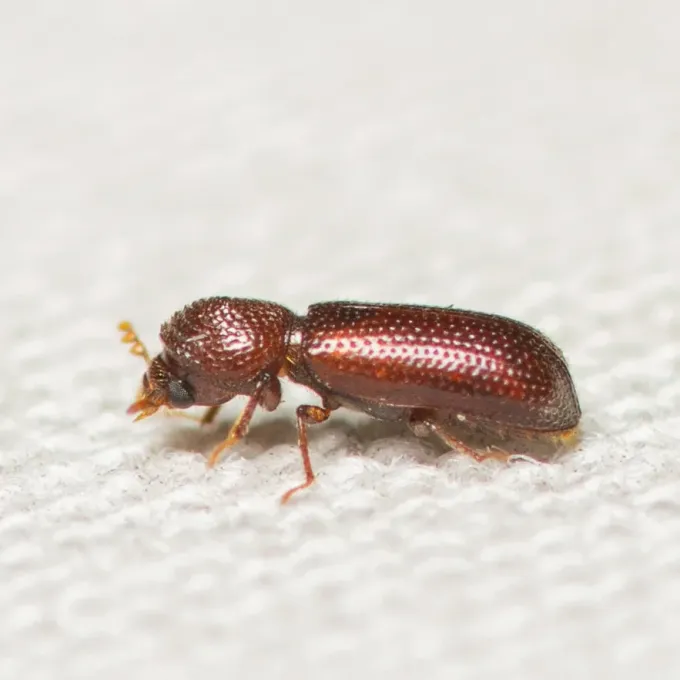
The Lesser grain borer (Rhyzopertha dominica) belongs to the Bostrichidae family (auger beetles). It is a small insect, measuring approximately 2.2–3 mm in length, with a cylindrical body that is dark brown or black in color.
The head is positioned ventrally and is concealed by the prothorax, which gives it a hood-like appearance with small teeth along the front edge. The elytra display distinct rows of punctures, contributing to its rough surface texture.
The life cycle involves several larval stages. Newly hatched larvae are active and have functional legs, but later instars are C-shaped, stout, and covered in hairs, adapted for living inside the grain kernel.
These beetles are highly heat-tolerant and flourish in stored environments with temperatures between 30–35°C. Adults are strong fliers, which enables them to spread rapidly throughout grain storage facilities and grain elevators.
Development is highly dependent on environmental conditions. Under optimal temperatures and sufficient moisture, the life cycle from egg to adult can be completed in less than a month, leading to rapid population explosions.
What it damages
The Lesser grain borer is a primary pest, meaning it is capable of attacking sound, undamaged grain. Both the adult beetles and the larvae are responsible for destroying the internal content of the kernels.
They commonly infest a wide variety of commodities including wheat, corn, barley, rice, sorghum, and millet. In some cases, they may also damage processed foods such as dried pasta or flour-based products.
The feeding activity creates large quantities of fine, powdery dust mixed with frass. This significantly reduces the quality, nutritional value, and market weight of the grain, rendering it unsuitable for food processing.
Infested grain becomes highly susceptible to subsequent colonization by secondary pests, as well as fungal infections. This often leads to grain heating and significant quality degradation across the entire storage bin.
The economic impact involves not only the loss of mass but also the necessity of costly fumigation treatments and the loss of commercial grade due to the presence of live insects and debris.
Signs of infestation
A primary indicator of an infestation is the presence of fine, floury dust (frass) visible on the surface of the grain mass, which is a byproduct of the feeding behavior of the larvae and adults.
A distinct, sweet, and musty odor is often associated with heavy infestations, serving as a warning sign for facility managers to inspect the stored stock immediately.
Temperature monitoring often reveals localized "hot spots" within the grain mass, caused by the metabolic activity of the insect population, which is a classic symptom of a severe infestation.
Adult beetles may be observed crawling on the grain surface, particularly during the dusk or night hours, confirming that an active population is present and moving within the silo.
Laboratory testing of grain samples typically reveals adult exit holes in the kernels, which are circular and clean, and may uncover internal larvae or pupae hidden deep within the grain structure.
Control measures
Effective management begins with temperature control; cooling the grain below 12°C significantly slows down the reproductive rate and development of the Lesser grain borer population.
Sanitation is critical in preventing infestations. Regularly cleaning bins, conveyers, and grain handling equipment prevents the accumulation of residual grain that serves as a breeding ground for these pests.
When an infestation is detected, fumigation with phosphine-based chemicals is the standard professional method, as it effectively penetrates the grain kernel to eliminate all life stages of the insect.
Empty storage facilities should be treated with residual contact insecticides before new grain is received to create a protective barrier against potential infestations.
- Regular moisture monitoring to keep levels low.
- Deployment of pheromone traps to monitor adult beetle movement.
- Maintaining proper facility hygiene to eliminate secondary food sources.
Taxonomy
- Latin name
- Rhyzopertha dominica
- Order
- Coleoptera (beetles)
- Family
- Bostrichidae
- EPPO code
- RHITDO
Discussion
No discussions yet — be the first.