
Soybean stem weevil
Rhyssomatus subtilis
Description
How to identify
The Rhyssomatus subtilis, known as the soybean stem weevil, belongs to the Curculionidae family. It is a small but highly destructive beetle capable of causing significant yield losses in soybean fields.
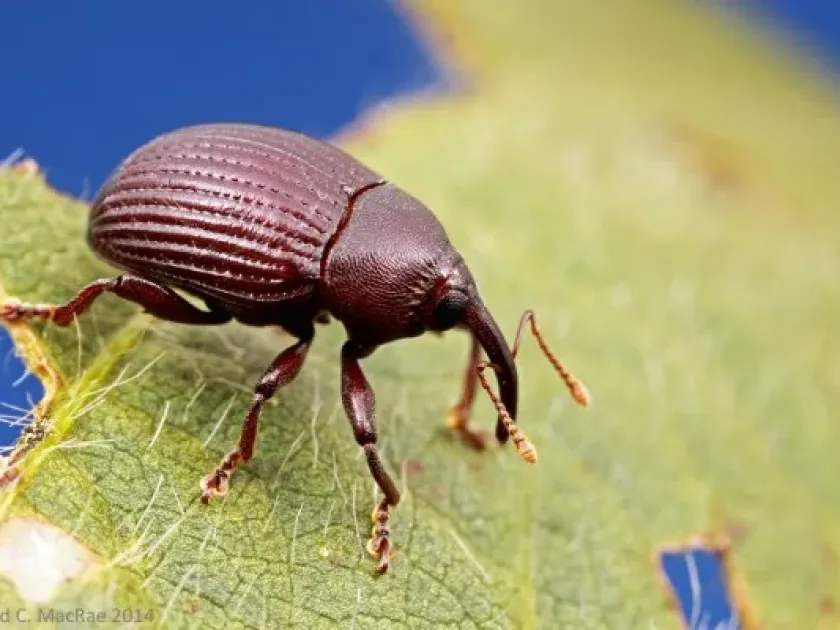
The adult beetle typically measures 4–6 mm in length. Its body is dark brown, often covered with fine scales, and it features the characteristic elongated snout common to all members of this family.
Larvae are legless, cream-colored, and possess a distinct dark head capsule. They spend their entire developmental period hidden deep within the stem tissues of the host plant.
The pupal stage generally occurs in the soil or protected niches of plant residues. From here, the adult emerges to seek out new soybean plants for feeding and oviposition.
Identification in the field requires a careful search, particularly during the early vegetative stages of soybean, as the adults are active and prone to flight.
What it damages
Soybean is the primary host for this pest. The damage is twofold, involving both adults feeding on foliage and larvae developing internally within the stems.
Adult beetles feed on leaves, leaf stalks, and growing tips, causing small perforations. While this damage is rarely fatal, it weakens the plant and reduces its overall vigor.
The most severe impact comes from the larvae, which tunnel through the interior of the stems, disrupting the vascular system and hindering nutrient and water transport.
Compromised stem structure leads to increased susceptibility to lodging. High winds or rain can easily topple heavily infested plants, making harvesting operations extremely difficult.
Significant infestations lead to reduced pod set, smaller bean size, and overall lower seed quality, which can cause substantial economic losses for farmers.
When it appears
Adults emerge from overwintering sites in the soil or crop debris at the start of the growing season, coinciding with the emergence of soybean seedlings.
The most critical periods for infestation are the branching and flowering phases, during which females actively seek out healthy stems for egg-laying.
Larval development occurs throughout the summer months. The speed of this process is heavily influenced by ambient temperature and soil moisture levels.
By late summer and early autumn, the new generation of adults completes development, exits the stems, and prepares for diapause to survive the winter.
Understanding these seasonal patterns is essential for planning scouting missions and applying insecticides at the most vulnerable stage of the pest's life cycle.
Signs of infestation
Early signs of infestation include small, clustered punctures on the leaves and petioles caused by adult feeding, indicating a need for intensive crop monitoring.
Darkened spots or slight swelling on the stem surface are clear indicators where females have oviposited. These areas are the entry points for the emerging larvae.
Internal examination of the stem often reveals frass-filled tunnels. The presence of these tunnels is a definitive sign of larval activity and stem tissue destruction.
Premature wilting of the upper part of the plant during dry periods is a symptom that the vascular integrity of the stem has been compromised.
Patches of lodged, broken plants scattered throughout the field are a late-season confirmation that the soybean stem weevil has had a significant impact.
Control measures
Cultural practices form the foundation of control. Implementing a robust crop rotation strategy is effective in breaking the life cycle of the weevil in infested fields.
Deep autumn plowing is a highly recommended practice, as it exposes overwintering pupae and adults to harsh weather and predators, significantly reducing populations.
Maintaining clean fields by removing wild host plants and cleaning up crop residues after harvest deprives the weevil of critical survival resources.
Chemical control focuses on the use of systemic insecticides, applied during the initial adult flight period to prevent egg-laying and minimize larval establishment.
- Using high-quality insecticidal seed treatments.
- Regular scouting using sweep nets to estimate adult population density.
- Fostering populations of natural predators to provide biological suppression.
Taxonomy
- Latin name
- Rhyssomatus subtilis
- Order
- Coleoptera (beetles)
- Family
- Curculionidae
- EPPO code
- RHSMSU
Discussion
No discussions yet — be the first.