
Rhysodes
Rhysodes
Description
How to identify
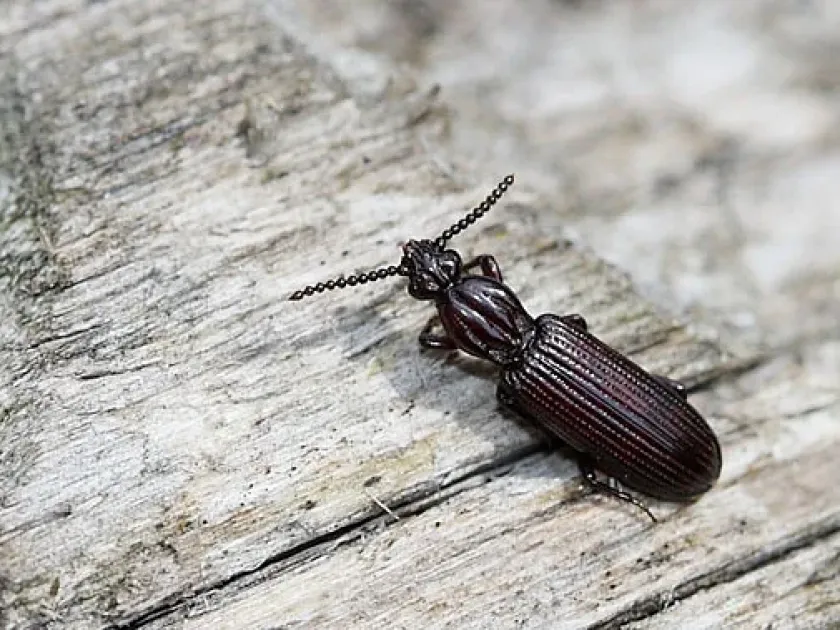
Rhysodes is a genus of beetles belonging to the family Rhysodidae, characterized by their distinct elongated bodies and deep grooves on the pronotum and elytra.
These beetles are relatively small, usually reaching 6–8 mm in length, with a heavily sclerotized and dark-colored exoskeleton that provides protection in tight environments.
Their head structure is specialized for boring through wood, featuring strong mandibles that allow them to move efficiently through decaying timber.
Larvae have a cylindrical body adapted for life within wood, where they feed on moistened fibers and remain protected from external environmental factors.
Unlike many other wood-boring species, they are highly specialized, often found in habitats where wood is already undergoing fungal decomposition.
What it damages
Rhysodes primarily attacks deciduous trees, especially logs and stumps that are in an advanced state of decay and have high moisture content.
While they are not typically considered primary pests of healthy living trees, their boring activity significantly accelerates the breakdown of woody materials.
In a forestry context, they can lower the quality of lumber by creating extensive internal tunnel networks, which reduces the structural integrity and market value of the timber.
Their presence is often an indicator of poorly managed forest stands where excessive debris or rotting logs have been left to accumulate.
The tunnels created by larvae allow moisture and pathogens to penetrate deeper into the wood, facilitating even faster decomposition of the organic matter.
When it appears
Adult activity usually peaks during the warmer months, as the insects emerge to seek new breeding sites and expand their colonizing reach.
The life cycle is lengthy, as the consumption of hard, decomposing wood is a slow metabolic process requiring sustained temperatures for development.
During the winter, both adults and larvae remain sheltered deep within the wood, utilizing the thermal mass of the decaying logs to survive cold conditions.
Springtime brings increased metabolic activity, leading to the emergence of the next generation and the expansion of the population in suitable forest areas.
Population density is highly dependent on the availability of suitable woody substrates throughout the year, which dictates their distribution in the forest.
Signs of infestation
The presence of Rhysodes is indicated by small, circular exit holes on the surface of bark or wood, which mark where the mature beetles have emerged.
Interior damage is characterized by winding tunnels filled with frass, which consists of wood particles mixed with larval excrement.
Localized softening or discoloration of the wood surface is a common sign of infestation, often accompanied by the growth of specialized wood-rotting fungi.
Exposing the inner layers of rotting logs often reveals the adult beetles, which are usually found in clusters near the feeding galleries.
An accumulation of fine wood dust at the base of trees or logs can serve as a primary indicator that wood-boring insects are active within the material.
Control measures
Effective management focuses on forest hygiene, particularly the removal of downed logs and woody debris that serve as the primary habitat for the beetles.
Implementing regular sanitary thinning and clearing of infested forest residues helps reduce the overall pressure of the pest in high-value stands.
Biological control through the preservation of natural predators and parasitoids is essential for maintaining a healthy balance in the ecosystem.
Monitoring programs that track the volume of decaying wood allow foresters to predict potential increases in pest populations and act proactively.
In cases of severe infestation in timber stocks, prompt processing or kiln-drying of wood is the most effective method to eliminate all stages of the insect life cycle.
Taxonomy
- Latin name
- Rhysodes
- Order
- Coleoptera (beetles)
- Family
- Rhysodidae
- EPPO code
- RHSOSP
Discussion
No discussions yet — be the first.