
Blood-legged flea weevil
Rhynchaenus sanguinipes
Description
How to identify
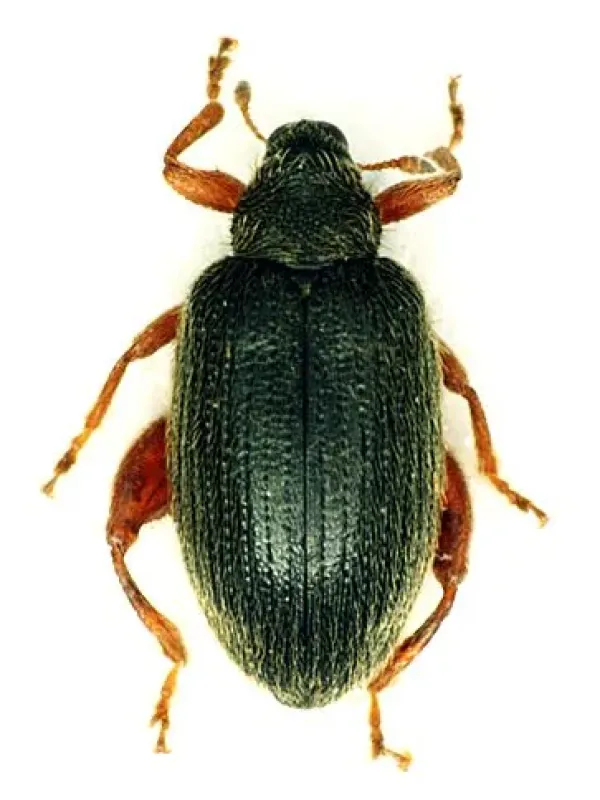
The blood-legged flea weevil (Rhynchaenus sanguinipes) belongs to the Curculionidae family of the Coleoptera order. These small beetles are characterized by enlarged hind femora, which grant them the ability to jump rapidly when threatened, a common trait among flea weevils.
Adult beetles have distinctively colored legs, which serves as the primary feature for their identification. Their bodies are compact and robust, allowing them to remain well-hidden within the foliage or bark crevices of their host plants during the day.
Larvae are legless, white to cream-colored, and typically develop within the host tissue. This endophytophagous lifestyle provides them with both nutrition and protection against predators and harsh environmental conditions.
The life cycle is synchronized with the phenology of their host plants. Females lay eggs inside the leaf tissues or shoots, ensuring that larvae can immediately start feeding upon hatching, which facilitates quick development during the growing season.
Adults overwinter in protected areas, such as leaf litter, soil crevices, or under tree bark. As temperatures rise in spring, they emerge to commence feeding and mating, marking the beginning of the new generation cycle.
What it damages
This pest causes damage to a variety of woody and herbaceous plants. The most significant damage occurs during the peak vegetative stage, when the plant is actively producing new, nutrient-rich tissue.
Adult beetles feed on leaves, creating numerous small, circular holes. This process reduces the photosynthetic capacity of the plant and causes a general weakening of the host organism over time.
Larval feeding, which creates "mines" or internal tunnels in the leaves, is more damaging than adult feeding. These tunnels destroy the vascular tissue, leading to leaf distortion, chlorosis, and premature senescence.
High population densities can cause severe defoliation, which is particularly detrimental to young nursery stock and seedlings. The loss of foliage reduces the plant's ability to store energy for subsequent growth seasons.
Additionally, the feeding sites serve as entry points for pathogens. Fungal and bacterial infections often exploit the damaged leaf surfaces, leading to secondary plant diseases that further compromise the plant's health.
Signs of infestation
The first sign of an infestation is the appearance of small, irregular holes or "shot-holes" scattered across the leaf surface. These holes may become brittle and turn brown as the surrounding tissue dries out.
Mining patterns, visible as winding, light-colored, or translucent tracks within the leaf lamina, are clear indicators of larval activity. Inspection under light often reveals the presence of the larva within the mine.
Leaf curling, twisting, or stunted development of new shoots is frequently observed in heavily infested areas. These symptoms are caused by the disruption of normal nutrient transport pathways by mining larvae.
Adult beetles can be detected by gently shaking the branches over a white surface. Their instinct to jump or drop to the ground makes them easily visible when disturbed by such movements.
General yellowing of leaves or premature leaf drop during the peak summer months is a strong indicator of a significant pest pressure that requires management intervention.
Control measures
Effective management of the blood-legged flea weevil involves a combination of cultural, biological, and chemical methods. Proactive monitoring is essential to avoid reaching economic injury levels.
Cultural practices, such as clearing leaf litter and soil cultivation under trees, can significantly reduce the overwintering population. Disruption of these habitats is a highly recommended preventive step.
Chemical control should be applied during the period of peak adult activity, particularly after the overwintered adults have emerged. Systemic insecticides are often preferred to target both adults and developing larvae within the leaves.
- Deployment of yellow sticky traps to monitor adult population levels.
- Sanitation by removing and destroying heavily infested plant parts.
- Encouraging natural predators such as parasitic wasps and predatory beetles.
- Utilizing biological control agents, including entomopathogenic fungi.
An Integrated Pest Management (IPM) approach is recommended, alternating insecticide classes to prevent resistance. Consistent field scouting ensures that control measures are implemented precisely when they are most effective.
Taxonomy
- Latin name
- Rhynchaenus sanguinipes
- Order
- Coleoptera (beetles)
- Family
- Curculionidae
- EPPO code
- RHYHSG
Discussion
No discussions yet — be the first.