
Willow leaf weevil
Rhynchaenus salicis
Description
How to identify
The willow leaf weevil (Rhynchaenus salicis) is a small beetle belonging to the Curculionidae family. Adults typically measure between 2 and 3 mm in length and possess characteristic enlarged hind femurs designed for jumping.
The body is generally dark or black, often covered with fine hairs, and equipped with a snout-like head structure (rostrum) typical of the weevil family, which they use to feed and lay eggs.
Larvae are legless, white, and specialized for mining inside the leaf tissue. They are rarely seen unless the leaf cuticle is peeled away to expose their feeding tunnels.
Pupation occurs within a specialized chamber formed inside the leaf. These pupal cells provide a degree of protection against environmental conditions and minor predators.
This species is highly host-specific, primarily affecting members of the Salix genus, making willow plantations and ornamental willow shrubs their main habitat.
What it damages
Both adults and larvae contribute to plant damage. Adult weevils feed by chewing small, circular holes in the leaves, which causes localized damage to the epidermis and disrupts the leaf's structure.
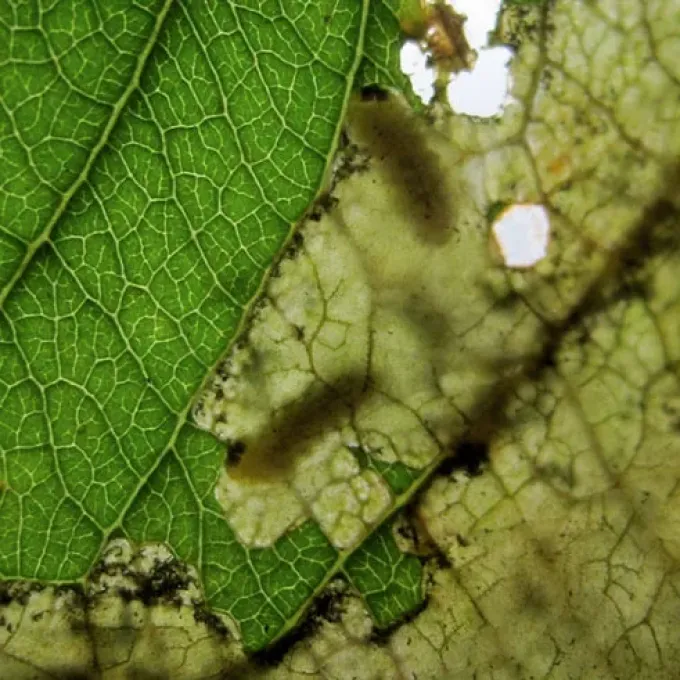
The primary damage is caused by the mining larvae. As they tunnel through the leaf parenchyma, they create conspicuous blotch-shaped mines that eventually turn brown and necrotic, severely impacting the tree's photosynthetic capability.
Heavy infestations lead to premature leaf drop, which significantly weakens the trees. This stress reduces the overall vigor of the willow, making it susceptible to secondary stressors like drought or diseases.
In ornamental settings, the aesthetic value of the willow is compromised as the leaves become disfigured, discolored, and sparse during the summer season.
Repeated annual attacks can hinder growth rates and may lead to dieback in twigs, especially in young or sensitive willow varieties that lack the resources to recover quickly.
When it appears
The life cycle begins in early spring when adult weevils emerge from their overwintering sites, such as leaf litter, bark crevices, or soil debris, to feed on newly budding willow leaves.
Following mating, females deposit eggs into the leaf tissues. The larval stage follows, with development completed during the warm months, typically from late spring into mid-summer.
New adults emerge during the summer. Depending on local climatic conditions, the willow leaf weevil may complete one or even two generations per year, prolonging the threat to the trees.
As temperatures begin to drop in late summer and autumn, the adult beetles seek shelter for hibernation. They enter a period of diapause until the following spring.
Monitoring efforts should be most intense during the late spring and early summer, which corresponds to the peak larval activity period and when damage becomes most visible.
Signs of infestation
Early symptoms include small, needle-like punctures on the surface of young leaves, caused by the adult weevils' initial feeding activity after emergence.
As the season progresses, the characteristic leaf mines become prominent. These appear as irregular light-colored patches on the leaf surface, often showing dark trails of larval excrement within the mine.
Affected leaves often exhibit curling, shriveling, or premature yellowing as the mining tunnels cause significant tissue disruption and loss of plant vitality.
Close inspection of the underside of the leaves or holding the leaf against light often reveals the presence of larvae inside the mines, confirming the infestation.
Abundant leaf fall under the willow canopy during the mid-summer period is a strong indicator of a severe infestation that warrants immediate management attention.
Control measures
Cultural control is a cornerstone of management, involving the rigorous removal and destruction of fallen leaves in autumn, which eliminates potential overwintering sites for the adult beetles.
Chemical control may be necessary in case of heavy infestation. Systemic insecticides are generally the most effective, as they are absorbed into the leaf tissues, reaching the larvae protected within the mines.
Proper timing is essential; insecticide applications should ideally target the adults upon emergence in spring before they have the opportunity to lay eggs.
Maintaining the health of the host tree through adequate watering and balanced fertilization can help trees better tolerate the leaf damage and recover faster.
- Monitor tree crowns regularly from spring to mid-summer.
- Use systemic insecticides for severe pest outbreaks.
- Sanitize the area by collecting and destroying leaf litter.
- Promote the presence of natural predators in the garden environment.
Taxonomy
- Latin name
- Rhynchaenus salicis
- Order
- Coleoptera (beetles)
- Family
- Curculionidae
- EPPO code
- RHYHSL
Discussion
No discussions yet — be the first.