
Rusty-legged flea weevil
Rhynchaenus rufipes
Description
How to identify
The Rusty-legged flea weevil (Rhynchaenus rufipes) belongs to the Curculionidae family, which is known for its wide range of plant-feeding beetles.
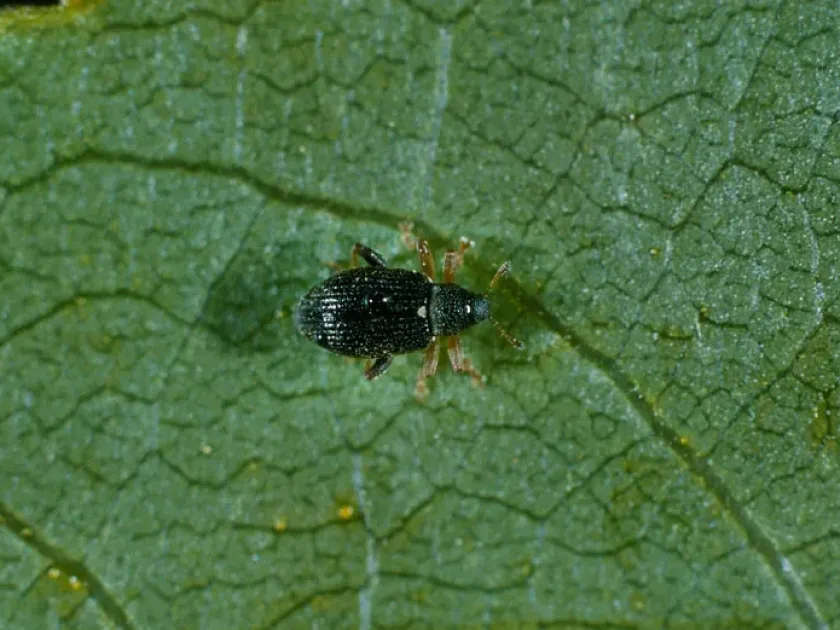
This beetle is physically distinguished by its dark, almost black body and its contrasting, rusty-brown legs and antennae, which are its primary identifier.
True to its common name, it possesses enlarged hind legs that allow the beetle to jump quickly when disturbed, a trait typical of flea weevils.
The larvae are small, legless, and have a fleshy appearance, often found residing within the leaf parenchyma where they remain hidden from predators.
Adult beetles are typically 2 to 3 mm long and have a robust, chitinous exoskeleton that provides significant protection against environmental stressors.
What it damages
This pest is primarily associated with plants of the Rosaceae family, causing considerable damage to various fruit-bearing trees.
Apples, pears, cherries, and plums are the most frequently infested crops, leading to both aesthetic damage and physiological stress on the trees.
Adults feed on the leaf surface, creating small, pin-like holes that inhibit the leaf’s ability to conduct photosynthesis efficiently.
The larvae are internal feeders, mining between the leaf layers, which creates unsightly brown patches and tunnels that reduce the overall health of the tree.
Severe infestations can lead to premature leaf drop, which significantly depletes the tree's energy reserves before it enters the dormancy period.
When it appears
These weevils overwinter as adults in protected environments, such as leaf litter, bark crevices, or the top layer of soil near the base of the trees.
Activity begins in the early spring, as temperatures rise and the trees start to push out new growth and buds, providing a vital food source.
Egg-laying occurs as the leaves develop, with larvae hatching to feed immediately within the leaf tissue, continuing their growth through the late spring.
The total life cycle is relatively rapid, allowing for multiple overlapping generations in warmer climates, extending the damage season into mid-summer.
As autumn approaches, adult weevils cease feeding and move to their hibernation sites to prepare for the winter months.
Signs of infestation
The most prominent sign of an infestation is the appearance of small, round, holes scattered across the leaf surface, often resembling a sieve.
Discoloration and yellowing of the foliage are common, as the damaged areas dry out and die due to the destruction of the underlying leaf tissue.
If you observe closely, you can detect serpentine tunnels or blotch mines inside the leaves, indicating the presence of active larvae.
Beetles are easily spotted when shaking branches, as they tend to jump away, allowing growers to quickly assess population density.
- Pin-hole damage on young leaves.
- Brown, withered leaf sections.
- Visible larval mines within the leaf blade.
- Reduced foliage density in the tree canopy.
Control measures
Cultural control is essential, focusing on the removal and destruction of fallen leaves and organic debris from the orchard floor.
Tilling the soil around the base of the trees in late autumn disrupts the overwintering sites and can significantly reduce the overwintering adult population.
Insecticide applications should be timed carefully, typically during the pre-bloom stage, to target adults before they lay eggs on the leaves.
Using integrated pest management (IPM) practices, such as pheromone monitoring, helps in determining the precise timing for chemical or biological interventions.
In cases of high infestation, localized spraying with approved systemic or contact insecticides is recommended to protect the tree's health during the critical growing phase.
Taxonomy
- Latin name
- Rhynchaenus rufipes
- Order
- Coleoptera (beetles)
- Family
- Curculionidae
- EPPO code
- RHYHRU
Discussion
No discussions yet — be the first.