
Poplar leaf mining weevil
Rhynchaenus populicola
Description
How to identify
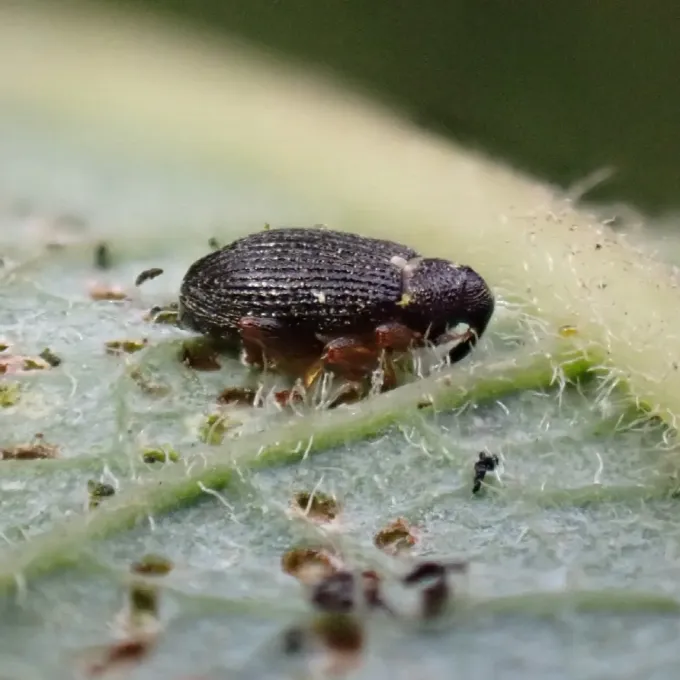
The Poplar leaf mining weevil (Rhynchaenus populicola) belongs to the order Coleoptera and the family Curculionidae. It is a tiny beetle characterized by its jumping hind legs, similar to flea beetles.
Adult beetles are generally 2–3 mm long, with a dark, often blackish body that may exhibit a subtle metallic luster. Their small size makes them difficult to spot against the textured bark of host trees.
The larvae are legless, cream-colored, and specialized for life within the leaf blade. They dwell between the upper and lower epidermis of the leaves, where they consume the internal tissues.
Adults are highly mobile and will jump or fly away when disturbed, which is a key behavioral trait useful for field identification during inspections of host foliage.
These insects overwinter as adults, seeking shelter in bark crevices, under forest litter, or in the upper soil layers, remaining dormant until temperatures rise in the spring.
What it damages
The primary hosts of this species are various poplar trees (Populus spp.), including black poplar, Canadian poplar, and pyramidal poplar, which are common in urban landscaping.
While poplar is the preferred host, the beetle may occasionally infest willow species if they are located near highly infested poplar stands, though damage is usually less severe.
The primary damage is caused by the larval stage, which mines the leaves. By consuming the leaf parenchyma, the larvae impair the tree's photosynthesis and overall physiological health.
Severe infestations can lead to widespread leaf browning, curling, and premature leaf drop, which significantly weakens the trees and makes them more susceptible to secondary stressors.
Beyond tree health, the aesthetic impact is significant, particularly in parks and along avenues where the ornamental value of the poplars is a primary management goal.
When it appears
Emergence from overwintering sites occurs in early spring, synchronized with the budding and initial leaf expansion of the poplar trees, providing food for the hungry adults.
After a period of maturation feeding, the beetles mate and females deposit eggs into the leaf tissue, usually near the midrib or major veins for optimal larval access.
The larval stage spans several weeks. As the larvae grow, they expand their mines, creating distinct blotches or winding tunnels that increase in size as the insect matures.
A second generation of adults typically emerges in early to mid-summer, causing a secondary wave of feeding damage that can be quite noticeable on the canopy.
As autumn approaches and temperatures drop, adults enter their overwintering phase, moving from the canopy to their sheltered winter habitats to survive the cold months.
Signs of infestation
Initial signs include small, circular feeding holes on the leaf surface caused by adult beetles grazing on the foliage during the spring.
The most diagnostic sign is the presence of mines. These appear as irregular, pale or brownish blotches where the leaf internal tissue has been hollowed out, leaving the skin intact.
Over time, the affected leaf tissue within the mines may wither and turn brittle, often tearing and leaving holes that can be mistaken for symptoms of fungal pathogens.
Large-scale browning of the crown in mid-summer is a clear indicator that the population density of the weevil has reached a level requiring immediate management action.
Inspecting the mines closely can reveal the presence of the larvae or their fine, dark excrement, which confirms the activity of the leaf mining weevil.
Control measures
The most effective cultural practice is the thorough collection and destruction of fallen leaves in autumn, as these harbor the overwintering population of the weevil.
For high-value ornamental trees, systemic insecticides can be applied early in the season to prevent the larvae from establishing mines within the leaf tissue.
Maintaining tree vigor through proper watering and fertilization helps the trees withstand the stress caused by the mining activity and promotes faster recovery after infestation.
Encouraging natural predators such as parasitic wasps and predatory beetles can help naturally suppress weevil populations in non-urban or integrated management areas.
- Monitor canopy health from late spring through early summer.
- Apply targeted insecticides only when infestation thresholds are exceeded.
- Prune and dispose of heavily infested branches to reduce local population pressure.
Taxonomy
- Latin name
- Rhynchaenus populicola
- Order
- Coleoptera (beetles)
- Family
- Curculionidae
- EPPO code
- RHYHPP
Discussion
No discussions yet — be the first.