
Apple flea weevil
Rhynchaenus pallicornis
Description
How to identify
The apple flea weevil, scientifically known as Rhynchaenus pallicornis, is a small beetle belonging to the Curculionidae family, often categorized as a significant orchard pest.
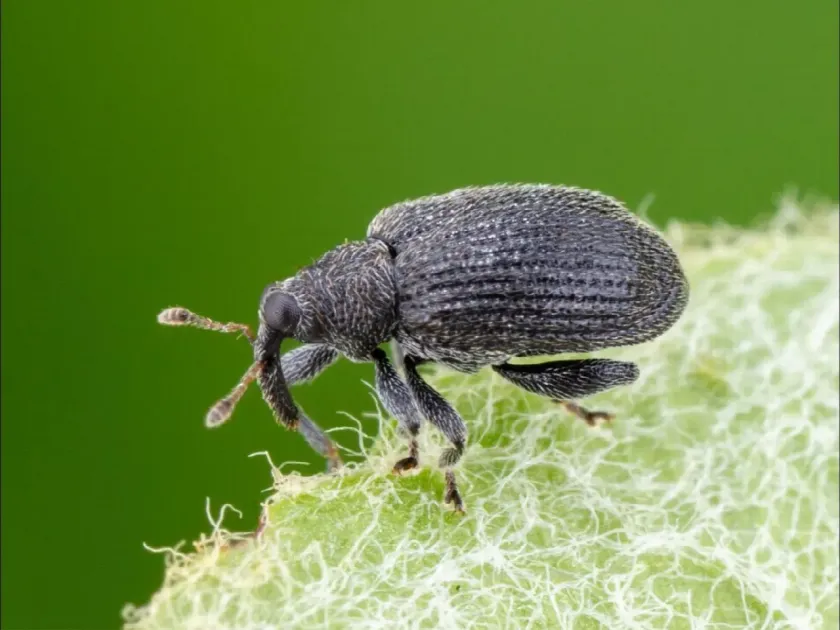
Adult beetles are tiny, measuring approximately 2.5–3 millimeters in length, and are usually dark brown or black in color with a hard, punctate exoskeleton.
They possess enlarged hind femora, which allow them to jump significant distances, a trait similar to flea beetles, hence the common name.
The larvae are small, legless grubs that develop within the leaf tissue, creating distinctive mines that compromise the health of the foliage.
Identification in the field is often confirmed by observing their jumping behavior when disturbed on the leaves or branches of apple trees.
What it damages
This pest primarily attacks apple trees, but it is also known to infest pear trees, hawthorn, and other related rosaceous plants in orchard settings.
Adults feed on the surface of leaves, creating small, circular holes, which can be numerous enough to reduce the photosynthetic capacity of the tree.
The larvae are the most damaging stage, as they tunnel through the leaf tissue, creating mines that result in the necrosis of leaf sections.
In nurseries, high infestations can stunt the growth of young trees, making them less marketable and more susceptible to other environmental stresses.
While the apple flea weevil rarely kills mature trees, the cumulative damage leads to yield reduction and weakened overall tree vigor.
When it appears
The apple flea weevil overwinters as an adult under bark scales, in leaf litter, or in the top layer of soil beneath host trees.
Activity begins in early spring, as temperatures rise, typically coinciding with the green tip or bud burst stage of apple tree development.
The female weevils lay eggs individually into the leaf tissue, starting in spring, which leads to the hatching of larvae that feed throughout late spring.
The larval stage lasts for several weeks, followed by pupation inside the leaf mine, resulting in the emergence of new adults by mid-summer.
A second generation may sometimes occur in warmer climates, extending the damage period until the adults move to their overwintering sites in autumn.
Signs of infestation
Early season damage manifests as small, shot-hole punctures on the unfolding buds and young leaves, caused by overwintering adult feeding.
Later in the season, the primary sign of infestation is the presence of brown, blotchy mines on the leaves, where the larvae have consumed the inner tissue.
Leaves that are heavily infested with larval mines tend to curl, turn yellow, and eventually drop prematurely, leading to canopy thinning.
Inspecting the underside of damaged leaves often reveals the larvae or the empty exit holes through which the adults emerged after pupation.
The presence of jumping beetles when shaking branches is a clear behavioral sign that the adult population is active and feeding in the orchard.
Control measures
Sanitation is a critical component of control; raking and destroying fallen leaves in autumn reduces the availability of overwintering sites.
Tillage and soil cultivation around the base of trees in the late autumn or early spring can disrupt the overwintering population and decrease emergence.
Chemical control focuses on timely applications of insecticides during the early stages of bud development to target overwintering adults before egg-laying.
- Targeted application of pyrethroids or systemic insecticides during the pre-bloom stage.
- Monitoring adult activity to ensure that control measures are applied at the peak of migration.
- Encouraging natural predators such as parasitic wasps and predatory beetles that keep populations in balance.
Integrated Pest Management (IPM) strategies, including the use of sticky traps and pheromone monitoring, can help determine if chemical intervention is necessary.
Taxonomy
- Latin name
- Rhynchaenus pallicornis
- Order
- Coleoptera (beetles)
- Family
- Curculionidae
- EPPO code
- RHYHPA
Discussion
No discussions yet — be the first.