
Beech leaf-mining weevil
Rhynchaenus fagi
Description
How to identify
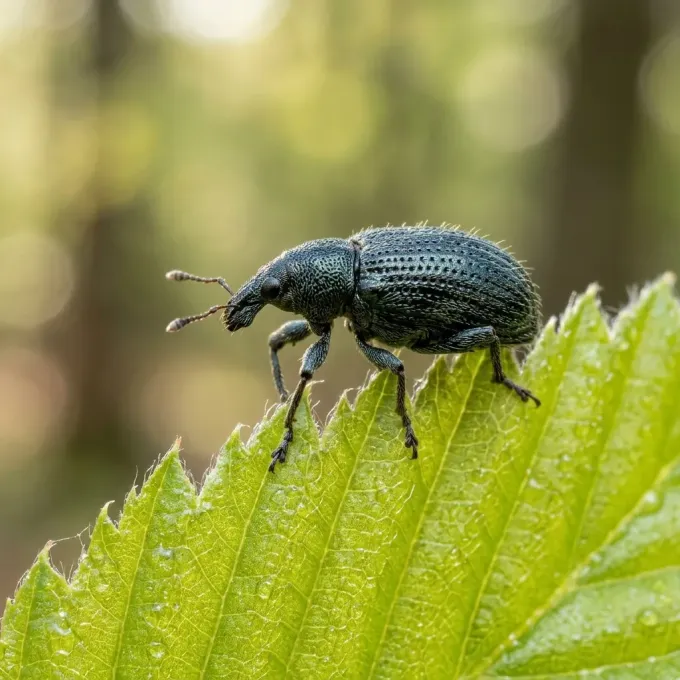
The beech leaf-mining weevil (Rhynchaenus fagi) is a small beetle belonging to the Curculionidae family. It is a specialized pest that exclusively targets beech trees (Fagus species).
Adult beetles are approximately 2–3 mm long, black in color, and possess enlarged hind femora, which allow them to jump effectively when disturbed. This characteristic makes them difficult to capture or observe.
The larvae are legless, white, and specialized for living within the leaf tissue. Their development is synchronized with the growth stages of the host tree's leaves.
Adults overwinter in the leaf litter, bark crevices, or nearby coniferous vegetation. As spring arrives, they emerge to feed on the developing buds and young leaves of the beech trees.
The species is widespread throughout Europe and can become a significant problem in regions where beech forests are dense or where environmental conditions favor its rapid reproduction.
What it damages
Damage is caused by both adults and larvae. Adult beetles feed on young leaves by chewing small holes, which leads to the characteristic "shot-hole" appearance on the foliage.
The primary damage, however, is caused by the larvae, which create extensive mines inside the leaf blades. By eating the internal parenchyma tissue, they significantly reduce the leaf's photosynthetic capacity.
As the larvae grow, the mines expand, causing the affected areas of the leaf to turn brown and die prematurely. In severe infestations, trees may lose a significant percentage of their foliage by mid-summer.
The premature leaf loss forces the tree to use its energy reserves to grow new leaves or leads to a decline in overall health and growth increment.
While an individual year of infestation might not kill a healthy mature tree, repeated defoliation weakens the tree's defense mechanisms, making it more susceptible to secondary pests and drought stress.
Signs of infestation
Early spring signs include numerous small holes in the newly unfurled leaves, indicating that adult beetles have been actively feeding on the emerging foliage.
By early summer, the presence of brown, blotchy mines on the leaves is the most visible sign of larval activity. These mines are concentrated in the areas between leaf veins.
Severe infestations often result in massive premature leaf drop, making the ground beneath the trees appear covered in brown, withered leaves long before autumn.
If you examine the underside of a damaged leaf, you can often see the darkened mines clearly outlined against the lighter tissue of the leaf.
A reduction in the density of the crown, sometimes described as a thinning effect, is a common indicator that the tree has been under pressure from the weevil for some time.
Control measures
Effective management of the beech leaf-mining weevil relies on integrated pest management practices rather than relying solely on chemical treatments.
Promoting a diverse forest ecosystem is essential, as it supports populations of natural predators like spiders, parasitoid wasps, and birds that keep the weevil population in check.
For ornamental or high-value trees, systemic insecticides can be applied during the early spring to protect the new foliage from adult feeding and subsequent egg-laying.
- Maintaining tree health through proper watering and soil care.
- Removing and destroying infested leaf litter to reduce the overwintering population.
- Monitoring the population density using pheromone-based traps.
Careful application of control measures is necessary to avoid disrupting the balance of beneficial insects that serve as natural regulators of the weevil population.
Taxonomy
- Latin name
- Rhynchaenus fagi
- Order
- Coleoptera (beetles)
- Family
- Curculionidae
- EPPO code
- RHYHFA
Discussion
No discussions yet — be the first.