
Elm leaf miner
Rhynchaenus excellens
Description
How to identify
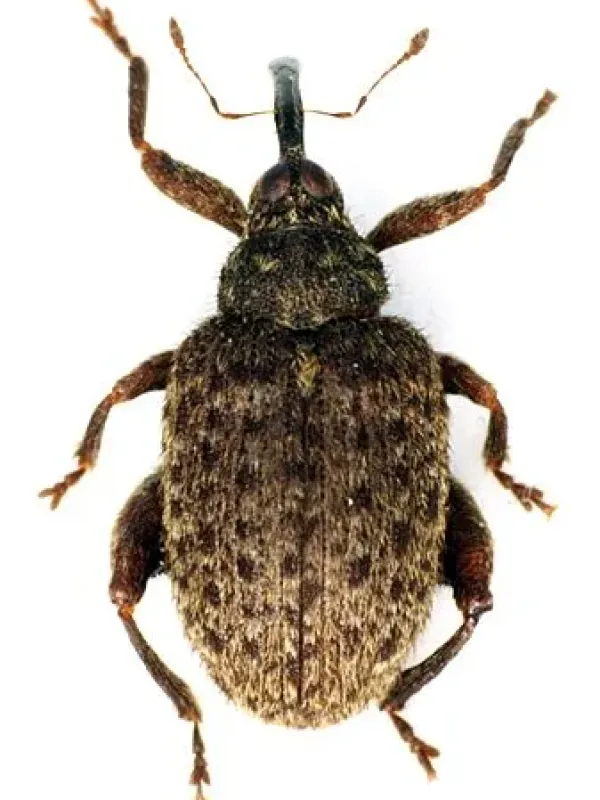
The elm leaf miner (Rhynchaenus excellens) is a member of the weevil family (Curculionidae). These small beetles are easily recognized by their specialized hind legs adapted for jumping.
The adult beetle typically measures between 2 and 3 millimeters in length. Their coloration ranges from dark brown to black, and their bodies are covered in fine hairs giving them a matte appearance.
The larvae are legless, consistent with most weevil species. They are creamy-white or yellowish in color, with a clearly visible head capsule designed for feeding inside leaf tissues.
Monitoring for this pest often involves visual inspection of the canopy or using sweep nets to capture adults during the peak of their active season.
Due to their tiny size and habit of living inside leaves, adults are often the most easily observed stage when they emerge to feed on the foliage.
What it damages
The primary hosts for this insect are trees of the genus Ulmus (Elm). The pest is particularly problematic in nurseries, urban parks, and mature forest plantations.
Adult beetles feed on the surface of the leaves, creating numerous small, shot-hole-like perforations that reduce the photosynthetic capacity of the tree.
The larvae are the most destructive stage, mining the interior of the leaf. These mines cause the leaf tissue to die, leading to brown blotches and necrotic areas.
Severe infestations can cause significant stress to young trees, resulting in stunted growth and a loss of aesthetic value in ornamental elm plantings.
Chronic damage over several growing seasons can weaken the tree, making it susceptible to secondary pests or opportunistic fungal pathogens.
When it appears
Overwintering adults emerge from hibernation in leaf litter or bark crevices during early spring, coinciding with the flushing of new elm leaves.
The mating and egg-laying period occurs from late spring into mid-summer. Females deposit eggs directly into the leaf tissue to ensure the larvae have immediate access to food.
Larval development occurs entirely within the leaf mine, where they also pupate. The duration of this cycle is highly dependent on ambient temperature and humidity levels.
A second generation of adults may appear in mid-to-late summer, continuing the cycle of feeding until the onset of autumn cooling.
As temperatures drop, the adults seek out protective overwintering sites, such as the layer of decaying leaves at the base of the trees or deep bark fissures.
Signs of infestation
The first indicator of an elm leaf miner presence is the appearance of small holes in the foliage caused by adult feeding activity during the early spring.
The most distinctive sign is the development of mines — irregular, blotch-like patterns within the leaf that turn from pale to brown as the larvae consume the interior tissue.
Heavily infested trees may exhibit leaf curling or premature browning of the entire canopy, often mistaken for drought stress or early seasonal change.
Closer examination of the mines will reveal small dark spots of larval frass, which are a definitive diagnostic feature of this particular species.
- Small puncture marks on young leaves.
- Light-colored blotch mines spreading across leaves.
- Browning and necrosis of damaged leaf tissue.
- Premature leaf drop in mid-summer.
Control measures
Chemical control involving systemic insecticides is the most effective approach for managing outbreaks in nurseries, applied during the initial adult emergence phase.
Cultural practices, such as the thorough removal and destruction of fallen leaves in autumn, significantly reduce the number of overwintering adults.
Biological control methods include the preservation of natural predators and parasitoids that naturally regulate the population of weevils in healthy ecosystems.
Monitoring programs using yellow sticky traps are essential for determining the precise timing for intervention and minimizing the need for broad-spectrum spraying.
Maintaining tree vigor through proper fertilization and watering helps the elm withstand the physiological stress caused by foliage loss and larval activity.
Taxonomy
- Latin name
- Rhynchaenus excellens
- Order
- Coleoptera (beetles)
- Family
- Curculionidae
- EPPO code
- RHYHEX
Discussion
No discussions yet — be the first.