
Willow flea weevil
Rhynchaenus canus
Description
How to identify
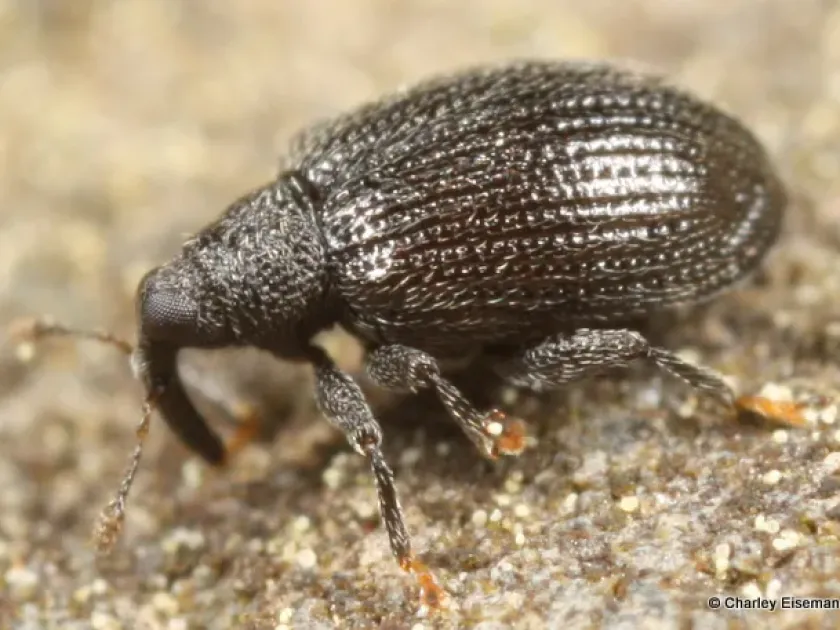
The willow flea weevil (Rhynchaenus canus) is a small beetle belonging to the Curculionidae family. It is a common pest that specifically targets various species of willow trees.
Adults are tiny, typically measuring between 2 and 3 millimeters in length. They are characterized by enlarged hind femora, which grant them an exceptional ability to jump, resembling flea beetles.
Their bodies are often covered with fine hairs, and their coloration varies from grayish to dark brown, allowing them to blend perfectly with the bark and foliage of the host tree.
The larvae are legless, cream-colored, and adapted for a cryptic lifestyle, as they develop entirely inside the tissues of the willow leaves.
Adult beetles are highly alert and respond to any vibration or disturbance by jumping away, making them difficult to capture or observe during daytime hours.
What it damages
Both adults and larvae cause significant harm to willow trees. Adults feed on the surface of the leaves, creating small, pinprick-like holes that affect photosynthesis.
Larvae, however, are leaf miners. They tunnel through the inner tissues of the leaf, creating irregular mines that cause the foliage to wither and turn brown.
Severe infestations can lead to premature leaf drop and the stunted development of new shoots, which diminishes the ornamental value and vigor of the trees.
Young willow saplings are particularly vulnerable, as repeated foliage damage can jeopardize their survival and slow their growth significantly.
While mature trees are generally more resilient, heavy mining activity weakens them, making them more susceptible to secondary stressors like drought or other pests.
When it appears
The lifecycle of the willow flea weevil is closely synchronized with the growing season of its host plant, the willow tree.
The cycle begins when overwintering adults emerge from the leaf litter or soil in early spring, coinciding with the appearance of new foliage.
After a period of feeding, the adults mate, and females deposit eggs directly into the leaf tissue. The larvae hatch and begin their mining phase, which lasts for several weeks.
Pupation occurs within the leaf mine itself. By mid-summer, a new generation of adults emerges and continues to feed on the foliage.
The insect typically produces one or two generations per year, depending on the climatic conditions and the duration of the local growing season.
Signs of infestation
The earliest signs of an infestation are small, circular holes on the leaves caused by adult feeding in late spring.
As the larvae develop, you will observe distinct brownish or yellowish patches on the leaf surface, which represent the mining tunnels created beneath the epidermis.
When held against the light, the leaves reveal the clear shape of the mines, often containing the larva or frass particles left behind during feeding.
As the infestation progresses, leaves may become distorted, curled, or scorched in appearance, creating an overall unhealthy look for the tree canopy.
Shaking the branches over a white sheet is a reliable way to detect the presence of the adult weevils, as they will readily jump and land on the surface.
Control measures
Managing the willow flea weevil requires a combination of sanitation and targeted chemical or biological treatments to maintain tree health.
- Remove and destroy fallen leaves in the autumn to eliminate the primary overwintering sites for the beetles.
- Apply systemic insecticides during the early spring to target adults before they have the chance to lay eggs.
- Use biological controls such as predatory wasps or entomopathogenic fungi to manage larval populations within the mines.
- Ensure adequate irrigation and fertilization to help the trees recover from minor infestations more effectively.
- Monitor trees regularly during the spring months, especially when identifying the first signs of pinprick holes on new growth.
Taxonomy
- Latin name
- Rhynchaenus canus
- Order
- Coleoptera (beetles)
- Family
- Curculionidae
- EPPO code
- RHYHCA
Discussion
No discussions yet — be the first.