
Alder flea weevil
Rhynchaenus alni
Description
How to identify
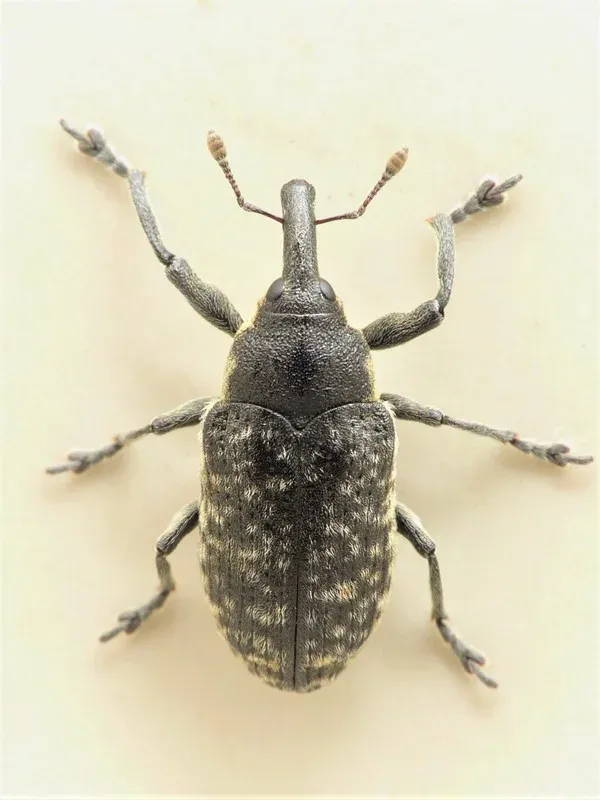
The alder flea weevil is a small beetle belonging to the Curculionidae family and the Coleoptera order. An adult individual is approximately 2–3 mm long and has a black or dark brown color, sometimes with a metallic sheen.
A distinctive feature of this species, common to most flea weevils, is its highly developed hind legs. These allow the insect to perform sudden jumps when it senses danger or is disturbed.
The beetles have powerful chewing mouthparts adapted for piercing and feeding on the leaf epidermis. The insect's body is covered with fine hairs, making it difficult to spot against the tree bark.
The larvae of the alder flea weevil are legless, yellowish-white, and have a slightly curved body. They develop exclusively inside the leaf tissues, which provides them with a hidden lifestyle.
The development cycle involves complete metamorphosis: egg, larva, pupa, and imago. Adult beetles overwinter in fallen leaves, under bark, or in the topsoil layer, becoming active in the spring.
What it damages
The primary food source for this pest is the alder tree. During years of mass outbreaks, the insect can infest large areas of forest plantations and parklands.
Although it prefers alder, cases of damage to other deciduous tree species growing nearby have been recorded. This makes the flea weevil a potential threat to mixed forest stands.
Adults cause damage by eating small holes in young leaves, which disrupts photosynthesis. Damaged leaves lose their aesthetic appeal and may dry out prematurely.
Larvae cause significantly more damage by creating extensive tunnels, known as mines, inside the leaf. This leads to the death of large sections of the leaf blade, weakening the tree's overall condition.
Mass infestation of trees by the flea weevil leads to premature leaf fall. This negatively affects wood growth and the tree's ability to prepare for the winter dormancy period.
When it appears
The emergence of overwintered beetles occurs in early spring, when the average daily air temperature exceeds 10 degrees Celsius. The activity period coincides with the budding phase of alder trees.
Females lay eggs in the tissues of young leaves, gnawing special chambers for this purpose. This process usually occurs in late April or May, depending on the climatic zone.
Larval development inside the leaves takes about 2–3 weeks. During this period, an increase in the area of damage on the leaves is visually noticeable, accompanied by the appearance of characteristic spots.
Pupation occurs inside the mine created by the larva. A new generation of beetles emerges in mid-summer, usually in July, and continues supplementary feeding until autumn.
In the fall, the beetles move to overwintering sites. They begin their migration to wintering spots when temperatures drop significantly, usually in September or October.
Signs of infestation
The first sign of the pest is the presence of numerous small holes in the emerging spring leaves. These look like needle pricks and expand over time.
The main diagnostic sign is the presence of mines on the leaves — light, irregularly shaped spots that eventually darken and dry out. If you look at the leaf against the light, you can see the larva inside.
When shaking tree branches during the activity period, one can observe the mass falling of beetles. They react instantly to vibration, so they are often found in the leaf litter under the tree.
An indirect sign is the deterioration of the tree's crown: it becomes sparse and turns a brownish hue by mid-summer, which is unusual for a healthy plant.
The presence of larval excrement inside the mine tunnel also confirms the species' presence. When inspecting the affected leaf, dark granules can be seen within the dry tissue.
Control measures
Effective protection includes collecting and destroying fallen leaves in the fall, as a significant portion of the pest population winters there.
During periods of high population density, the use of systemic insecticides is justified. Treatments should be carried out at the beginning of the growing season when beetles start feeding.
- Spraying with contact insecticides when beetles emerge from wintering.
- Using biological preparations based on entomopathogenic fungi to reduce larval numbers.
- Encouraging natural enemies such as insectivorous birds and parasitic wasps.
Applying agrotechnical methods, such as fertilization to stimulate the alder's immunity, helps the tree better withstand leaf damage.
In forest nurseries, it is recommended to monitor the pest population using pheromone or sticky traps, which allows for timely implementation of control measures.
Taxonomy
- Latin name
- Rhynchaenus alni
- Order
- Coleoptera (beetles)
- Family
- Curculionidae
- EPPO code
- RHYHAL
Discussion
No discussions yet — be the first.