
Southern pine tip moth
Rhyacionia subtropica
Description
How to identify
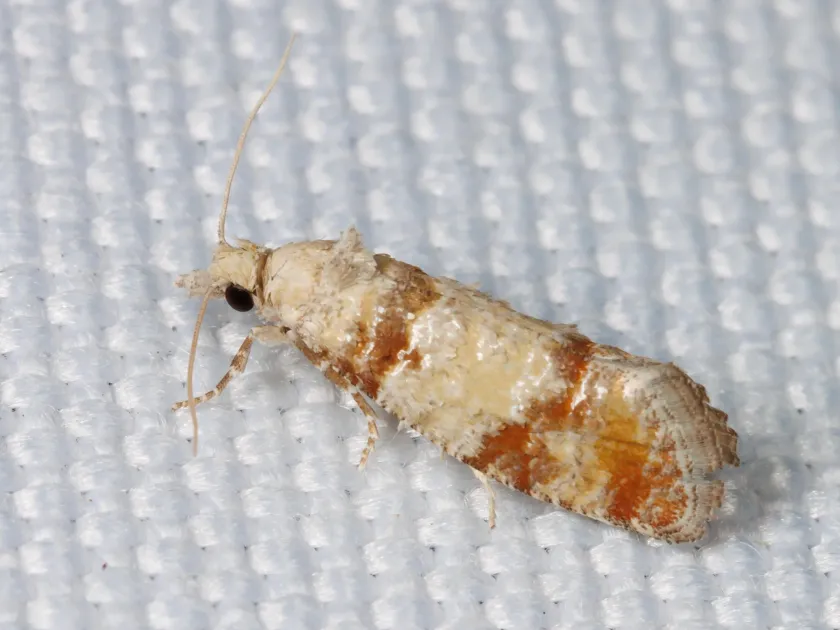
The Southern pine tip moth (Rhyacionia subtropica) is a member of the Tortricidae family within the order Lepidoptera. Adult moths are relatively small, characterized by their reddish-brown forewings featuring distinct silver cross-bands.
The larvae progress through several developmental stages (instars). They start as yellowish caterpillars and mature into a reddish-brown coloration with a dark head capsule, which serves as a vital diagnostic feature for field identification.
Adults are nocturnal and crepuscular, making them difficult to spot during daylight hours. During their active mating season, females lay individual eggs on the needles or near the buds of host trees.
Pupation occurs within the damaged shoots, where the larvae spin a protective silken cocoon. This hidden pupation site provides significant protection against environmental stressors and potential predators.
Entomologists often utilize synthetic pheromone lures to monitor populations. These traps are highly effective in determining peak flight periods, which is essential for timing subsequent control measures accurately.
What it damages
The primary hosts for Rhyacionia subtropica include several pine species, notably Slash pine and Loblolly pine. In areas where these hosts are cultivated, the moth can reach high infestation levels.
Larvae feed directly on the succulent, growing tips of the pines. This localized feeding destroys the terminal bud, which is responsible for the height growth of the tree, leading to stunted or deformed development.
Continuous infestation results in multi-leadered, bushy trees with significant structural deformities. These trees often lose their apical dominance, which negatively impacts their timber quality and market value.
Economic damage is most severe in young plantations and tree nurseries. Infestations can result in significant seedling mortality or the need for extensive culling of nursery stock that no longer meets quality standards.
Trees weakened by repeated tip moth attacks are more susceptible to secondary stressors, including bark beetle infestations and fungal pathogens, which can ultimately lead to the decline of entire stands.
When it appears
The life cycle of the Southern pine tip moth is strongly influenced by temperature, allowing for multiple generations per year in subtropical environments. This high reproductive rate often leads to rapid population explosions.
The species typically overwinters as a larva inside the host plant's tissues. As temperatures rise during early spring, these larvae resume feeding, marking the beginning of the new annual cycle.
The first adult flight of the year usually occurs in late spring. This event initiates the first egg-laying phase, as moths disperse throughout the pine stand to find suitable hosts for their offspring.
Subsequent generations continue to overlap throughout the warm season, meaning different developmental stages—from eggs to pupae—may coexist simultaneously within the same plantation during mid-summer.
As autumn approaches and temperatures drop, the final generation of larvae prepares for winter. By burying themselves deep within the woody tissue of the shoots, they ensure their survival during the colder months.
Signs of infestation
The earliest symptom of an infestation is the presence of small resinous droplets or "pitch globs" on the tips of branches. These are formed by the larva as it attempts to bore into the plant tissue.
Accumulated frass, which consists of larval waste and resin particles, is often visible near the entry points of the tunnels. This distinctive debris is a reliable sign of active larval presence.
Yellowing, browning, and drooping of new shoots are classic indicators of damage. When a larva bores into the center of a shoot, it disrupts the flow of water and nutrients, causing the tip to wilt.
Broken or severely distorted terminal shoots are common in areas with a history of tip moth activity. These deformations often force the tree to sprout multiple side branches, creating a stunted, unnatural appearance.
Empty pupal casings protruding from the exit holes in the shoot are clear evidence that a moth has successfully emerged. Finding these casings confirms that the infestation has reached its final seasonal phase.
Control measures
Integrated Pest Management (IPM) is essential for controlling the Southern pine tip moth. The most effective approach involves combining cultural, chemical, and biological strategies to keep populations below threshold levels.
Pruning and destroying infested shoots before the larvae emerge as adults is a vital cultural practice. This reduces the local population density, especially in small, managed stands or nursery environments.
Chemical control should be timed to target the window between egg hatching and the larva's entry into the shoot. Once the larva is inside the tissue, it is protected from most contact insecticides.
Biological control using Bacillus thuringiensis or releasing natural parasitoids can help maintain ecological balance. These methods are preferred in environmentally sensitive areas or where broad-spectrum pesticides are restricted.
- Sanitation through pruning of infested branch tips.
- Monitoring via pheromone traps to time insecticide sprays.
- Systemic insecticide application for high-value seedlings.
- Maintaining optimal tree health through proper fertilization.
- Preservation of natural predator and parasitoid habitats.
Taxonomy
- Latin name
- Rhyacionia subtropica
- Order
- Lepidoptera (butterflies)
- Family
- Tortricidae
- EPPO code
- RHYASU
Discussion
No discussions yet — be the first.