
Pine Shoot Moth
Rhyacionia pinivorana
Description
How to identify
The pine shoot moth (Rhyacionia pinivorana) is a member of the Tortricidae family within the order Lepidoptera. These small moths are primarily nocturnal, making them difficult to spot in pine forests during the day.
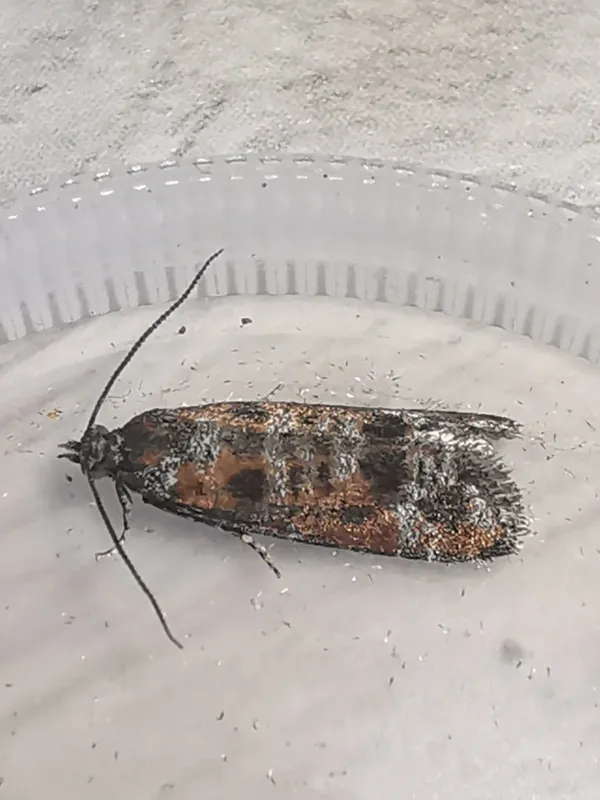
Adult moths possess a wingspan of approximately 15–20 mm, displaying a rust-colored pattern on their forewings that serves as excellent camouflage against pine bark.
The larval stage is the most destructive phase of the insect's life cycle. The larvae are reddish-brown with dark heads and possess strong mouthparts adapted for boring into woody tissues.
Eggs are typically laid on pine needles or near buds. Upon hatching, the young larvae immediately seek out a host bud to begin feeding, which protects them from predators.
The species completes one generation per year, with the larvae overwintering inside the damaged shoots to emerge as adults the following spring or early summer.
What it damages
Rhyacionia pinivorana primarily targets Pinus sylvestris (Scots pine) and other related conifer species, particularly in young stands and nurseries under 15 years of age.
Larvae bore directly into developing buds and shoots, consuming the interior vascular tissues. This feeding behavior destroys the terminal leader, which is essential for healthy vertical growth.
The loss of the leading shoot often causes the tree to develop a crooked or deformed trunk, significantly impacting the economic value and structural integrity of the timber.
Repeated attacks over several years can lead to stunted growth and increased susceptibility to other biotic stressors, such as fungal pathogens or secondary wood-boring insects.
Heavy infestations in forest nurseries can result in significant losses, as the damage renders the young seedlings unsalable and unsuitable for plantation establishment.
When it appears
The flight period for adult moths typically occurs from late spring through early summer, coinciding with the active growth flush of pine shoots.
Larval activity is concentrated in the spring and early summer months, which is the period of peak nutrient demand for the developing conifer shoots.
Pupation takes place inside the tunnels created by the larvae within the shoots, usually occurring during the mid-summer months before the adult moths emerge.
The larvae overwinter in the dormant shoots, remaining protected within their boring tunnels until environmental conditions trigger their growth cycle in the spring.
Monitoring for the presence of adult moths using pheromone traps is standard practice for forestry professionals to determine the timing of management interventions.
Signs of infestation
The presence of resin exudation on the surface of buds is one of the earliest signs that larvae have begun to tunnel into the plant tissue.
A classic symptom of infestation is the formation of withered, brown shoot tips, colloquially known as "flags," which contrast sharply with the healthy green needles.
Careful observation reveals small entry holes covered with silk webbing and dark brown frass (larval excrement), indicating active boring by the larvae.
Deformation of the leader shoot into a 'goose-neck' or 'S' shape occurs as the tree attempts to redirect growth following the destruction of the original terminal bud.
The discovery of empty pupal cases protruding from the exit holes in late summer confirms that the adult moths have emerged and that the current generation has completed its cycle.
Control measures
Silvicultural management, including the removal and destruction of infested shoots during the dormant season, is a highly effective way to reduce local pest populations.
Chemical control with systemic insecticides is most effective when applied during the egg-hatching phase, before the larvae successfully tunnel into the protected interior of the bud.
Biological control efforts utilize natural predators and parasitoids, such as various species of parasitic wasps and tachinid flies, to keep population levels in check.
Maintaining high stand diversity and avoiding overly dense monocultures can help reduce the prevalence and rapid spread of Rhyacionia pinivorana in vulnerable areas.
Integrated Pest Management (IPM) programs rely on pheromone trap monitoring to ensure that control measures are timed precisely for maximum environmental and economic efficiency.
Taxonomy
- Latin name
- Rhyacionia pinivorana
- Order
- Lepidoptera (butterflies)
- Family
- Tortricidae
- EPPO code
- RHYAPV
Discussion
No discussions yet — be the first.