
Pine shoot moth
Rhyacionia logaea
Description
How to identify
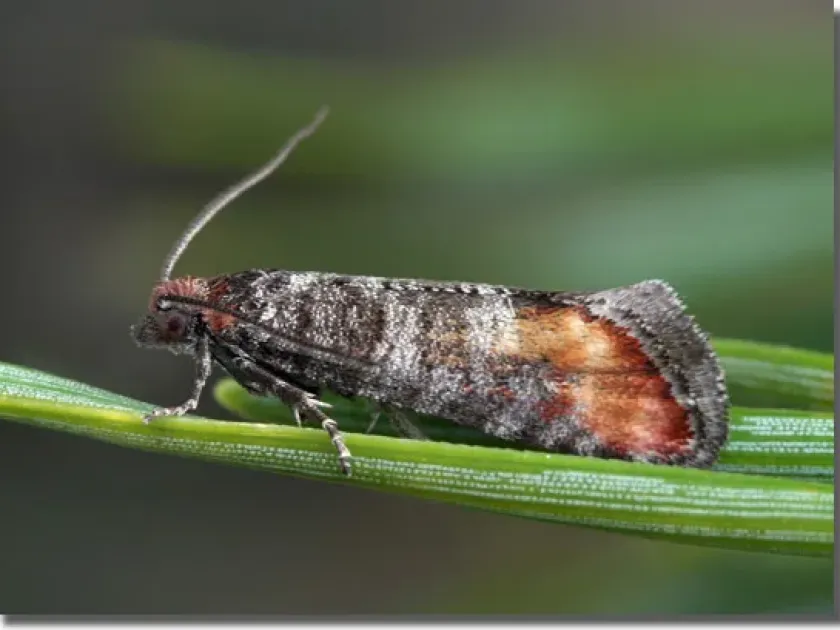
The pine shoot moth (Rhyacionia logaea) belongs to the Tortricidae family within the order Lepidoptera. The adult moth is a small insect with a wingspan of approximately 15–18 mm, recognized by its copper or reddish-brown banded wings that provide excellent camouflage against pine bark.
The larvae are small caterpillars, typically yellowish or reddish in color with a shiny, dark head. They are specialized borers that spend their developmental stages tunneling inside the tender shoots and buds of their host trees.
The life cycle is closely synchronized with the phenology of Scots pine (Pinus sylvestris). Under typical climatic conditions, there is one generation per year, though temperature fluctuations can slightly influence the timing of emergence.
Adults are primarily nocturnal. Females lay their eggs singly or in small groups on needles or bud scales, ensuring that larvae can begin boring into the plant tissue immediately upon hatching.
Accurate identification often requires inspection of both the adult moths and the specific damage patterns on the shoots, as several species in the Rhyacionia genus share similar biological characteristics and host ranges.
What it damages
The primary hosts are young Scots pine trees, usually between 5 and 20 years old, which are most susceptible to damage during their phase of rapid height growth. The larvae target the buds and the succulent new shoots.
Feeding larvae tunnel into the center of the shoot, destroying the pith. This damage severely stunts growth and causes the shoot to bend or twist, resulting in a characteristic distortion known as a "rosette" or "hook" formation.
A telltale sign of damage is the heavy flow of resin at the entrance points of the larvae. The tree's defensive response creates hardened beads of white or clear resin on the surface of the infected shoots.
In nurseries, infestation can be devastating, leading to distorted stems and multi-leader trees that are unsuitable for forest planting or ornamental use. Repeated attacks may eventually kill young trees if the infestation is heavy.
In addition to physical deformation, the compromised tissue often becomes an entry point for secondary pathogens, such as fungi or bacteria, which can cause further localized dieback and weaken the tree's immune system.
When it appears
Adult moths emerge and are active from late spring, typically starting in late May and continuing through July. This is the critical window for mating and egg-laying, which determines the potential level of infestation for the following season.
Larvae hatch in early summer and immediately begin boring into the needles and subsequently into the buds and shoots. They continue feeding throughout the summer months to reach their full larval size.
The larvae overwinter inside the hollowed-out shoots or buds of the host tree. This protected environment allows them to withstand cold winters, shielded from both harsh weather and some predators.
Pupation occurs in early spring within the larval galleries. As the weather warms, the pupae prepare for adult emergence, often pushing themselves slightly out of the exit hole before the moth hatches.
Understanding these developmental stages is essential for effective pest management, as applications of control measures must be timed precisely to intercept the life stages most vulnerable to treatment.
Signs of infestation
The earliest sign of infestation is the yellowing and subsequent browning of needles at the base of the bud, caused by the initial feeding of young larvae before they burrow deeper into the shoot.
Visual presence of hardened, globose resin deposits on the shoots is a classic indicator of a pine shoot moth attack. These resinous masses often trap the larvae's frass, making them easier to spot.
Distorted growth patterns, such as bent or hooked leaders, clearly indicate that the pith has been hollowed out. In severe cases, the terminal leader may fail entirely, forcing the tree to develop lateral branches as new leaders.
- Yellowing and browning needles near the buds.
- Resinous masses on twigs and leaders.
- Distorted or hooked shoot tips.
- Presence of frass pellets stuck in the resin.
During the spring, small, translucent pupal skins may be found protruding from the shoot, indicating that a moth has successfully emerged from that location.
Control measures
Sanitation is a critical management practice. Removing and burning infested shoots during the dormant season (late autumn or winter) is highly effective as it eliminates the larvae before they can pupate or emerge.
Chemical control involving systemic insecticides is often used in high-value plantations. Applications should be timed to coincide with the period of peak adult activity or the early larval stage before they are protected by the shoot tissue.
Biological control methods, such as using preparations containing Bacillus thuringiensis, can be used to target young larvae effectively, providing a more environmentally friendly alternative to traditional pesticides.
Monitoring using pheromone traps is highly recommended to track adult moth populations. This data allows for the timing of interventions, ensuring that control measures are applied only when necessary and at the most effective time.
Promoting general forest health through appropriate silvicultural practices, such as maintaining correct planting densities, helps ensure that trees are robust enough to withstand and recover from minor infestations.
Taxonomy
- Latin name
- Rhyacionia logaea
- Order
- Lepidoptera (butterflies)
- Family
- Tortricidae
- EPPO code
- RHYALO
Discussion
No discussions yet — be the first.