
Pine shoot moth
Rhyacionia dativa
Description
How to identify
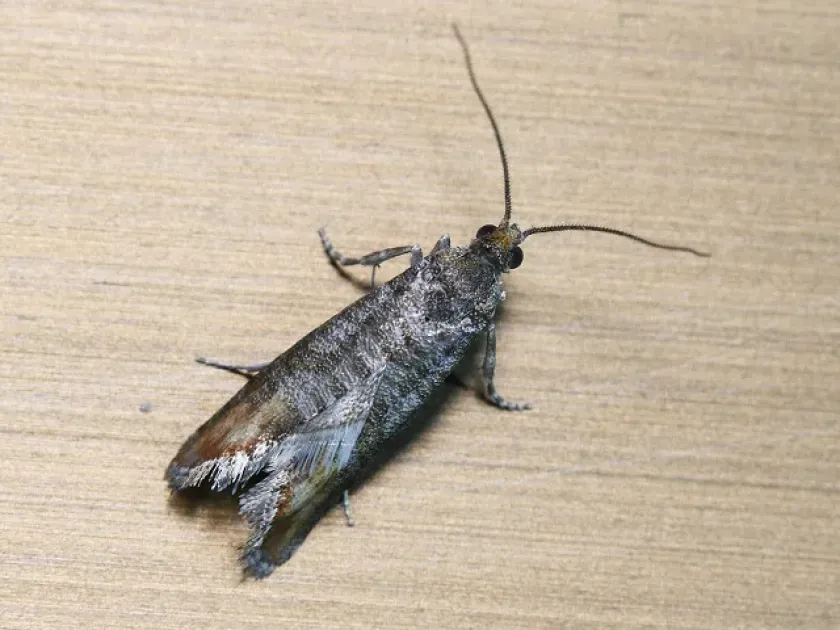
The pine shoot moth (Rhyacionia dativa) belongs to the order Lepidoptera and the family Tortricidae. The adult moth features a wingspan of 15–20 mm, with forewings exhibiting an ochre-brown pattern and silver cross-lines, which provide excellent camouflage against pine bark.
The larva (caterpillar) typically reaches 12–15 mm in length. Its body is yellowish-brown or reddish with a dark head and a distinct thoracic shield. A key identifying feature is the presence of small, light-colored warts on its segments.
The pupa is brownish and develops within the damaged shoot or inside a silk-lined cocoon hidden in crevices. It is capable of movement, which allows it to emerge slightly from the shoot before the adult moth ecloses.
This species follows a univoltine life cycle (one generation per year). Larvae overwinter inside the buds or at the base of the shoots, providing them with a safe haven against harsh winter temperatures.
Females lay eggs singly or in small groups, usually on needles or bud scales. Due to their minute size and protective coloration, eggs are extremely difficult to spot during routine field inspections.
What it damages
Young pine trees (Pinus sylvestris and other species) are the primary hosts. The pest prefers stands aged 3 to 15 years, where the active growth of young shoots provides abundant soft tissues for the larvae to feed upon.
Damage is caused by larvae boring into buds and young current-year shoots. This leads to the destruction of the apical bud, which stunts the tree's vertical growth and disrupts the tree's physiological development.
Severe infestations cause trunk deformation and multi-leader development, often referred to as "bayonet" shoots. This significantly lowers the timber quality and aesthetic value of the pine stands.
Trees weakened by the pine shoot moth become susceptible to secondary infestations by bark beetles and borers, which can accelerate the decline and death of the plantation.
The economic impact manifests as reduced growth rates in forest stands and increased long-term costs for forest maintenance, replanting, and chemical management efforts.
When it appears
Adult moths typically emerge in late spring or early summer (May–June), depending on the local climate. This is the period when females are most active in finding suitable sites for egg-laying.
The active feeding phase of larvae occurs throughout the summer. During this time, they burrow deep into the shoots, making them harder to target with topical pesticides once they are well-entrenched.
As autumn approaches, larvae cease feeding and prepare for diapause. They remain inside their tunnels within the damaged shoots throughout the winter months until conditions become favorable again.
In spring, as temperatures rise, the larvae resume activity to complete their development and pupate. The pupation process typically peaks in April or early May.
Agronomists use pheromone traps to monitor the onset of the moth flight, which is crucial for timing interventions before the larvae successfully penetrate the plant tissue.
Signs of infestation
The first sign of infestation is the appearance of resin droplets on young shoots at the entry points where larvae have bored into the plant tissue.
Visually, damaged shoots eventually turn yellow, wilt, and bend, creating a distorted shape. Careful observation will reveal small holes or "tunnels" in the buds or shoot bases.
The presence of fine frass (larval excrement) mixed with resin around the entry hole is a clear indication of active feeding by the pine shoot moth.
In late summer and autumn, the crowns of young pines may appear scorched or "burnt" due to the widespread wilting of leaders and lateral shoots attacked during the growing season.
- Resin droplets ("tears") on the stem.
- Distorted growth and "flagged" or bent leaders.
- Drying and browning of terminal buds.
- Accumulation of brownish frass near entry points.
Control measures
Chemical control involves the application of systemic insecticides during the moth flight period or shortly after egg hatching, while larvae are still exposed on the plant surface.
Biological control methods utilize Bacillus thuringiensis-based products, which are effective against young larvae and offer a more environmentally friendly alternative for forest ecosystems.
Cultural practices include planting mixed-species stands to reduce host density and facilitate natural pest regulation. Pruning and destroying heavily infested shoots before adult emergence helps lower the local population.
Supporting local populations of insectivorous birds and parasitic wasps provides a natural suppression mechanism, keeping the pest population below damaging levels.
Implementing a pheromone-based monitoring system allows for precise timing of treatments, ensuring that interventions are only carried out when the pest population exceeds economic damage thresholds.
Taxonomy
- Latin name
- Rhyacionia dativa
- Order
- Lepidoptera (butterflies)
- Family
- Tortricidae
- EPPO code
- RHYADA
Discussion
No discussions yet — be the first.