
Busck's Pine Tip Moth
Rhyacionia busckana
Description
How to identify
Busck's Pine Tip Moth (Rhyacionia busckana) belongs to the order Lepidoptera and the family Tortricidae. It is a specialized pest that targets various pine species, acting as a major economic threat in pine nurseries and young forest plantations.
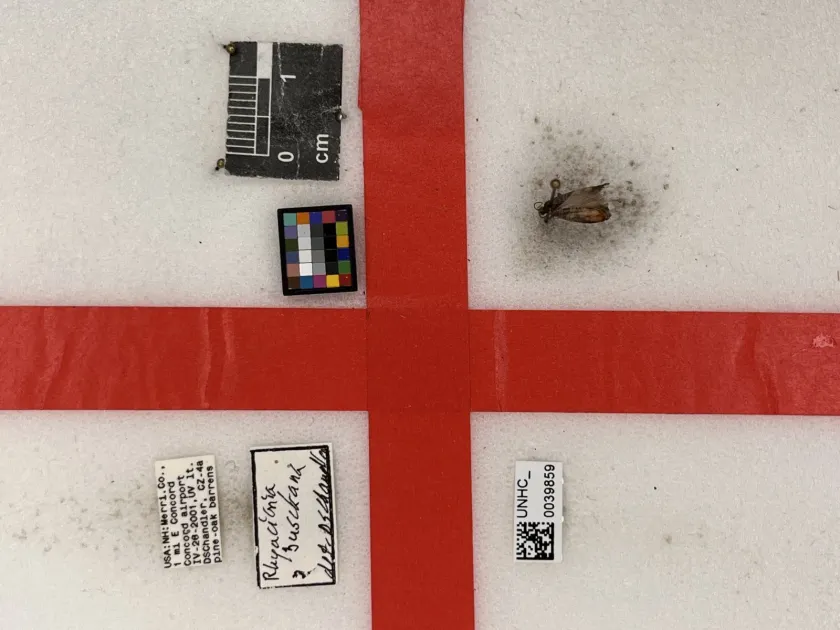
The adult moth is relatively small with cryptic coloration that mimics pine bark. This effective camouflage helps the insect remain hidden from predators during the daytime, facilitating its survival and reproduction in pine-dominated ecosystems.
The insect follows a complete metamorphosis life cycle: egg, larva (caterpillar), pupa, and adult. The larval stage is the most destructive period, during which the insect feeds inside the plant tissues, making it difficult to detect by traditional surveillance methods.
Its biological cycle is strictly synchronized with the phenology of pine trees. The emergence of larvae typically coincides with the active growth phase of the trees, ensuring that the caterpillars have access to the highly nutritious tissues of developing buds.
Proper identification of this species is complex due to the morphological similarity with other members of the genus Rhyacionia. In many cases, professional entomological analysis of reproductive structures is required for definitive classification.
What it damages
The moth primarily attacks young pines, focusing on nursery seedlings and saplings. The larvae feed on the apical and lateral buds, which are crucial for the tree's vertical development and overall structural integrity.
By boring into the buds, the larva consumes the interior tissues, causing the death of the primary growth point. This prevents the tree from maintaining a straight leader, leading to stunted or malformed growth patterns.
Frequent damage to terminal buds results in deformed tree architecture, often creating a "forked" top. This loss of apical dominance significantly reduces the timber value and the aesthetic quality of the trees in landscaping or commercial forestry.
The internal tunneling activity creates entry points for secondary pathogens, such as fungi and bacteria. These secondary infections can cause localized necrosis, which may lead to the dieback of entire branches beyond the initial point of insect damage.
In cases of severe infestation, the cumulative stress on the tree weakens its defenses, making it susceptible to secondary wood-boring insects, which can eventually lead to the mortality of the host tree.
Signs of infestation
The most visible sign of an infestation is the accumulation of resinous frass on the exterior of the buds. As the larva feeds, it mixes wood particles with resin, creating distinct, hardened clumps that serve as a tell-tale sign of the presence of larvae.
Needle yellowing and wilting around the affected bud are early indicators of trouble. If a shoot fails to elongate properly or appears bent and withered, it is a clear symptom of internal feeding by the moth larvae.
Careful inspection of the buds often reveals silk-lined tunnels inside. If the bud is sliced open, one may find the larvae or the remnants of their destructive activity, including webs and frass mixed with plant tissue.
Deformations such as "rosette" growth or lateral branching after the loss of the leader are late-stage signs of the pest's impact. The tree attempts to compensate for the lost terminal growth by diverting resources to auxiliary buds.
Finding empty pupal casings protruding from the exit holes in the buds or shoots indicates that the life cycle is complete and that the adults have already emerged, marking the end of that particular generation's activity.
Control measures
Mechanical control is effective in small areas or nurseries, involving the manual removal and destruction of infested shoots. This must be performed before the adult moths emerge to prevent the next generation from spreading.
Biological control using Bacillus thuringiensis sprays is a sustainable strategy. This approach targets the larvae before they bore into the shoots, significantly reducing the population while minimizing the impact on non-target species.
Chemical control should be timed to coincide with the mass hatching of larvae. Applying systemic insecticides during this window ensures the pest is exposed to the toxins while moving across the surface of the needles, effectively preventing entry into the buds.
Pheromone traps are highly recommended for monitoring programs. They allow foresters to track adult moth activity and calculate the optimal time for intervention, ensuring that control efforts are both timely and cost-effective.
- Regular health monitoring of forest plantations
- Proper sanitation and removal of damaged plant material
- Selection of resistant pine cultivars
- Integration of pheromone monitoring systems
- Judicious use of systemic insecticides during larval emergence
Taxonomy
- Latin name
- Rhyacionia busckana
- Order
- Lepidoptera (butterflies)
- Family
- Tortricidae
- EPPO code
- RHYABU
Discussion
No discussions yet — be the first.