
European pine shoot moth
Rhyacionia buoliana
Description
How to identify
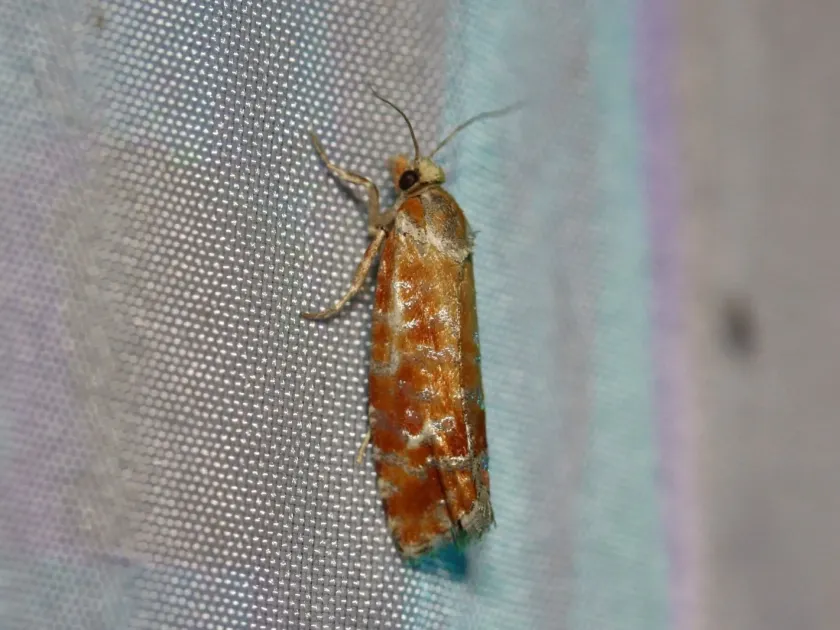
The European pine shoot moth (Rhyacionia buoliana) belongs to the Tortricidae family of moths. The adult moth features a rusty-orange forewing pattern with silvery cross-lines, with a wingspan of approximately 18 to 22 mm.
The larvae are small, reaching about 10-12 mm in length. They have a brown to reddish-brown body with a shiny black head and prothoracic shield, making them distinct from other common pine-infesting lepidopterans.
This species completes one generation per year across most of its distribution range. The life cycle consists of the egg, larval, pupal, and adult stages, with larvae overwintering in the buds of the host tree.
Identification is primarily based on the presence of resinous masses near the tips of the shoots. During the larval stage, the insect constructs a silk-lined chamber, which is often covered by hardened pine resin.
Monitoring for adults is typically conducted using pheromone traps, which are highly effective for detecting the presence and intensity of a pest population during the summer flight period.
What it damages
The primary host trees include various Pinus species, with a particular affinity for Scots pine, Austrian pine, and red pine. The pest is a significant threat to young plantations and nurseries.
Larval feeding destroys the terminal and lateral buds. This damage prevents the tree from maintaining apical dominance, which causes the leader to die back and often leads to the characteristic deformation known as "posthorn" growth.
Severe infestations reduce the height growth of trees and severely degrade the commercial value of timber due to multiple branching and trunk crookedness. The aesthetic value of ornamental pines is also permanently ruined.
In high-density populations, the continuous loss of buds keeps young trees in a stunted state. This makes them highly susceptible to secondary attacks by bark beetles and pathogens that thrive on stressed trees.
Young trees between the ages of 5 and 15 years are the most vulnerable. Protection during this critical growth phase is essential for long-term stand development and forest health.
When it appears
Adult moths emerge in late June and fly through July. After mating, females lay individual eggs on the needles or near the buds of the current year's growth, usually at the base of the shoot.
Upon hatching, larvae initially feed on the needle bases, creating small webs. As they grow, they move toward the buds and construct a protective resinous chamber to overwinter throughout the cold months.
In the spring, usually April or May, the larvae emerge from their wintering sites and bore directly into the developing buds. This activity is the most damaging phase of their life cycle.
Pupation occurs within the damaged shoot by early June. The pupal stage lasts approximately two to three weeks before the adult moth emerges to start the cycle again.
Timing interventions is crucial; insecticide applications are most effective when larvae are moving from the needles to the buds in late summer or during their spring emergence before they enter the bud tissue.
Signs of infestation
The most visible sign of infestation is the presence of pitch or resin masses on the pine buds. These blobs of resin are clear indicators that the larva has bored into the tissue.
The death or browning of needles surrounding the bud is another sign that the larval feeding has disrupted the flow of nutrients to the shoot tip, leading to localized tissue death.
A distorted or "crooked" shoot, often referred to as a posthorn, confirms that the terminal bud was damaged in the previous season. This visual cue is a classic diagnostic marker for this species.
Small holes in the buds, sometimes accompanied by silk webbing and frass (insect excrement), clearly point to recent or ongoing larval activity within the protective plant tissue.
- resinous masses on terminal buds;
- browning or wilting of the shoot tips;
- crooked stems (posthorn effect);
- webbed needles at the base of buds.
Control measures
Integrated Pest Management (IPM) for this moth includes the use of systemic insecticides. These should be applied when larvae are exposed, specifically during the period of migration between needle feeding and bud boring.
Mechanical control, which involves pruning and destroying infested shoots, is highly effective in small-scale settings like nurseries and landscapes. This practice prevents the spread of the population to healthy trees.
Biological control methods involve supporting natural parasitoids, such as specific wasps. Maintaining natural predators helps to balance the ecosystem and suppress moth outbreaks over time.
Silvicultural management, including the avoidance of pure pine stands in high-risk areas, can reduce the impact of the moth. Promoting mixed-species forests helps limit the efficiency of host-seeking moths.
Continuous monitoring programs and the removal of heavily infested, severely deformed trees during early thinning operations are recommended to maintain the overall vigor and productivity of the forest stand.
Taxonomy
- Latin name
- Rhyacionia buoliana
- Order
- Lepidoptera (butterflies)
- Family
- Tortricidae
- EPPO code
- EVETBU
Discussion
No discussions yet — be the first.