
Blueberry leafroller
Rhopobota myrtillana
Description
How to identify
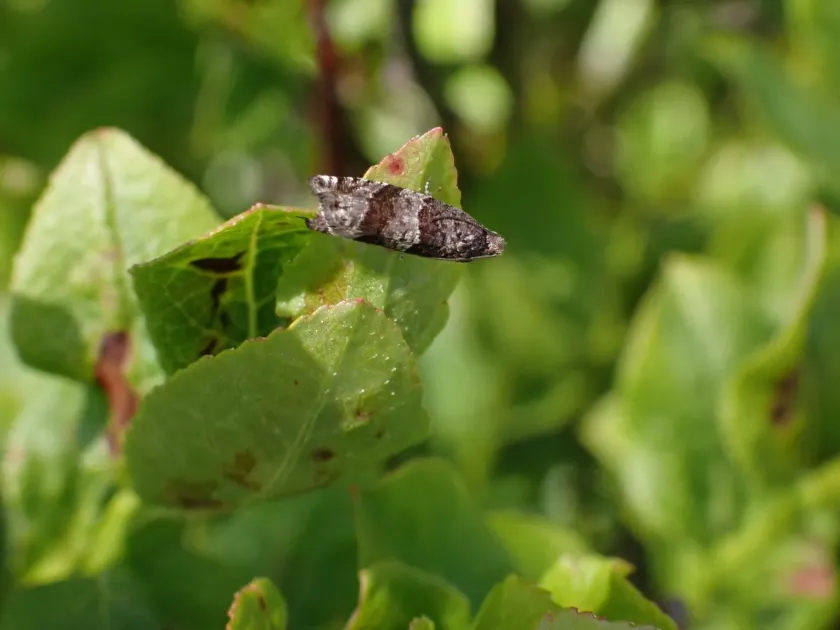
The blueberry leafroller (Rhopobota myrtillana) belongs to the Tortricidae family within the Lepidoptera order. This small moth is known for its cryptic lifestyle.
Adult moths have a wingspan of approximately 12–15 mm. The forewings feature a grayish-brown pattern, which provides excellent camouflage against bark and leaves.
Larvae pass through several developmental stages, changing color from light green to yellowish-brown. Their bodies are sparsely covered with hairs, and the head is usually darker.
Pupae are brown and develop inside tight cocoons constructed by the larvae between curled leaves or within plant debris beneath the shrubs.
Eggs are typically laid by females either individually or in small clusters on the underside of leaves or on the shoots of host plants.
What it damages
The primary food source for this pest is the bilberry/blueberry (Vaccinium myrtillus). The pest may also affect other species within the Vaccinium genus.
These larvae are monophagous or oligophagous, specializing in plants from the Ericaceae family, which restricts their natural host range significantly.
The greatest economic damage occurs in commercial blueberry plantations, where massive outbreaks lead to a substantial reduction in the shrub's vegetative mass.
Damage to buds and young leaves in spring negatively affects the formation of fruit buds for the following year, directly reducing total harvest yields.
In cases of high population density, the larvae may damage not only the foliage but also the flower buds and ovaries, leading to premature berry drop.
When it appears
The lifecycle of the blueberry leafroller is closely synchronized with the phenology of its host plant. Typically, young larvae hibernate within cocoons.
In spring, when the blueberry plants begin sap flow and bud break, the larvae resume feeding, shifting to young, actively growing tissues.
The flight of the first-generation moths is observed in late spring to early summer. During this period, mating occurs, followed by egg deposition.
A second generation of larvae develops in mid-summer, causing damage to the fully formed leaf canopy and new growth shoots.
Pupation occurs in late summer or early autumn, after which the next generation of moths emerges or larvae enter diapause to prepare for winter.
Signs of infestation
The first and most noticeable sign of a leafroller infestation is the presence of curled or webbed terminal leaves on the blueberry bushes.
Upon inspection, one can find nests formed by leaves tied together with silk, inside which the larvae reside and feed.
Affected areas show irregular leaf edges, skeletonization marks, or holes of varying sizes where the larvae have consumed the leaf parenchyma.
The presence of larval excrement, which appears as small dark granules inside the curled leaves, is a reliable indicator of active pest feeding.
Weakening and yellowing of shoots, along with premature leaf drop during severe infestations, visually mark the impacted zones in the plantation.
Control measures
The most important cultural practice is the timely pruning and removal of infested shoots, where the hotspots of leafroller development are located.
It is recommended to maintain a weed-free zone around berry plantations, especially removing any Ericaceae weeds that can serve as pest reservoirs.
Biological control methods include the use of products based on Bacillus thuringiensis, which are effective against early-instar larvae.
During periods of mass infestation, contact or systemic insecticides are used, strictly adhering to pre-harvest intervals for safety.
- Monitoring with pheromone traps to identify the exact timing of the moth flight.
- Encouraging natural predators such as entomophagous insects (e.g., Trichogramma) and insectivorous birds.
- Maintaining optimal plant spacing to ensure good air circulation and light penetration within the canopy.
Taxonomy
- Latin name
- Rhopobota myrtillana
- Order
- Lepidoptera (butterflies)
- Family
- Tortricidae
- EPPO code
- RHPOVA
Discussion
No discussions yet — be the first.