
Greater mouse-tailed bat
Rhinopoma microphyllum
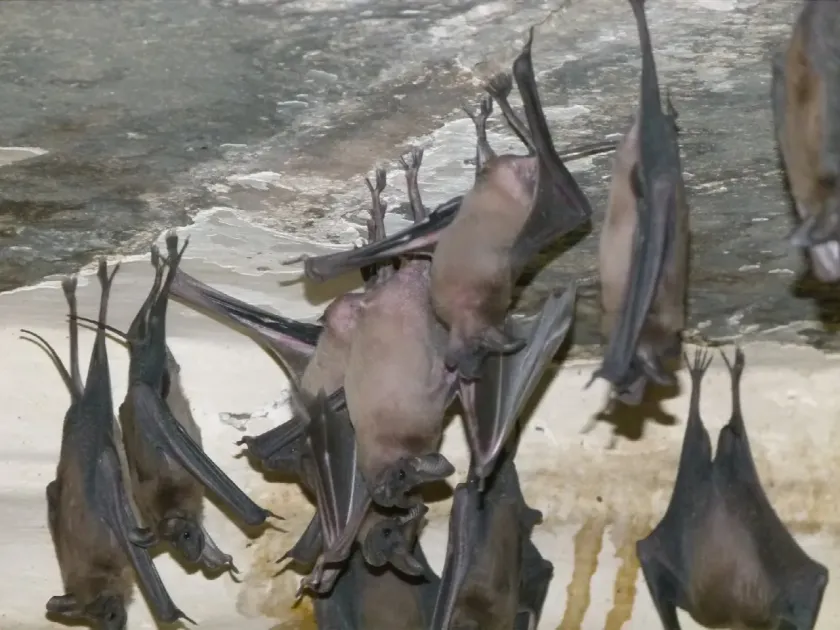
Description
How to identify
The greater mouse-tailed bat (Rhinopoma microphyllum) is a member of the order Chiroptera, family Rhinopomatidae. It is characterized by its exceptionally long, thin, and rat-like tail that is almost equal to the length of its body.
Physically, these bats possess a distinctively shaped nose leaf and large, rounded ears. Their fur color is typically sandy or greyish-brown, providing excellent camouflage in the arid, rocky environments where they reside.
These mammals are highly adapted to warm, dry climates, where they form colonies in caves, crevices, or deep cavities within man-made structures such as abandoned agricultural buildings.
They rely on advanced echolocation to forage for various insects during the night, often covering significant distances from their daytime roosts to reach feeding grounds.
Biological studies indicate that these bats are capable of storing significant amounts of fat, which allows them to survive periods of food scarcity in extreme environments.
What it damages
While the greater mouse-tailed bat is an insectivore and does not feed on crops, it is occasionally viewed as a nuisance in agricultural settings. The primary issue stems from their roosting behavior inside buildings.
The accumulation of guano (bat droppings) in storage facilities or barns can lead to structural deterioration, as the acidic nature of the waste can corrode metal and damage building materials.
The presence of large colonies can lead to sanitary concerns, as the accumulation of waste promotes the growth of fungi and bacteria, potentially contaminating stored agricultural products.
While these bats are generally beneficial by consuming agricultural insect pests, their presence in high densities around sensitive storage areas requires careful management to ensure food safety standards.
The disturbance caused by the sheer number of animals and the noise produced during evening emergence can also be problematic for farm operations conducted at night.
Control measures
Management of the greater mouse-tailed bat should prioritize non-lethal exclusion techniques, as these bats contribute positively to pest control in surrounding fields.
Exclusion is the most effective approach; this involves installing fine-mesh screens over all potential entry points, including vents, eaves, and crevices, to physically prevent bats from entering buildings.
Ultrasonic deterrent devices are recommended as a secondary measure to discourage bats from establishing new roosts in sensitive areas by disrupting their navigational systems.
Maintaining high standards of building hygiene is crucial; removing old guano and cleaning surfaces eliminates odors that might attract other members of the colony to return.
Implementing artificial lighting systems, particularly high-intensity lights with motion sensors, can effectively deter these nocturnal animals from using agricultural buildings as daytime shelters.
Taxonomy
- Latin name
- Rhinopoma microphyllum
- Family
- Rhinopomatidae
- EPPO code
- RHNPMP
Discussion
No discussions yet — be the first.