
Buckwheat weevil
Rhinoncus perpendicularis
Description
How to identify
The buckwheat weevil Rhinoncus perpendicularis is a small beetle belonging to the Curculionidae family, commonly known for its impact on buckwheat crops.
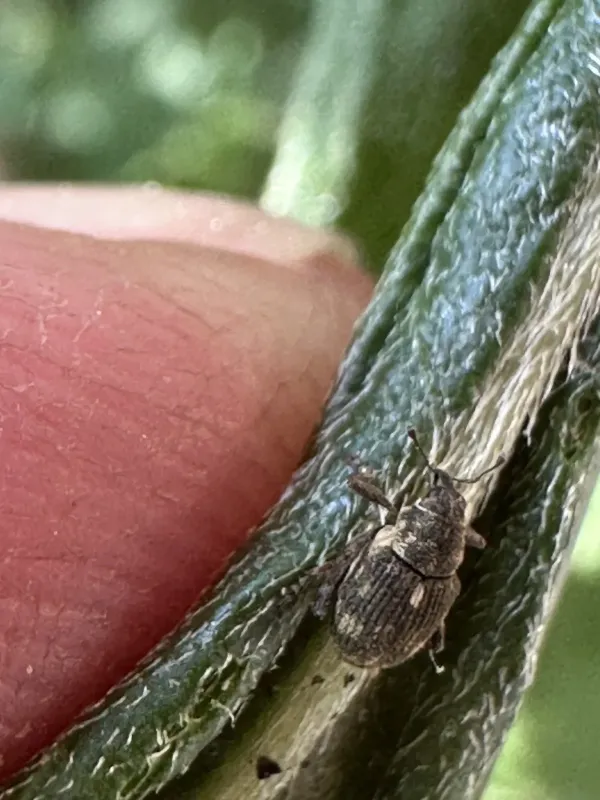
Adult beetles typically measure between 2 to 3 millimeters in length, with their bodies covered in dense scales that provide a brownish-grey mottled appearance.
A distinctive feature of this species is a lighter-colored spot at the base of the elytra, which helps in identifying them in the field alongside their elongated rostrum.
The larvae are legless, curved, and creamy-white, adapted for living and feeding within the internal tissues of the host plants.
When disturbed, the adults exhibit a characteristic defensive behavior of feigning death, dropping from the plant to the ground where they become difficult to spot.
##damage##The primary host for this pest is common buckwheat, where it can complete its full life cycle and cause noticeable economic loss.
The weevil also thrives on various weed species within the Polygonaceae family, such as smartweed and sorrel, which serve as alternate hosts.
Adult weevils cause damage by feeding on the leaves, creating small, irregularly shaped holes that reduce the plant's total photosynthetic area.
The larvae are the most destructive stage, as they tunnel into the stems and petioles, feeding on the inner plant tissue and disrupting nutrient transport.
Severe infestations weaken the plants, leading to stunted growth, reduced grain yield, and lower overall quality of the harvested product.
When it appears
The buckwheat weevil overwinters as an adult, seeking shelter under plant debris, in the upper soil layers, or in adjacent forest belts.
Activity resumes in the spring once temperatures consistently exceed 10–12 degrees Celsius, allowing the beetles to begin feeding and mating.
Migration to buckwheat fields typically coincides with the early growth stages of the crop, providing optimal conditions for oviposition.
The insect typically has one generation per year, though specific climate conditions can influence the timing and duration of the developmental cycle.
Pupation occurs in the soil, where the larvae move after completing their development phase within the plant tissue to form an earthen cell.
Signs of infestation
The earliest sign of an infestation is the appearance of small, circular or irregular holes scattered across the leaf surface.
If stems are split open, internal tunneling and frass (larval excrement) can often be observed, indicating significant larval activity.
Plants affected by a large population may show signs of yellowing, wilting, or a general loss of vigor during critical growth periods.
In heavily infested fields, the overall canopy might appear less uniform, with stunted plant patches visible from a distance.
- Perforated leaves showing multiple bite marks.
- Presence of adults on the lower or upper surfaces of the leaves.
- Tunneling marks inside the stem or petiole structure.
- General crop decline and reduced development speed.
Control measures
Deep autumn plowing is a highly effective practice for burying and destroying overwintering adults and pupae in the soil.
Maintaining strict crop rotation and avoiding planting buckwheat on the same plot for consecutive years significantly reduces pest pressure.
Effective weed control, particularly of Polygonaceae species, is essential to deprive the weevil of alternative food sources throughout the season.
Chemical control measures using approved insecticides should be applied when adult populations reach the economic damage threshold.
Field scouting is crucial during the early stages of buckwheat development to ensure timely intervention and minimize potential crop loss.
Taxonomy
- Latin name
- Rhinoncus perpendicularis
- Order
- Coleoptera (beetles)
- Family
- Curculionidae
- EPPO code
- RHNUPE
Discussion
No discussions yet — be the first.